
EU Leaders Deadlock on 2028-2034 Budget and €45 Billion Ukraine Loan as Decision Deferred to December Summit
Why it matters
The clash over joint borrowing sets the precedent for whether the European Union can structurally fund regional security through mutualized debt or remain bound by national vetoes.
What happened (in 30 seconds)
- Talks stalled on critical financing: EU leaders held a marathon 12-to-14-hour summit in Brussels on November 26, 2026, failing to reach consensus on the bloc’s seven-year budget and a proposed €45 billion ($49 billion) loan facility for Ukraine.
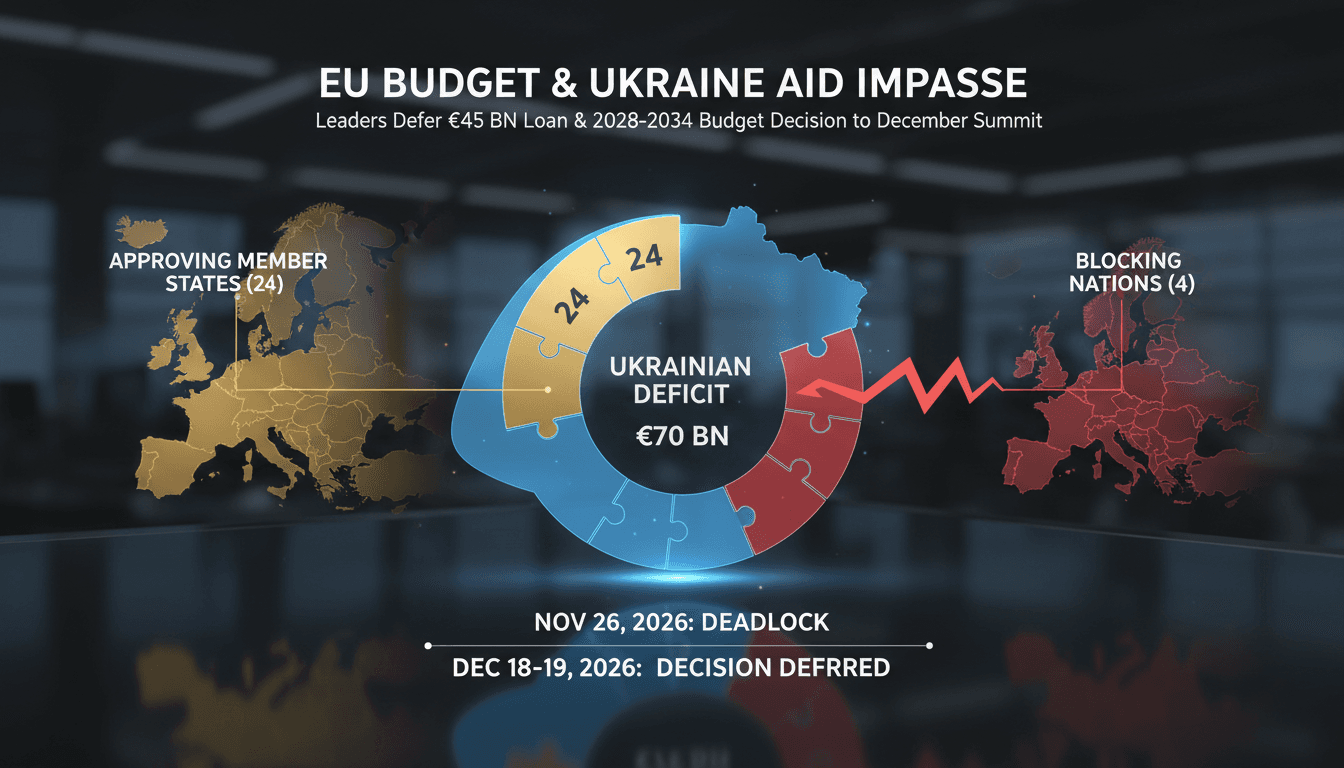
- The coalition fractured over shared liabilities: While 24 member states backed the loan framework, opposition from Hungary, Slovakia, the Czech Republic, and Bulgaria blocked unanimity due to objections over joint debt issuance and military-linked spending.
- The decision was kicked to December: Negotiations over the 2028–2034 Multiannual Financial Framework (MFF) and the emergency credit facility were deferred to the December 18–19 European Council summit.
The context you actually need
- A severe sovereign shortfall looms: The European Commission designed the €45 billion loan package to plug roughly two-thirds of Kyiv’s projected €70 billion fiscal deficit for 2027.
- The long-term budget is on the line: The debate directly intersects with the €1.58 trillion to €1.78 trillion Multiannual Financial Framework, which dictates EU spending priorities, regional cohesion funds, and debt repayment schedules across seven years.
- Precedent complicates new commitments: Following a prior €90 billion facility deployed across 2026 and 2027, member states face tightening domestic balance sheets and impending 2027 national elections, stiffening resistance to additional liabilities.
What's really happening
The standoff in Brussels is not merely a scheduling delay; it is a structural collision over how the European Union finances geopolitical obligations. The European Commission proposed covering Kyiv's projected €70 billion 2027 budgetary shortfall through a €45 billion loan mechanism funded via joint EU debt. Under this structure, repayments would be tied strictly to future Russian reparations rather than national coffers.
However, this mechanism requires unanimous support, exposing deep fault lines between net contributor states and capital-recipient nations. German Chancellor Friedrich Merz and French President Emmanuel Macron conditioned overall movement on the €1.58 trillion to €1.78 trillion Multiannual Financial Framework upon member states universally backing the Ukraine loan. Germany explicitly rejected previous compromises that allowed selective opt-outs, arguing that the financial burden of external security must be distributed across all 27 capitals.
Opposing this stance is a bloc comprising Hungary, Slovakia, the Czech Republic, and Bulgaria. These governments maintain hard structural objections to joint debt issuance, particularly where borrowed proceeds intersect with defense expenditures. For these nations, common borrowing instruments represent an unacceptable expansion of collective liability that constrains domestic balance sheets. Furthermore, net recipients of cohesion funds fear that absorbing Ukraine-related financing into the central EU budget framework will compress regional economic development allocations in the 2028–2034 cycle.
The timing adds mechanical urgency. With key national elections scheduled across Europe in 2027, leaders like Macron pushed for an immediate year-end agreement to lock in fiscal commitments before potential legislative changes erode consensus. Conversely, leaders such as Italy’s Giorgia Meloni and Dutch officials argued against artificial deadlines, prioritizing structural concessions over speed. European Council President António Costa secured support from 24 states, yet the institutional requirement for unanimity leaves the bloc’s core fiscal machinery stalled until the December 18–19 summit. Without a resolved compromise on liability structures, the EU risks entering 2027 without a credible mechanism to fund eastern balance sheets.
Who feels it first (and how)
- Ukrainian fiscal planners: The Ministry of Finance in Kyiv faces an unhedged €70 billion budget deficit for 2027, with two-thirds of its intended external credit line frozen in legislative procedure.
- European sovereign debt desks: Traders and debt management offices managing supranational EU paper must assess whether the Commission will expand its issuance pipeline through new syndicated bonds or be forced back to bilateral member-state guarantees.
- Central and Eastern European finance ministries: Capital allocators in regional development and infrastructure projects face unresolved visibility on their 2028–2034 cohesion fund disbursements until the overarching MFF framework is cleared.
What to watch next
- The December 18–19 European Council summit: This gathering serves as the operational deadline for leaders to either break the unanimity gridlock or construct an alternative off-budget funding vehicle.
- Concessions on opt-out mechanisms: Watch whether Germany softens its stance against exemptions, allowing dissenting nations to bypass joint loan liabilities in exchange for approving the broader MFF baseline.
- Structure of debt repayment guarantees: Any revisions to the reparations-linked loan covenants will indicate how far Brussels is willing to reshape financial safeguards to win over hesitant member states.
EU leaders did not reach an agreement on the €45 billion loan or the 2028–2034 MFF during the November 26, 2026 summit; 24 nations supported the measure while four opposed it; decisions are formally postponed to December 18–19.
The EU will explore bilateral or off-budget structural workarounds if unanimous consent for direct joint borrowing cannot be achieved before the 2027 national electoral cycle begins.
Whether Kyiv will be forced to adjust its 2027 fiscal baseline if the €45 billion loan framework undergoes deep reductions to appease domestic parliaments across the dissenting bloc.
Frequently Asked Questions
- Why it matters?
- The clash over joint borrowing sets the precedent for whether the European Union can structurally fund regional security through mutualized debt or remain bound by national vetoes.
- What happened (in 30 seconds)?
- Talks stalled on critical financing: EU leaders held a marathon 12-to-14-hour summit in Brussels on November 26, 2026, failing to reach consensus on the bloc’s seven-year budget and a proposed €45 billion ($49 billion) loan facility for Ukraine. The coalition fractured over shared liabilities: While 24 member states backed the loan framework, opposition from Hungary, Slovakia, the Czech Republic, and Bulgaria blocked unanimity due to objections over joint debt issuance and military-linked spendi
- What's really happening?
- The standoff in Brussels is not merely a scheduling delay; it is a structural collision over how the European Union finances geopolitical obligations. The European Commission proposed covering Kyiv's projected €70 billion 2027 budgetary shortfall through a €45 billion loan mechanism funded via joint EU debt. Under this structure, repayments would be tied strictly to future Russian reparations rather than national coffers. However, this mechanism requires unanimous support, exposing deep fault
- Who feels it first (and how)?
- Ukrainian fiscal planners: The Ministry of Finance in Kyiv faces an unhedged €70 billion budget deficit for 2027, with two-thirds of its intended external credit line frozen in legislative procedure. European sovereign debt desks: Traders and debt management offices managing supranational EU paper must assess whether the Commission will expand its issuance pipeline through new syndicated bonds or be forced back to bilateral member-state guarantees. Central and Eastern European finance ministries
- What to watch next?
- The December 18–19 European Council summit: This gathering serves as the operational deadline for leaders to either break the unanimity gridlock or construct an alternative off-budget funding vehicle. Concessions on opt-out mechanisms: Watch whether Germany softens its stance against exemptions, allowing dissenting nations to bypass joint loan liabilities in exchange for approving the broader MFF baseline. Structure of debt repayment guarantees: Any revisions to the reparations-linked loan coven
Conservative-leaning political and national coverage.
"The Washington Times is a conservative-leaning newspaper known for its political coverage and advocacy of right-of-center viewpoints."
— A47 Editor
EU leaders split over budget spending and a $49 billion loan to Ukraine
EU leaders struggled to bridge major differences over the bloc's long-term budget and failed to agree on a new $49 billion loan intended to help Ukraine meet its economic and military needs next year, according to The Washington Times.
Global news coverage with extensive reporting on Middle Eastern conflicts and geopolitics.
"Al Jazeera is a Qatar-based broadcaster known for wide regional coverage and alternative perspectives."
— A47 Editor
EU leaders struggle to agree on long-term budget, $49bn Ukraine loan
EU leaders gathered in Brussels for an extraordinary summit to discuss the bloc's budget proposal for 2028 to 2034 and a roughly $49 billion loan for Ukraine, but failed to reach agreement on the long-term budget. European Council President Antonio C...
Comprehensive coverage of Middle Eastern and global issues.
"Al Jazeera is a prominent voice from the Global South, especially the Middle East, with an emphasis on underreported stories."
— A47 Editor
EU leaders struggle to agree on long-term budget, $49bn Ukraine loan
EU leaders gathered in Brussels for an extraordinary summit to discuss the bloc's budget proposal for 2028 to 2034 and a roughly $49 billion loan for Ukraine, but failed to reach agreement on the long-term budget. European Council President Antonio C...
European current affairs, EU politics, and regional developments.
"France 24 is viewed as a globally focused outlet with balanced coverage and a European perspective."
— A47 Editor
EU leaders face showdown over Ukraine funding as divisions deepen
EU leaders are meeting in Brussels to address deep divisions over the bloc's long-term budget, including a proposed €45 billion loan intended to keep Ukraine funded through 2027, with the talks reflecting sharp disagreements among member states.
24/7 international news from a French perspective in multiple languages.
"France 24 is viewed as a globally focused outlet with balanced coverage and a European perspective."
— A47 Editor
Ukraine seeks €115 billion in foreign aid for 2027, Zelensky says
Ukrainian President Volodymyr Zelensky said Tuesday that Ukraine will need €115 billion in external financing in 2027 to sustain its economy and the war effort against Russia, and that Kyiv has secured commitments for about €90 billion from the Europ...