
Congressional Democrats Move to Condition Pentagon Funding on Restrictions for Iran War Operations Ahead of December 11 Deadline
Why it matters
Legislative limits on offensive military spending directly affect Gulf maritime security, fuel cost trajectories, and operational stability for global supply chains tied to the Strait of Hormuz.
What happened (in 30 seconds)
- The legislative deadline: Lawmakers in the US Congress set up a confrontation over the December 11, 2026, government funding expiration to limit spending on offensive military actions in the nine-month conflict with Iran.
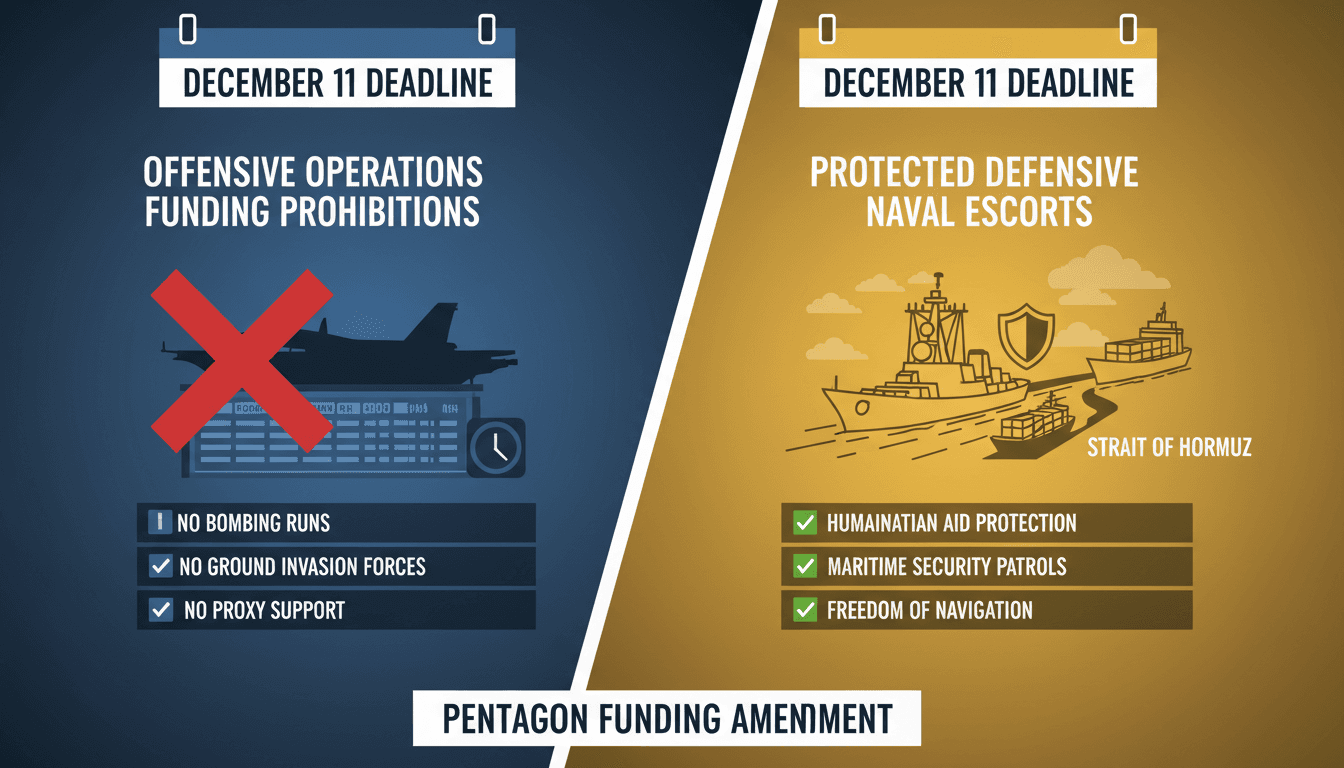
- The proposed firewall: Key Senate figures, including Chris Van Hollen, Tammy Duckworth, and Tim Kaine, introduced restrictions barring appropriations for unauthorized offensive strikes while maintaining carve-outs for defensive operations, intelligence sharing, and naval escorts.
- The bargaining counter: The debate emerged alongside a $1.5 trillion Pentagon funding request, giving incoming majorities direct fiscal leverage to condition broad defense appropriations on operational restrictions.
The context you actually need
- The constitutional mechanism: The current hostilities have run for nine months without explicit congressional authorization, leading lawmakers to rely on the power of the purse—reminiscent of Vietnam-era funding cutoffs—to assert structural oversight.
- The transition dynamic: With Democratic majorities scheduled to take office in both congressional chambers in January 2027, the December 11 budget deadline functions as an interim fiscal lever between the legislative and executive branches.
- The maritime perimeter: The operational scope of proposed restrictions differentiates between offensive strikes on regional targets and defensive deployments designed to protect commercial navigation throughout the Persian Gulf.
What's really happening
The core driver of the negotiations on Capitol Hill is an incentive mismatch between executive war powers and legislative budgetary authority. When military campaigns proceed without formal statutory authorization, the appropriations process becomes the primary operational checkpoint. Lawmakers are not attempting to end general defense funding; instead, they are deploying a targeted conditional-appropriations model. By tethering restrictions specifically to offensive kinetic actions while keeping defensive allocations intact, legislative negotiators are seeking to force an operational pivot without triggering the political fallout of a total military cutoff.
The financial pivot centers on the administration's request for $1.5 trillion in supplemental Pentagon funding. Defense spending requests of this scale require bilateral consensus to navigate procedural thresholds in the Senate. This dynamic grants legislative factions the leverage needed to demand structural boundaries on operational deployments in exchange for avoiding a pre-holiday federal shutdown. The presence of internal caucus divisions—balancing members willing to absorb shutdown risks against those prioritizing continuous government operations—shapes the final boundaries of the statutory language.
The practical implications hinge on line-item operational definitions. Legislative drafting in this context requires precise legal lines between offensive actions and force protection. Under the proposed frameworks, funding remains authorized for intelligence sharing, interceptor missile replenishment, and naval escorts protecting commercial transit through the Strait of Hormuz. Conversely, expenditures directed toward sustained offensive strike capabilities, logistics chains for inland operations, and unapproved tactical escalations are excluded from general allocations.
This creates an operational reality where the executive branch must calculate the marginal financial cost of individual tactical maneuvers. If an operation falls outside strict defensive statutory criteria, accounting officers face legal barriers to disbursing funds. For regional operators, the institutional dispute acts as a governor on conflict escalation, dampening the potential for uncoordinated offensive actions while preserving the defensive security architecture that underpins commercial maritime operations.
Who feels it first (and how)
- Gulf logistics and maritime operators: Freight forwarders and tanker fleets navigating the Strait of Hormuz face fluctuating insurance war-risk premiums and route planning adjustments based on whether defensive escorts remain funded.
- Energy markets and industrial consumers: Corporate treasurers and fuel buyers tracking crude supply lines see price sensitivity linked directly to whether appropriations talks reduce or prolong conflict escalation risks.
- Defense procurement and manufacturing sectors: Contractors exposed to Pentagon supplemental requests face budget timeline realignments as the $1.5 trillion allocation gets conditioned on specific operational restrictions.
- Regional commercial hubs: Logistics and distribution operations in centers like Dubai experience indirect impacts through fuel surcharges and commercial freight volume predictability tied to corridor stability.
What to watch next
- Statutory language on defensive exceptions: Monitor the explicit definitions governing escort missions and force protection in the final continuing resolution to assess baseline maritime security guarantees.
- The December 11 fiscal resolution: Watch whether congressional leadership utilizes a short-term stopgap extension or passes a comprehensive defense package to gauge near-term funding stability.
- Executive veto indicators: Observe formal responses from the administration regarding whether statutory operational limits on the $1.5 trillion defense request will be accepted or challenged.
The conflict has operated for nine months without explicit legislative authorization, and the funding deadline is December 11, 2026, alongside a $1.5 trillion Pentagon request.
Negotiators will settle on compromise language that keeps defensive escorts in the Strait of Hormuz funded to avoid supply disruptions and prevent an immediate government shutdown.
The extent to which the executive branch would attempt to bypass funding prohibitions through emergency drawdown authorities, and whether incoming January 2027 majorities will enact stricter post-deadline enforcement measures.
Frequently Asked Questions
- Why it matters?
- Legislative limits on offensive military spending directly affect Gulf maritime security, fuel cost trajectories, and operational stability for global supply chains tied to the Strait of Hormuz.
- What happened (in 30 seconds)?
- The legislative deadline: Lawmakers in the US Congress set up a confrontation over the December 11, 2026, government funding expiration to limit spending on offensive military actions in the nine-month conflict with Iran. The proposed firewall: Key Senate figures, including Chris Van Hollen, Tammy Duckworth, and Tim Kaine, introduced restrictions barring appropriations for unauthorized offensive strikes while maintaining carve-outs for defensive operations, intelligence sharing, and naval escort
- What's really happening?
- The core driver of the negotiations on Capitol Hill is an incentive mismatch between executive war powers and legislative budgetary authority. When military campaigns proceed without formal statutory authorization, the appropriations process becomes the primary operational checkpoint. Lawmakers are not attempting to end general defense funding; instead, they are deploying a targeted conditional-appropriations model. By tethering restrictions specifically to offensive kinetic actions while keepin
- Who feels it first (and how)?
- Gulf logistics and maritime operators: Freight forwarders and tanker fleets navigating the Strait of Hormuz face fluctuating insurance war-risk premiums and route planning adjustments based on whether defensive escorts remain funded. Energy markets and industrial consumers: Corporate treasurers and fuel buyers tracking crude supply lines see price sensitivity linked directly to whether appropriations talks reduce or prolong conflict escalation risks. Defense procurement and manufacturing sectors
- What to watch next?
- Statutory language on defensive exceptions: Monitor the explicit definitions governing escort missions and force protection in the final continuing resolution to assess baseline maritime security guarantees. The December 11 fiscal resolution: Watch whether congressional leadership utilizes a short-term stopgap extension or passes a comprehensive defense package to gauge near-term funding stability. Executive veto indicators: Observe formal responses from the administration regarding whether stat
Pan-Arab political news and analysis.
"Al-Quds Al-Arabi is a London-based Arabic newspaper known for political coverage."
— A47 Editor
الديمقراطيون يخططون لوقف تمويل الحرب على إيران وسط غموض بشأن الخطوة التالية
Democrats in the U.S. Congress are prioritizing ending funding for the war on Iran, a military campaign launched by President Donald Trump nine months ago, but have not yet agreed on a mechanism to ensure the military operations are brought to an end...
Capitol Hill news, legislation, and policy insight.
"The Hill specializes in U.S. politics and policy, with a focus on Capitol Hill developments and a reputation for insider reporting."
— A47 Editor
Democrats’ plan to end funding for Iran war leaves open what comes next
Democratic leaders in Congress are prioritizing an effort to cut off funding for the U.S. war with Iran, a conflict President Trump launched nine months ago without congressional input. The base report, published by The Hill, examines what would foll...
Global news coverage with extensive reporting on Middle Eastern conflicts and geopolitics.
"Al Jazeera is a Qatar-based broadcaster known for wide regional coverage and alternative perspectives."
— A47 Editor
Can Trump continue with Iran war despite funding restrictions?
Al Jazeera reports that a Congressional budget bill could be used as a pressure tactic on President Donald Trump to end the war with Iran, but the same measure could also trigger a government shutdown, raising questions about whether the administrati...
Comprehensive coverage of Middle Eastern and global issues.
"Al Jazeera is a prominent voice from the Global South, especially the Middle East, with an emphasis on underreported stories."
— A47 Editor
Can Trump continue with Iran war despite funding restrictions?
Al Jazeera reports that a Congressional budget bill could be used as a pressure tactic on President Donald Trump to end the war with Iran, but the same measure could also trigger a government shutdown, raising questions about whether the administrati...