
Spain Snap Election on November 29 Puts Morocco Ties at Centre of Campaign Debate
Why it matters
The vote reveals how domestic political volatility collides with deep structural dependencies across North African energy transit, Mediterranean border security, and bilateral trade infrastructure.
What happened (in 30 seconds)
- A domestic collapse triggered snap elections: Spanish Prime Minister Pedro Sánchez called general elections for November 29, 2026, following the parliamentary defeat of core housing decrees.
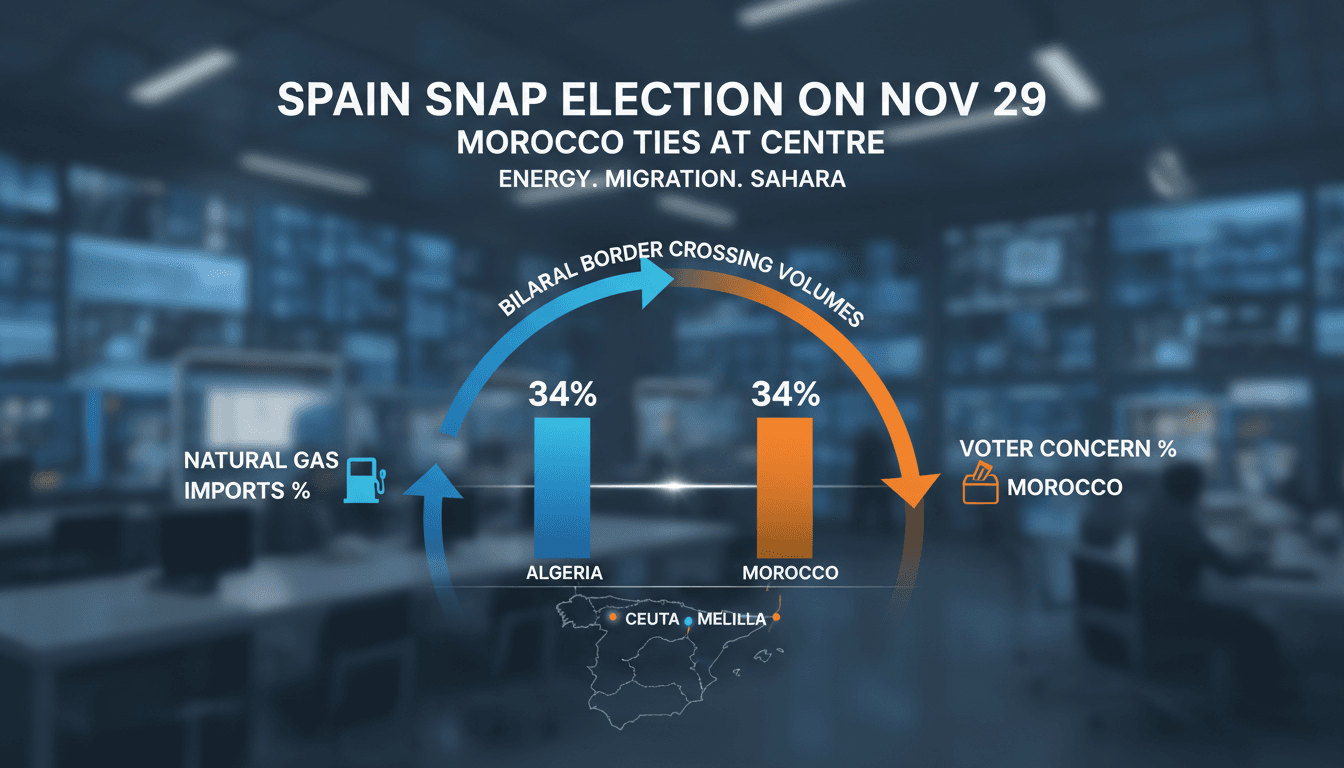
- Rabat became an electoral wedge: Pre-election polling from Cluster17 shows bilateral relations with Morocco and the status of Ceuta and Melilla represent the top international priority for 34% of Spanish voters.
- Three divergent paths emerged: The campaign pits Sánchez’s pragmatism against Alberto Núñez Feijóo’s Popular Party platform of balanced regional diplomacy and Vox’s demands for bilateral reviews and border enforcement.
The context you actually need
- The 2022 Western Sahara shift: Madrid fundamentally altered decades of neutral diplomacy in 2022 by endorsing Morocco’s autonomy initiative for Western Sahara, which stabilized relations with Rabat while creating friction with Algiers.
- The July 2026 migration threshold: Border enforcement pressures escalated sharply following a migration incident in Ceuta involving over 72,000 crossings, elevating border security into an active campaign issue.
- Algerian energy dynamics: Despite diplomatic reorientations toward Rabat since 2022, Spain remains tied to wider North African energy flows, with Algeria supplying 34% of Spain’s natural gas imports in early 2026.
What's really happening
Electoral positioning suggests a potential break in Spanish-Moroccan diplomacy, but structural economic and security mechanisms heavily disincentivize any fundamental rupture.
At the political surface, the November 2026 snap election exposes genuine friction. The opposition Popular Party (PP) frames the incumbent administration's stance toward Rabat as overly conciliatory, advocating for a recalibration that restores parity with Algeria. Further to the right, Vox campaigns on explicit measures, including cross-border reviews, punitive economic levers, and challenges to shared international projects such as the joint hosting framework for the 2030 FIFA World Cup.
Underneath campaign dynamics, however, the incentive structure governing Madrid and Rabat relies on rigid mutual dependencies. First, border control operates as an integrated security architecture. Managing migratory pressure across the Mediterranean, highlighted by the July 2026 Ceuta event involving 72,000 people, requires daily intelligence sharing and maritime coordination between Spanish and Moroccan interior ministries. Any governing coalition in Madrid that restricts cooperation risks unilateral border pressures that domestic security services cannot manage alone.
Second, energy and commercial infrastructure enforce institutional continuity. While Spain relies on Morocco for transit stability and agricultural commerce, it simultaneously relies on Algeria for 34% of its natural gas imports as of early 2026. A incoming administration led by the PP may attempt to warm relations with Algiers, but doing so cannot come at the expense of unraveling the 2022 roadmap with Rabat without destabilizing southern maritime borders.
Third, regional investment continuity overrides legislative turnover. Bilateral trade volumes and joint infrastructure commitments create institutional inertia that standard political cycles rarely reverse. Even if a coalition government emerges requiring concessions to parties critical of Morocco, diplomatic communication channels between Rabat and Madrid remain active. The realistic landing zone across all governing scenarios is rhetorical recalibration rather than structural realignment.
Who feels it first (and how)
- Ceuta and Melilla local administrators: Municipal authorities face immediate operational adjustments depending on whether national border enforcement protocols tighten post-election.
- Spanish agricultural and logistics operators: Import-export firms reliant on integrated supply chains across the Strait of Gibraltar absorb immediate shifts in port customs processing or regulatory enforcement.
- European energy procurement teams: Utilities monitoring Iberian gas balances track whether diplomatic outreach to Algeria alters LNG procurement versus pipeline volumes.
- Regional diplomatic and security attachés: Defense and intelligence personnel navigate near-term communication adjustments during potential ministerial transitions in Madrid.
What to watch next
- The formation of the governing coalition: Whether the Popular Party governs alone or requires support from Vox dictates whether Madrid adopts symbolic bilateral escalations or maintains bureaucratic inertia.
- Algerian natural gas import ratios: Any policy shift intended to restore balance between North African neighbors will show up first in bilateral gas import contracts departing from early 2026's 34% Algerian benchmark.
- Joint 2030 World Cup committee meetings: Bilateral project milestones between Spain, Portugal, and Morocco offer the earliest signal of diplomatic continuity or politicized delay.
The snap election takes place on November 29, 2026, with Morocco policy operating as the primary international issue for 34% of the electorate following parliament's rejection of housing legislation.
The structural realities of migration containment, maritime security, and trade volume will prevent any post-election government from fully dismantling the bilateral cooperation framework established in 2022.
Whether a conservative-led government can effectively repair diplomatic channels with Algeria without triggering diplomatic counter-measures from Morocco regarding Western Sahara.
Frequently Asked Questions
- Why it matters?
- The vote reveals how domestic political volatility collides with deep structural dependencies across North African energy transit, Mediterranean border security, and bilateral trade infrastructure.
- What happened (in 30 seconds)?
- A domestic collapse triggered snap elections: Spanish Prime Minister Pedro Sánchez called general elections for November 29, 2026, following the parliamentary defeat of core housing decrees. Rabat became an electoral wedge: Pre-election polling from Cluster17 shows bilateral relations with Morocco and the status of Ceuta and Melilla represent the top international priority for 34% of Spanish voters. Three divergent paths emerged: The campaign pits Sánchez’s pragmatism against Alberto Núñez Feijó
- What's really happening?
- Electoral positioning suggests a potential break in Spanish-Moroccan diplomacy, but structural economic and security mechanisms heavily disincentivize any fundamental rupture. At the political surface, the November 2026 snap election exposes genuine friction. The opposition Popular Party (PP) frames the incumbent administration's stance toward Rabat as overly conciliatory, advocating for a recalibration that restores parity with Algeria. Further to the right, Vox campaigns on explicit measures
- Who feels it first (and how)?
- Ceuta and Melilla local administrators: Municipal authorities face immediate operational adjustments depending on whether national border enforcement protocols tighten post-election. Spanish agricultural and logistics operators: Import-export firms reliant on integrated supply chains across the Strait of Gibraltar absorb immediate shifts in port customs processing or regulatory enforcement. European energy procurement teams: Utilities monitoring Iberian gas balances track whether diplomatic outr
- What to watch next?
- The formation of the governing coalition: Whether the Popular Party governs alone or requires support from Vox dictates whether Madrid adopts symbolic bilateral escalations or maintains bureaucratic inertia. Algerian natural gas import ratios: Any policy shift intended to restore balance between North African neighbors will show up first in bilateral gas import contracts departing from early 2026's 34% Algerian benchmark. Joint 2030 World Cup committee meetings: Bilateral project milestones betw
Global news coverage with extensive reporting on Middle Eastern conflicts and geopolitics.
"Al Jazeera is a Qatar-based broadcaster known for wide regional coverage and alternative perspectives."
— A47 Editor
What Spain’s election means for Morocco
Spain's Socialist government under Prime Minister Pedro Sánchez has called a snap general election for November 29, a move that followed the failure of emergency housing legislation in parliament. The vote could end eight years of Socialist-led rule,...
Comprehensive coverage of Middle Eastern and global issues.
"Al Jazeera is a prominent voice from the Global South, especially the Middle East, with an emphasis on underreported stories."
— A47 Editor
What Spain’s election means for Morocco
Spain's Socialist government under Prime Minister Pedro Sánchez has called a snap general election for November 29, a move that followed the failure of emergency housing legislation in parliament. The vote could end eight years of Socialist-led rule,...
24/7 international news from a French perspective in multiple languages.
"France 24 is viewed as a globally focused outlet with balanced coverage and a European perspective."
— A47 Editor
Spain general election 2026: Could Sánchez lose power?
Spanish voters head to the polls on November 29 in a snap general election called by Prime Minister Pedro Sánchez, ending a period in which his Socialist-led government has ruled for eight years. Sánchez is fighting to stay in power, while an allianc...
UAE-based English-language newspaper covering regional politics, economics, and global affairs.
"The National reflects Emirati policy perspectives while maintaining international editorial standards."
— A47 Editor
Can Spain's Pedro Sanchez stage another comeback in Sunday's election?
Spanish Prime Minister Pedro Sanchez faces a snap general election on Sunday, November 29, after parliament rejected emergency housing legislation and months of social unrest, political scandals and disputes over immigration and housing eroded suppor...