
UK Net Migration Falls to 77000 in Year to June 2026 Lowest Non-Pandemic Level Since 1997
Why it matters
A 92% decline from the 2023 migration peak recalibrates the UK's macroeconomic baseline, shifting enterprise focus from cross-border talent acquisition to domestic workforce constraints.
What happened (in 30 seconds)
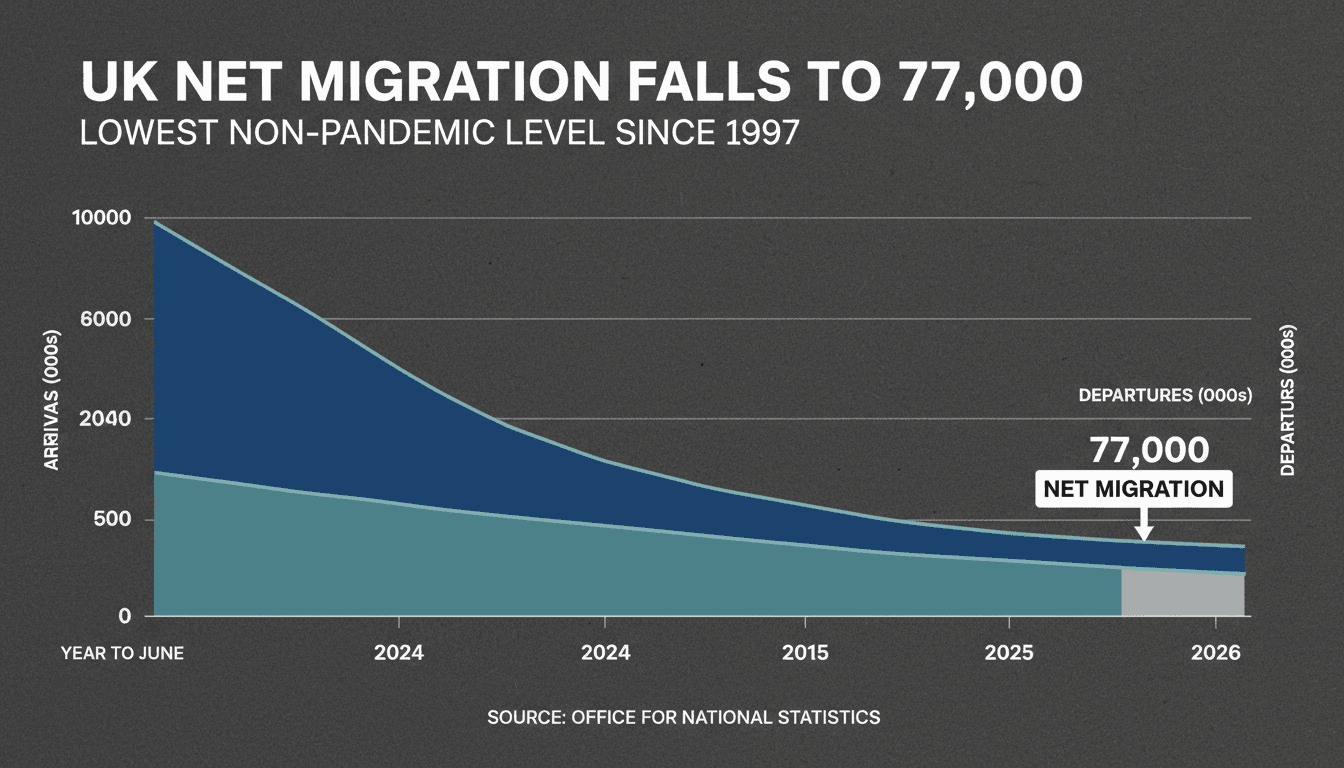
- Net migration fell to 77,000 for the year ending June 2026, marking a 62% drop from 204,000 in the previous year and the lowest non-pandemic level recorded since 1997.
- Inflows contracted sharply to 738,000 alongside an outflow of 661,000 emigrants, driven down by a 121,000 reduction in non-EU net arrivals.
- Key entry channels declined across the board, led by work visas falling by 45,000, study routes dropping by 33,000, and asylum claims decreasing by 19,000.
The context you actually need
- A sixteen-year policy cycle closed, hitting the target of returning net migration to the tens of thousands originally pledged by David Cameron in 2010.
- The post-Brexit surge reversed, unwinding the climb that peaked at 944,000 in the year ending March 2023 following initial regulatory restructuring.
- Compounded rule changes took hold, as restrictions on family dependants, elevated salary thresholds, and student route limits introduced under Conservative leadership were maintained by the Labour government.
What's really happening
The drop to 77,000 is not a statistical anomaly; it is the structural outcome of tightened administrative levers intersecting with elevated outflows. The Office for National Statistics (ONS) confirmed that total immigration of 738,000 was largely offset by 661,000 emigrants leaving the country. This narrowing gap of 77,000 represents a 92% decline from the historical high of 944,000 recorded in March 2023.
The primary driver behind this correction sits within the non-EU category, where net migration fell by 121,000 to reach 258,000. Under successive administrations, policy architects systematically adjusted access requirements for international candidates. Higher salary floors for skilled worker visas priced out entry-level and mid-tier roles, while prohibitions on student and care-worker dependants reduced the total volume of secondary arrivals. These institutional barriers produced a direct drop of 45,000 work visas and 33,000 student arrivals in the twelve-month period to June 2026. Concurrently, asylum grants declined by 19,000.
While arrivals contracted, the emigration side of the ledger maintained sustained volume. Total departures reached 661,000, bolstered by record net outflows of British nationals alongside departing international graduates and former sponsored workers whose visas expired. When high baseline departures collide with restricted entry channels, the net mathematical result is a steep trajectory downward.
For business operators, this mechanical shift changes the economics of human capital. During the 2021–2023 expansion, organisations bridged domestic recruitment shortages through non-EU visa sponsorship routes. With the entry threshold raised and overall volumes down, domestic employers face an immediate operational trade-off: absorb elevated wage floors to qualify international recruits, or adjust operating models to function within a more static local labour pool. The policy architecture has achieved its designated volumetric goal; the resulting systemic effect transfers the cost of adjustment onto industries reliant on steady overseas labour flows.
Who feels it first (and how)
- Corporate HR and Talent Acquisition Teams: Face restricted headcount pipelines and higher qualifying wage commitments for foreign candidates.
- Higher Education Administrators: Experience decreased non-EU enrolments, putting fiscal pressure on tuition revenue that subsidises institutional operations.
- Sectors Reliant on Overseas Labour: Experience tightening headcount availability, accelerating incentives to either automate or raise domestic compensation.
- Global Professionals and Postgraduates: Encounter higher barriers to entry, limited dependant allowances, and stricter pathways from study to long-term UK residency.
What to watch next
- Labour Supply Adjustments: Monitor whether domestic wage increases or sector-specific automation offset the 45,000-person drop in overseas work arrivals.
- Further Downward Trajectory: Watch upcoming ONS quarterly releases to verify whether net migration stabilises near 77,000 or contracts further in the short term.
- Higher Education Restructuring: Track university balance sheets as reduced international student inflows (down 33,000) alter non-EU fee income.
Net migration for the year ending June 2026 reached 77,000, based on 738,000 arrivals and 661,000 departures, led by a 121,000 drop in non-EU net migration.
The reduction in overseas arrivals will maintain short-term staffing constraints for industries that expanded international recruitment between 2021 and 2023.
Whether market forces and business lobbying will lead policymakers to modify salary thresholds if domestic labour shortages increase.
Frequently Asked Questions
- Why it matters?
- A 92% decline from the 2023 migration peak recalibrates the UK's macroeconomic baseline, shifting enterprise focus from cross-border talent acquisition to domestic workforce constraints.
- What happened (in 30 seconds)?
- Net migration fell to 77,000 for the year ending June 2026, marking a 62% drop from 204,000 in the previous year and the lowest non-pandemic level recorded since 1997. Inflows contracted sharply to 738,000 alongside an outflow of 661,000 emigrants, driven down by a 121,000 reduction in non-EU net arrivals. Key entry channels declined across the board, led by work visas falling by 45,000, study routes dropping by 33,000, and asylum claims decreasing by 19,000.
- What's really happening?
- The drop to 77,000 is not a statistical anomaly; it is the structural outcome of tightened administrative levers intersecting with elevated outflows. The Office for National Statistics (ONS) confirmed that total immigration of 738,000 was largely offset by 661,000 emigrants leaving the country. This narrowing gap of 77,000 represents a 92% decline from the historical high of 944,000 recorded in March 2023. The primary driver behind this correction sits within the non-EU category, where net migr
- Who feels it first (and how)?
- Corporate HR and Talent Acquisition Teams: Face restricted headcount pipelines and higher qualifying wage commitments for foreign candidates. Higher Education Administrators: Experience decreased non-EU enrolments, putting fiscal pressure on tuition revenue that subsidises institutional operations. Sectors Reliant on Overseas Labour: Experience tightening headcount availability, accelerating incentives to either automate or raise domestic compensation. Global Professionals and Postgraduates: Enc
- What to watch next?
- Labour Supply Adjustments: Monitor whether domestic wage increases or sector-specific automation offset the 45,000-person drop in overseas work arrivals. Further Downward Trajectory: Watch upcoming ONS quarterly releases to verify whether net migration stabilises near 77,000 or contracts further in the short term. Higher Education Restructuring: Track university balance sheets as reduced international student inflows (down 33,000) alter non-EU fee income.
Political developments, policy debates, elections, and government affairs in the UK.
"BBC News is widely regarded as a reputable international news organization, known for its impartial tone and public service mandate."
— A47 Editor
'Big moment' as net migration now in tens of thousands
UK net migration has fallen to 77,000 in the year to June, according to figures from the Office for National Statistics, a level BBC political editor Chris Mason describes as a "big moment" for the national debate on immigration. The figure is the lo...
Key macro releases (CPI, jobs, PMIs), surprise indexes, and market implications.
"Great for data-print awareness and instant read-through to rates and risk assets."
— A47 Editor
UK net migration falls to lowest level since 1997
UK net migration has fallen to its lowest level since 1997, according to the base report from Investing.com published on 27 November 2026, with the story categorised under markets and carrying a neutral tone.
UK politics, business, and social stories.
"Sky News is a UK-based 24-hour channel known for fast-breaking news and political coverage."
— A47 Editor
UK net migration falls to lowest level in three decades, excluding pandemic
UK net migration fell to 77,000 in the year to June 2026, according to provisional new data from the Office for National Statistics (ONS), marking the lowest level in three decades when the pandemic period is excluded.