
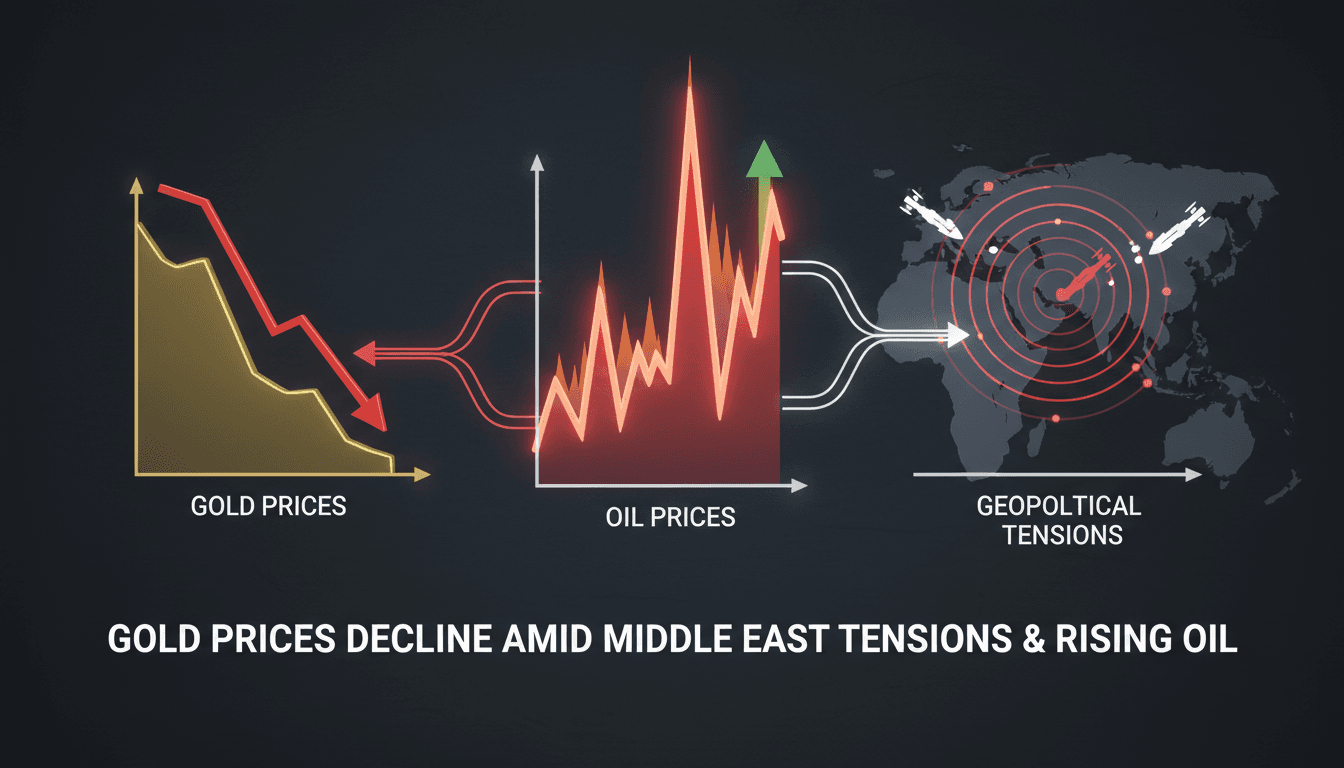
Gold prices decline amid escalating Middle East tensions and rising oil prices
Here's what it means for you.
The recent decline in gold prices signals a shift in market sentiment as geopolitical tensions rise. Investors are increasingly concerned about inflation and the potential for higher interest rates, which can diminish gold's appeal as a safe haven asset. As oil prices surge, the economic landscape becomes more complex, impacting various sectors and investment strategies. Market participants should closely monitor upcoming economic data releases and Federal Reserve communications, as these will provide critical insights into future monetary policy and market direction. The interplay between geopolitical events and economic indicators will be pivotal in shaping investment decisions in the near term.
What happened
Gold prices have fallen for the second consecutive day, dropping over 1% amid rising oil prices and fears of a blockade in the Strait of Hormuz. Spot gold decreased by 1.2% to $4,072.49 per ounce, while US gold futures for August delivery fell by 0.8% to $4,081.30. This decline is attributed to escalating tensions between US and Iranian forces, which have included missile and drone attacks.
The situation has heightened inflation concerns, contributing to a broader market reaction. As oil prices rose nearly 3%, the dynamics of the commodities market shifted, further impacting gold's value. The combination of these factors has created a challenging environment for gold investors.
The Context
The recent escalation of hostilities in the Middle East, particularly involving Iran and US forces, has raised significant concerns about regional stability. The probability of a US interest rate hike in September has surged to approximately 71%, reflecting market expectations that could influence gold prices. This heightened anticipation of prolonged high interest rates is a critical factor in the current market landscape.
As geopolitical tensions continue to unfold, the implications for inflation and economic growth become increasingly pronounced. Investors are now faced with a complex scenario where both geopolitical instability and economic indicators are likely to exert ongoing pressure on gold prices. The situation around the Strait of Hormuz is particularly sensitive, given its importance to global oil supply.
Takeaway
Looking ahead, market participants should keep a close eye on upcoming US economic data releases, including the Consumer Price Index (CPI) and Producer Price Index (PPI). These indicators will provide valuable insights into inflation trends and the potential trajectory of interest rates. Additionally, Federal Reserve Chair Kevin Warsh's congressional testimony will be crucial for understanding future monetary policy directions.
The interplay between geopolitical events and economic data will be critical in determining the future trajectory of gold prices and overall market sentiment. Continued volatility in the Middle East and its impact on oil prices will likely keep investors on edge, influencing their strategies in the commodities market.
Global markets, investing, and macroeconomics from a premier financial newsroom.
"Bloomberg is respected for in-depth financial reporting and data-driven analysis."
— A47 Editor
Gold Holds Decline on Renewed Hormuz Blockade and Hawkish Fed
Gold prices have continued to decline amid escalating tensions in the Strait of Hormuz, where military hostilities between the United States and Iran have intensified. Recent comments from U.S. monetary policymakers have also increased expectations f...
Business, markets, economy, and corporate news with strong UAE and regional relevance.
"Emirates 24|7 business coverage tends to center UAE markets, property, regulation, and regional economic developments."
— A47 Editor
Gold falls for second day as Middle East tensions dim hopes for Fed rate cuts
Gold prices have continued to decline for a second consecutive day, with spot gold falling 1.2% to $4,072.49 per ounce amid escalating tensions between the US and Iran. The situation has been exacerbated by missile and drone exchanges, particularly a...
Regional and international reporting focused on Middle Eastern politics, diplomacy, and economics.
"Asharq Al-Awsat is a Saudi-owned international newspaper reflecting mainstream Gulf political perspectives."
— A47 Editor
Gold Falls Over 1% as Oil Rises and Strait of Hormuz Fears Reignite
Gold prices have fallen over 1% amid rising oil prices and renewed fears regarding the Strait of Hormuz, a critical maritime route for oil shipments. The decline in gold, which is now priced at approximately $4,060.46 per ounce, reflects the impact o...
Pan-Arab news coverage spanning politics, business, sports, and regional affairs.
"Asharq Al-Awsat reflects a broad Arab editorial perspective with strong attention to regional geopolitics."
— A47 Editor
الذهب يتراجع بأكثر من 1% مع صعود النفط وتجدد المخاوف بشأن مضيق هرمز
Gold prices fell by more than 1% on Monday, driven by a significant rise in oil prices amid renewed concerns over the potential closure of the Strait of Hormuz. This decline reflects the ongoing volatility in the commodities market influenced by geop...
Arabic-language economic and business reporting with strong UAE market relevance.
"Emarat Al Youm business coverage often centers UAE property, banking, consumer issues, and economic policy."
— A47 Editor
الذهب يهبط أكثر من 1% مع ارتفاع النفط الذهب يهبط أكثر من 1% مع ارتفاع النفط
Gold prices fell by more than 1% at the start of Asian trading today, driven by concerns over a potential closure of the Strait of Hormuz, which has led to a sharp increase in oil prices.