
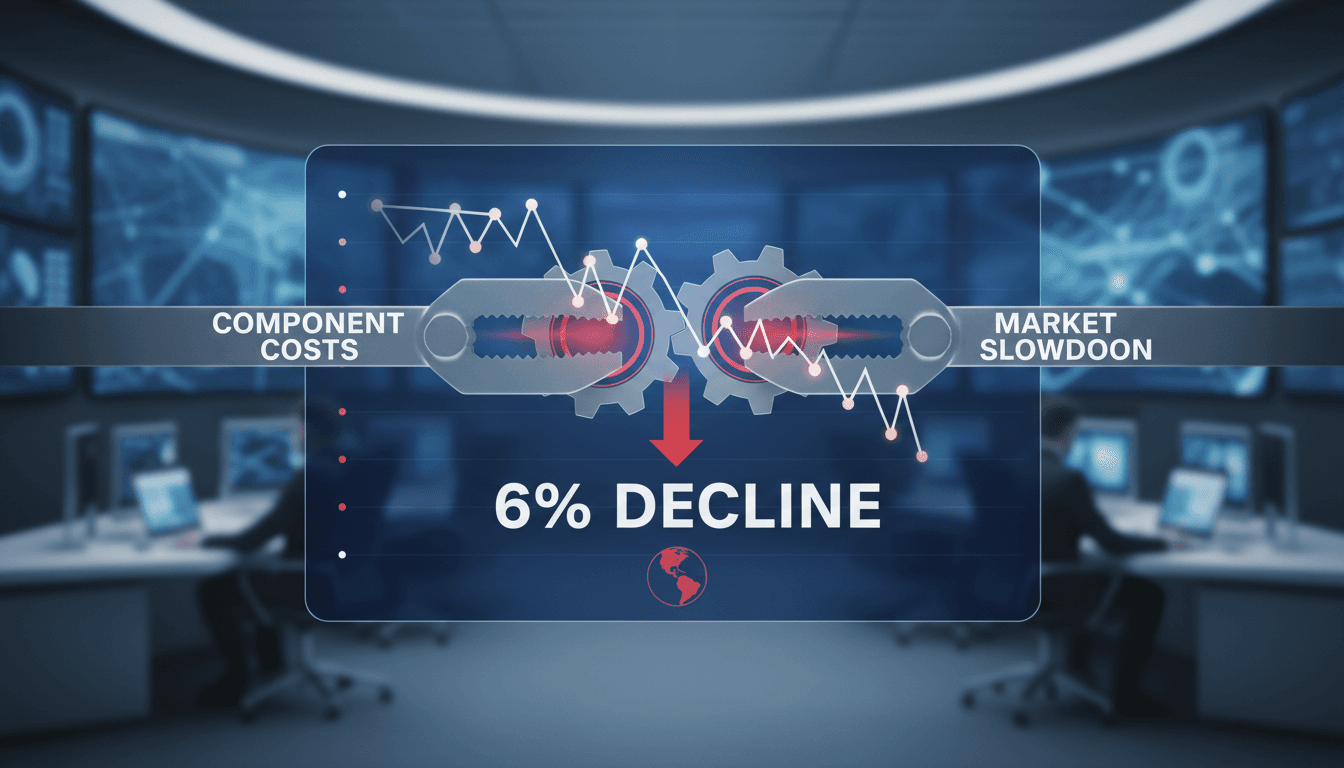
Ericsson Reports 6% Revenue Decline Amid Rising Component Costs
Here's what it means for you.
Ericsson's recent revenue decline signals significant challenges in the telecommunications sector, particularly for companies reliant on component sourcing. The 6% drop in revenue may prompt investors to reassess their confidence in Ericsson's long-term profitability. As the company navigates these pressures, stakeholders should remain vigilant regarding potential strategic shifts that could impact market dynamics.
What happened
Ericsson has reported a 6% decline in revenue for the second quarter of 2026, primarily attributed to rising component costs and decreased patent licensing income. The company's revenue fell to SEK 52.7 billion, down from SEK 56.1 billion a year earlier. This downturn has led to a warning about future profitability, particularly affecting its networks business.
Following the announcement, Ericsson's shares experienced their largest drop in 18 months, reflecting investor concerns over the company's financial health. The decline in sales is particularly pronounced in key markets such as North America and Europe, intensifying pressure on the company's margins.
The Context
The telecommunications industry is currently facing rising semiconductor and component prices, which have significantly impacted companies like Ericsson. As sales decline in major markets, the pressure on margins has become more pronounced, leading to a challenging financial landscape. The company's adjusted operating profit has also been negatively affected by weaker patent licensing income, further complicating its financial outlook.
Ericsson's situation is emblematic of broader trends in the tech sector, where supply chain issues and fluctuating demand are creating uncertainty. The timing of this announcement coincides with a period of heightened scrutiny from investors, who are increasingly focused on profitability and cost management strategies.
Takeaway
Looking ahead, Ericsson's ability to manage rising component costs will be crucial for restoring profitability and investor confidence. Stakeholders should monitor the company's response to these pressures in upcoming earnings reports, as well as any potential strategic shifts in its business model. The current financial challenges may necessitate a reevaluation of operational strategies to adapt to changing market conditions.
As the situation evolves, it will be important to watch how Ericsson navigates these challenges and whether it can regain traction in its key markets.
Opinionated AI coverage for general audiences.
"TNW’s AI vertical covering tools, ethics, and trends."
— A47 Editor
Ericsson revenue falls 6% as component costs bite and licensing income dries up
Ericsson reported a revenue decline of 6% in the second quarter, totaling SEK 52.7 billion, down from SEK 56.1 billion a year prior, primarily due to reduced patent licensing income and adverse currency fluctuations, despite some growth in select reg...
U.S. business news, corporate developments, and economy.
"The Wall Street Journal is respected for deep financial and economic reporting with a center-right editorial perspective."
— A47 Editor
Ericsson Cautions on Lower Profitability Due to Rising Component Costs
Ericsson has issued a warning regarding lower profitability due to rising component costs and declining sales in North America and Europe, impacting its networks business. The company is grappling with increased semiconductor prices, which further ex...
Technology business and AI-related headlines.
"Data-driven tech newsroom with global scope."
— A47 Editor
Ericsson Falls as Higher Component Costs Weigh on Networks Unit
Ericsson AB's shares experienced a significant decline, marking the largest drop in approximately 18 months, as the company announced that its margins for the networks unit would face pressure this quarter due to rising component costs.
Technology business news, market impacts, and innovation trends.
"Bloomberg is a premier financial and tech news provider, respected for its in-depth reporting and analytical rigor."
— A47 Editor
Ericsson Falls as Higher Component Costs Weigh on Networks Unit
Ericsson AB's shares experienced a significant decline, marking the largest drop in approximately 18 months, as the company announced that its margins for the networks unit would face pressure this quarter due to rising component costs.