
Databricks launches new architecture to enhance AI data management
Here's what it means for you.
Databricks' latest innovations are set to transform how enterprises manage data for AI applications. By addressing critical issues of data pipeline latency and performance, these advancements could lead to more efficient and integrated data strategies. As organizations increasingly rely on real-time data access, the implications for operational efficiency and decision-making are significant. The introduction of Lake Transactional/Analytical Processing (LTAP) and Lakehouse//RT positions Databricks as a leader in AI data management, potentially reshaping industry standards. Enterprises will need to adapt to these changes to remain competitive in a rapidly evolving landscape.
What happened
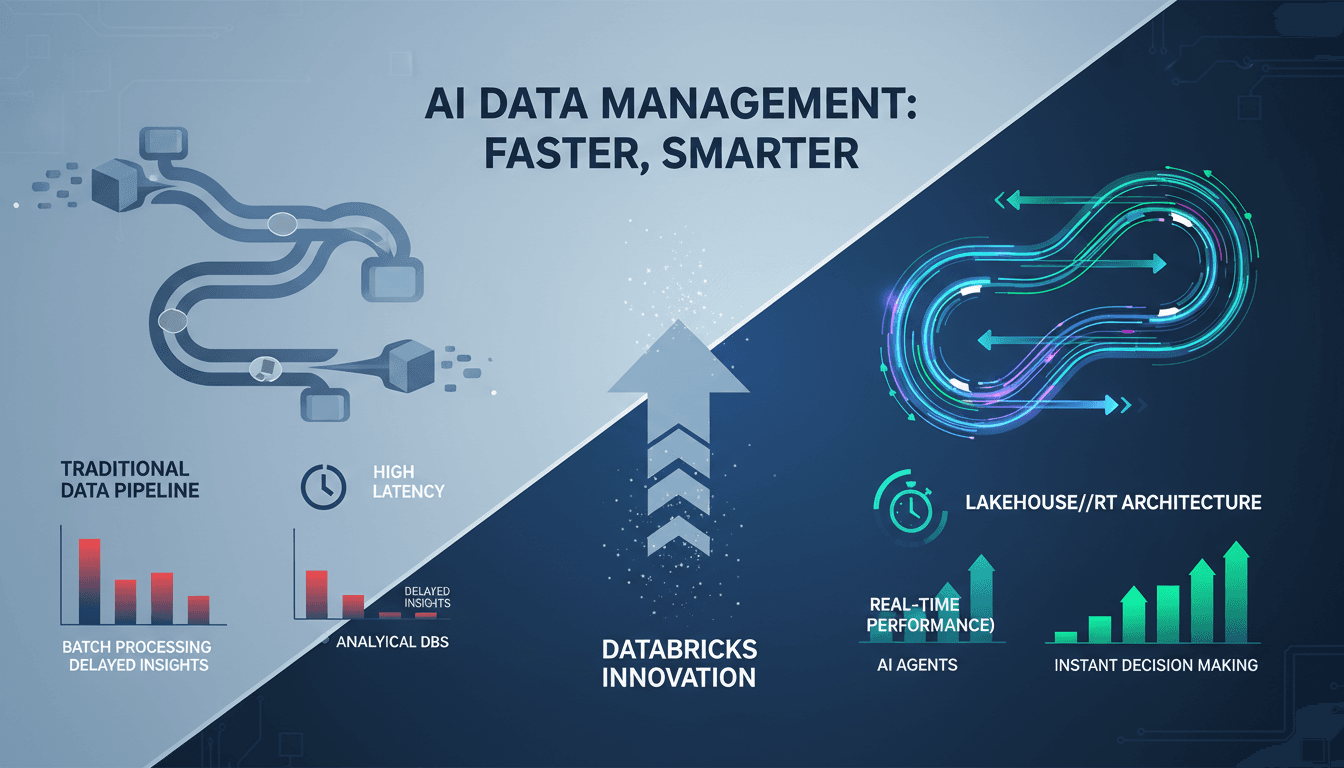
At the Data + AI Summit, Databricks unveiled new products aimed at enhancing data management for AI applications. The architecture includes Lake Transactional/Analytical Processing (LTAP) and the real-time analytics engine Lakehouse//RT. These innovations are designed to unify operational and analytical data, eliminating the need for separate serving infrastructures.
Lakehouse//RT boasts the capability to handle up to 12,000 queries per second with sub-100ms latency. This performance is crucial for AI agents that require immediate access to data. The introduction of LTAP allows transactional data to be stored directly in Delta or Iceberg format, streamlining the data processing workflow.
The Context
Databricks is responding to the growing demand for seamless data integration in AI applications. The separation between transactional and analytical databases has long been a challenge for enterprises, and these new products aim to bridge that gap. Analysts are closely monitoring the effectiveness of these solutions in meeting enterprise expectations.
As AI technologies continue to evolve, the need for real-time data access becomes increasingly critical. Databricks' innovations could redefine how organizations approach data management, fostering a more integrated strategy that enhances operational efficiency.
Takeaway
The advancements introduced by Databricks could significantly impact how enterprises manage data for AI applications. As organizations begin to adopt this new architecture, it will be essential to observe how effectively these solutions address existing pain points. Competitive responses from other data management vendors will also be crucial to watch.
The demand for seamless data integration is expected to grow as enterprises increasingly rely on AI. Databricks' innovations may play a pivotal role in shaping future data management strategies, making it a key player in the industry.
AI news with an enterprise and cloud focus.
"Covers AI in the context of data infrastructure, cloud, and enterprise stacks."
— A47 Editor
The AGI moment? Databricks’ new releases zero in on support and deployment of AI agents
Databricks Inc. has announced new releases aimed at enhancing the support and deployment of artificial intelligence agents, introducing a new architecture called Lake Transactional/Analytical Processing. This architecture allows AI agents to access b...
Focuses on transformative tech, AI, gaming, and startup innovation.
"VentureBeat is respected for its in-depth reporting on AI, startups, and disruptive technologies in Silicon Valley and beyond."
— A47 Editor
Databricks says it solved the decades-old data pipeline problem that's been slowing AI agents
<p>For decades, data professionals have struggled with the challenge of managing both operational and analytical databases in a unified approach that doesn't introduce latency and performance degradation.</p><p>Agents made the problem structural...
Tech business coverage, major deals, product launches, and Silicon Valley trends.
"WSJ’s tech section offers authoritative reporting on the intersection of technology and business, including exclusive industry analysis."
— A47 Editor
Databricks Releases General AI Agents for Businesses
The data-analytics company is pushing further into AI applications for general work as it aims to carve out a place in the artificial-intelligence world.
Big data coverage adjacent to AI/ML ecosystems.
"Tracks data infrastructure trends that enable modern AI."
— A47 Editor
Databricks declares the end of pipelines with a unified platform for operational and analytical data
Databricks Inc. has announced a new data architecture at the Data + AI Summit in San Francisco, aimed at integrating operational and analytical data to eliminate the traditional separation between transactional databases and analytical systems. This ...