
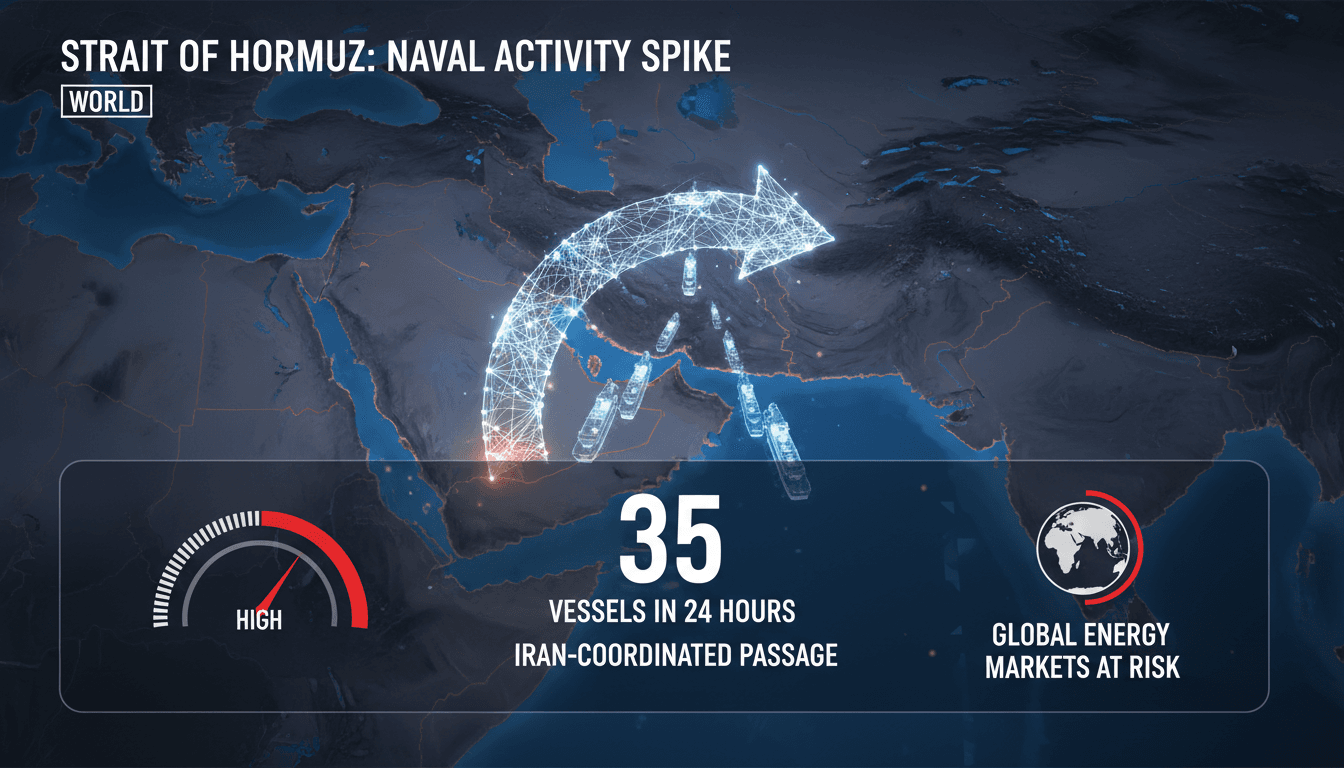
Iran Coordinates Passage of 35 Vessels Through Strait of Hormuz Amid Rising Tensions
Here's what it means for you.
The recent coordination of 35 vessels by Iran through the Strait of Hormuz signals a strategic assertion of control over a critical maritime route. This development comes amid escalating tensions due to U.S. sanctions and military actions, which could have significant implications for global energy markets. Stakeholders in the oil and shipping industries should remain vigilant as these dynamics unfold. As Iran continues to navigate these pressures, the potential for increased maritime security conflicts looms large. The situation warrants close monitoring, particularly for its impact on international shipping routes and energy supply chains.
What happened
Iran has reported that 35 vessels crossed the Strait of Hormuz in the last 24 hours, coordinated by its Islamic Revolutionary Guard Corps (IRGC). This announcement highlights Iran's efforts to assert control over maritime traffic in a region marked by heightened tensions. The IRGC's involvement underscores the military posture Iran is adopting in response to ongoing U.S. sanctions and military actions.
This coordinated passage of vessels is significant, as the Strait of Hormuz is a vital route for global oil shipments. Approximately 20% of the world's oil exports traverse this narrow waterway, making any disruptions potentially impactful on global energy markets.
The Context
The Strait of Hormuz serves as a critical maritime route, linking the Persian Gulf with the Arabian Sea. It has become a focal point of geopolitical tensions, particularly with the U.S. imposing sanctions that affect Iranian oil exports. In this context, Iran's assertion of control over maritime traffic is a direct response to external pressures and a demonstration of its strategic military capabilities.
The recent announcement follows a series of events, including previous claims by Iran regarding vessel crossings. As the situation evolves, the involvement of the IRGC indicates a heightened military readiness to protect Iranian interests in the face of U.S. condemnation and regional instability.
Takeaway
The situation in the Strait of Hormuz remains volatile, with potential implications for global energy markets. As tensions escalate, stakeholders should monitor U.S.-Iran negotiations regarding maritime security closely. Any military escalations in the region could further complicate the already precarious balance of maritime safety and international shipping.
The ongoing developments will likely influence global oil prices and shipping routes, making it essential for industry players to stay informed about the evolving landscape in this strategic waterway.
Latest Bahasa Malaysia headlines across national affairs, politics, business, and public developments.
"Astro Awani offers a broad latest-news feed useful for detecting fast-moving Malaysian institutional stories."
— A47 Editor
25 kapal lepasi Selat Hormuz - IRGC
The Islamic Revolutionary Guard Corps (IRGC) reported that 25 vessels successfully passed through the Strait of Hormuz in the last 24 hours, having received clearance and safety coordination from the IRGC naval forces.
Pan-Arab news coverage spanning politics, business, sports, and regional affairs.
"Asharq Al-Awsat reflects a broad Arab editorial perspective with strong attention to regional geopolitics."
— A47 Editor
إيران تعلن عبور 35 سفينة من «هرمز»... وأميركا تدين محاولات فرض رسوم مرور
Iran announced that 35 ships passed through the Strait of Hormuz in the last 24 hours, coordinated with the Iranian Revolutionary Guard, according to the official Iranian television report on Friday.
Pan-Arab political news and analysis.
"Al-Quds Al-Arabi is a London-based Arabic newspaper known for political coverage."
— A47 Editor
إيران: 31 سفينة تجارية عبرت مضيق هرمز خلال آخر 24 ساعة
The Iranian Revolutionary Guard Corps announced that 31 commercial vessels, including oil tankers and container ships, have transited the Strait of Hormuz in the last 24 hours, amidst ongoing U.S. sanctions. This operation was conducted under the coo...
English-language reporting on Saudi politics, policy, and society.
"Saudi Gazette reflects mainstream Saudi institutional perspectives."
— A47 Editor
Iran claims coordinating passage of 26 vessels out of Hormuz in 24 hours
Iran's Islamic Revolutionary Guard Corps (IRGC) announced the coordination of the passage of 26 vessels through the Strait of Hormuz within 24 hours, amidst stalled negotiations between Washington and Tehran regarding maritime traffic. The IRGC empha...