
Volkswagen faces protests over proposed job cuts and factory closures in Germany
Here's what it means for you.
Volkswagen's proposed restructuring plan could significantly reshape the automotive landscape in Germany, impacting not only the company's workforce but also its competitive edge in the global market. The potential loss of up to 100,000 jobs raises concerns about economic stability in the regions where these factories operate. As the IG Metall union mobilizes against these cuts, the situation underscores the tension between corporate cost-cutting measures and employee job security. The outcome of this restructuring will be pivotal for Volkswagen's operational strategy moving forward, as it seeks to adapt to evolving market demands. Stakeholders, including employees and investors, will be closely monitoring developments in the coming weeks.
What happened
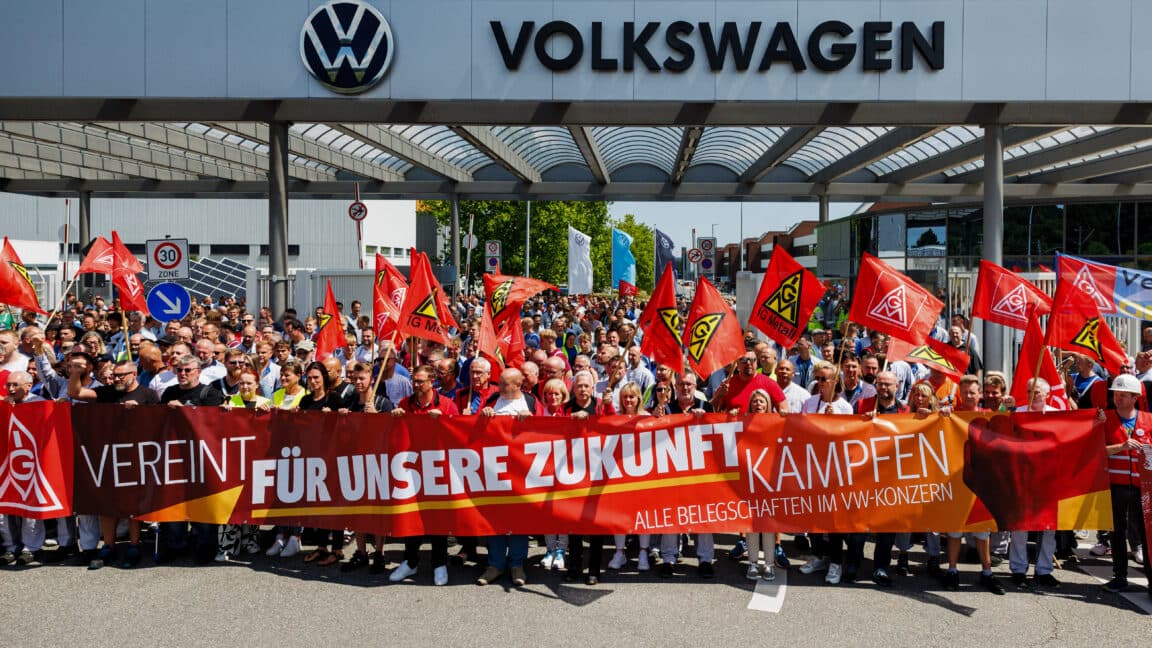
Volkswagen's supervisory board is currently reviewing a restructuring plan that could lead to the loss of up to 100,000 jobs and the closure of several factories. This plan has sparked significant protests organized by the IG Metall union at 18 Volkswagen sites across Germany. The protests are a direct response to CEO Oliver Blume's push for deep cost cuts amid a major overhaul of the company's operations.
The restructuring plan was formally presented to the supervisory board on July 9, 2026, and has since faced backlash from workers concerned about their job security. The proposed changes include halving the company's car lineup, which further intensifies the stakes for employees and the broader automotive market.
The Context
Volkswagen stands as the second-largest automaker in the world, making its decisions impactful not only for its workforce but also for the industry at large. The IG Metall union, a powerful advocate for workers' rights, is actively opposing the proposed job cuts and factory closures, highlighting the potential for widespread unrest. As the company navigates this challenging period, the balance between cost reductions and workforce stability will be crucial.
The timing of these developments coincides with a significant shift in the automotive market, where companies are increasingly pressured to adapt to changing consumer preferences and technological advancements. The outcome of the supervisory board's decision will have lasting implications for Volkswagen's operational strategy and its competitive position.
Takeaway
As Volkswagen moves forward, the company's ability to manage the restructuring process while maintaining workforce morale will be critical. Stakeholders should monitor the supervisory board's decision closely, as it will dictate the future direction of the company. Additionally, further protests or union actions may arise in response to the proposed job cuts, indicating a growing divide between management and employees.
The implications of this restructuring extend beyond Volkswagen, potentially influencing labor relations and operational strategies across the automotive sector. The coming weeks will be pivotal in determining how Volkswagen balances its need for cost efficiency with the demands of its workforce.
In-depth reporting on tech, policy, and science including AI.
"Respected analysis for technically savvy readers, including AI topics."
— A47 Editor
Volkswagen Group tells its board how to fix it, unions disagree
Volkswagen Group has presented a plan to its board that proposes reducing the number of vehicle models by half, although it did not address potential plant closures or job cuts. This strategy reflects the company's efforts to streamline operations am...
In-depth coverage of hardware, software, science, and policy.
"Ars Technica provides expert technology news, hardware reviews, and analysis for a technically savvy audience."
— A47 Editor
Volkswagen Group tells its board how to fix it, unions disagree
Volkswagen Group has presented a plan to its board that proposes reducing the number of vehicle models by half, although it did not address potential plant closures or job cuts. This strategy reflects the company's efforts to streamline operations am...
U.S. business news, corporate developments, and economy.
"The Wall Street Journal is respected for deep financial and economic reporting with a center-right editorial perspective."
— A47 Editor
Volkswagen’s Vast Jobs Factory Is Under Threat Like Never Before
Volkswagen, the world's second-largest automaker, is planning to halve its car lineup as part of a significant restructuring effort, which also includes the potential reduction of up to 100,000 jobs. This overhaul is a response to ongoing challenges ...
UK and international business news, economics, and corporate coverage.
"The Guardian’s business section covers finance and markets with a progressive editorial tone."
— A47 Editor
VW workers protest in Germany over proposed job cuts and factory closures
Protests erupted at 18 Volkswagen sites in Germany as the company presented a plan to cut up to 100,000 jobs and close factories to its supervisory board. The demonstrations, organized by the IG Metall union, highlighted workforce concerns over the d...
News and current affairs from across Europe.
"The Guardian is known for its progressive editorial stance and in-depth analysis."
— A47 Editor
VW workers protest in Germany over proposed job cuts and factory closures
Protests erupted at 18 Volkswagen sites in Germany as the company presented a plan to cut up to 100,000 jobs and close factories to its supervisory board. The demonstrations, organized by the IG Metall union, highlighted workforce concerns over the d...
Global markets, investing, and macroeconomics from a premier financial newsroom.
"Bloomberg is respected for in-depth financial reporting and data-driven analysis."
— A47 Editor
Volkswagen CEO Blume Pushes for Deep Cost Cuts
Volkswagen AG's CEO, Oliver Blume, is advocating for a comprehensive restructuring plan that could lead to the elimination of up to 100,000 jobs and the closure of four factories in Germany. This initiative is aimed at addressing the company's financ...