
Bank of England to Maintain Interest Rates Amid Middle East Tensions
Here's what it means for you.
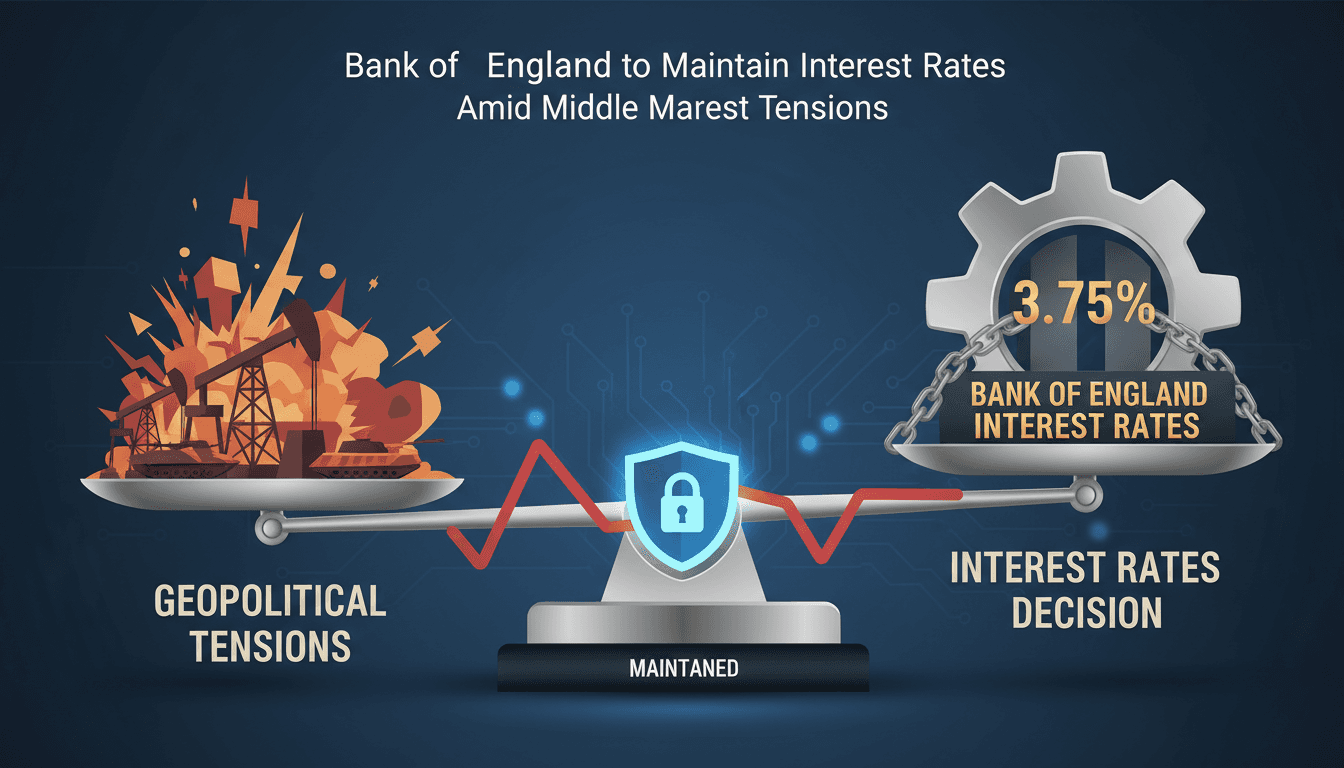
The Bank of England's decision to keep interest rates steady at 3.75% reflects a cautious stance in the face of rising geopolitical tensions. This stability is crucial for businesses and consumers alike, as it helps maintain predictable borrowing costs. However, the central bank's readiness to adjust rates in response to worsening conditions underscores the fragility of the current economic landscape. As the situation in the Middle East evolves, stakeholders should remain vigilant about potential economic impacts. The Bank's future decisions will be closely tied to global events, making it essential for market participants to monitor developments closely.
What happened
The Bank of England is expected to hold its interest rates steady at 3.75% due to increasing economic uncertainty linked to ongoing conflicts in the Middle East. This decision comes as geopolitical tensions escalate, prompting the central bank to adopt a cautious approach. Analysts suggest that while rates will remain unchanged for now, the Bank is prepared to increase borrowing costs if the situation escalates further.
The last interest rate cut by the Bank occurred in December 2025, and the current rate is significant as it directly impacts borrowing costs and economic activity. The ongoing conflict in the Middle East has contributed to economic instability, influencing the Bank's decision-making process.
The Context
The Bank of England's decision to maintain interest rates is set against a backdrop of rising geopolitical tensions, particularly in the Middle East. The central bank's cautious approach reflects the delicate balance it must maintain in fostering economic stability while navigating potential risks. Stakeholders, including businesses and consumers, are closely watching these developments, as they could have far-reaching implications for the economy.
The last interest rate cut occurred in December 2025, marking a significant moment in the Bank's monetary policy. As the situation continues to unfold, the Bank's readiness to raise rates if conditions worsen highlights the interconnectedness of global events and domestic economic management.
Takeaway
Future decisions on interest rates will depend heavily on the resolution of the Middle East conflict and its economic implications. Analysts suggest that the Bank of England may signal its readiness to adjust rates if the geopolitical landscape deteriorates further. As such, monitoring developments in the region will be crucial for understanding potential shifts in monetary policy.
The Bank of England's next policy meeting will be a key event to watch for updates on interest rates. Stakeholders should remain alert to how global events may influence the Bank's decisions in the coming months.
Macro commentary, policy analysis, growth/inflation themes, and global outlooks.
"Contextual macro coverage that complements day-to-day market headlines."
— A47 Editor
Bank of England on track to hold rates as Iran response eyed
The Bank of England is expected to maintain its interest rates at 3.75% during its upcoming meeting, amid ongoing geopolitical tensions related to the conflict in Iran. This decision aligns with the broader trend of central banks in the US and UK hol...
Corporate news, economic trends, and markets with UK and global scope.
"BBC News is widely regarded as reputable and impartial, with a public service mandate."
— A47 Editor
Interest rates expected to be held by Bank of England
The Bank of England is expected to maintain its interest rates at 3.75%, following its last cut in December. This decision comes amid ongoing geopolitical tensions in the Middle East, particularly the conflict in Iran, which has created uncertainty i...
United Kingdom-focused news including local politics, business, and social issues.
"BBC News is widely regarded as a reputable international news organization, known for its impartial tone and public service mandate."
— A47 Editor
Interest rates expected to be held by Bank of England
The Bank of England is expected to maintain its interest rates at 3.75%, following its last cut in December. This decision comes amid ongoing geopolitical tensions in the Middle East, particularly the conflict in Iran, which has created uncertainty i...
Practical investing ideas, macro commentary, and market strategy.
"MoneyWeek is a UK-based investment magazine focused on actionable insights."
— A47 Editor
Live: Will the Bank of England hold interest rates at 3.75%?
The Bank of England is expected to maintain its interest rates at 3.75% during the upcoming meeting on June 18, amid rising economic uncertainty due to the ongoing conflict in Iran. Experts suggest that the current geopolitical climate is influencing...
Global political, business, and cultural coverage from WSJ international desks.
"The Wall Street Journal offers extensive international reporting with a reputation for financial insight and a center-right editorial stance."
— A47 Editor
BOE Expected To Leave Key Rate Unchanged, Parting Ways With ECB
The Bank of England (BOE) is expected to maintain its key interest rate, diverging from the European Central Bank (ECB), which is anticipated to raise rates in response to rising inflation linked to the ongoing conflict in the Middle East.