
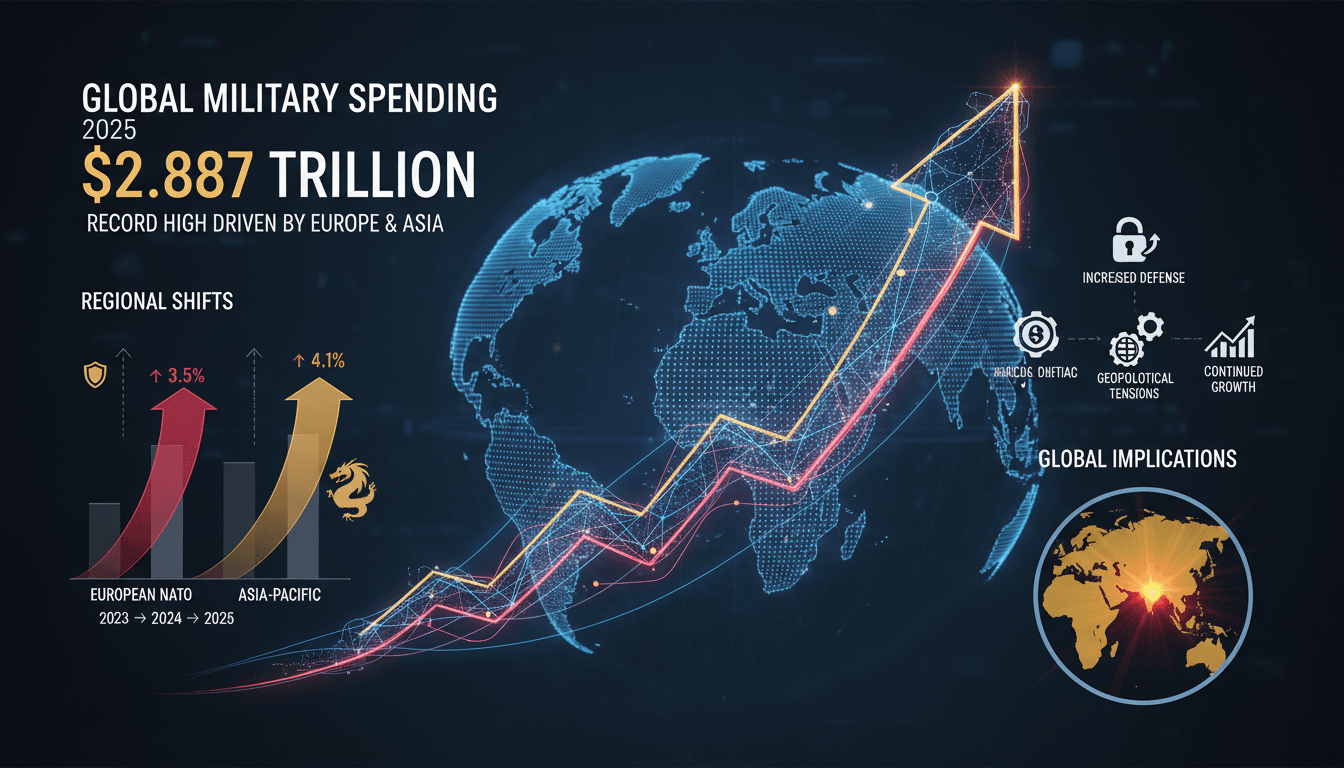
Global military expenditure hits record $2.887 trillion in 2025 driven by European and Asian increases
Here's what it means for you.
In an increasingly unstable world, rising military spending could reshape job markets and economic priorities across sectors.
Why it matters
This surge in military expenditure reflects heightened geopolitical tensions, influencing global economic stability and defense industry dynamics.
What happened (in 30 seconds)
- Global military spending reached a record $2.887 trillion in 2025, marking an increase of 2.9% from the previous year.
- Europe's military outlay surged by 14% to $864 billion, driven by NATO commitments and regional conflicts.
- The U.S. spending declined by 7.5% to $954 billion, primarily due to paused aid to Ukraine.
The context you actually need
- Historical growth: Military expenditures have risen for 11 consecutive years, largely due to ongoing conflicts like the war in Ukraine and tensions in the Indo-Pacific.
- Regional dynamics: Europe and Asia are leading the charge in military spending, with NATO countries and China significantly increasing their budgets.
- U.S. policy shifts: Changes in U.S. defense policy have pressured allies to increase their military investments, impacting global defense strategies.
What's really happening
The global military expenditure landscape is shaped by a complex interplay of geopolitical tensions, national security strategies, and economic pressures. The record spending of $2.887 trillion in 2025, as reported by the Stockholm International Peace Research Institute (SIPRI), underscores a significant shift in how nations prioritize defense in response to perceived threats.
Europe's military spending saw the most substantial increase, with a 14% rise to $864 billion. This surge is largely attributed to NATO allies striving to meet the alliance's target of spending 2% of their GDP on defense. Countries like Germany, which increased its military budget by 24% to $114 billion, exemplify this trend. The ongoing conflict in Ukraine has galvanized European nations to bolster their military capabilities, reflecting a broader commitment to collective security in the face of Russian aggression.
In Asia, military expenditures rose by 8.1% to $681 billion, driven by tensions involving China and its neighbors, particularly in the South China Sea. China's military budget alone grew by 7.4% to $336 billion, while Japan's increased by 9.7% to $62.2 billion. This regional arms race is fueled by concerns over territorial disputes and the need for enhanced defense capabilities against potential threats.
Conversely, the United States, the largest military spender, experienced a 7.5% decline in its defense budget to $954 billion. This reduction is primarily linked to a pause in military aid to Ukraine, reflecting shifting priorities within U.S. defense policy. Despite this decline, the U.S. is expected to exceed $1 trillion in military spending in the coming years, driven by ongoing conflicts and the need to maintain military readiness.
The implications of these spending trends are profound. Nations are increasingly viewing military investment as essential to national security, leading to a reallocation of resources that could impact other sectors, including education and healthcare. As countries prioritize defense, the potential for economic diversification may be stifled, particularly in regions heavily reliant on military contracts.
Who feels it first (and how)
- Defense contractors: Companies in the defense sector will see increased demand for military equipment and technology.
- Government employees: Jobs in defense and military sectors may grow, particularly in countries ramping up spending.
- Taxpayers: Increased military budgets could lead to higher taxes or reallocation of public funds from social services to defense.
- Local economies: Regions with defense manufacturing facilities may experience economic boosts, while others may face budget cuts in non-defense areas.
What to watch next
- NATO spending commitments: Watch for how NATO countries respond to the alliance's defense spending targets, as this will influence European military budgets.
- U.S. defense policy shifts: Monitor changes in U.S. military aid and spending, particularly regarding Ukraine and Indo-Pacific strategies, as these will impact global military dynamics.
- Emerging defense technologies: Keep an eye on investments in new military technologies, as advancements could reshape defense strategies and spending priorities.
Global military spending has reached a record high, with Europe and Asia leading the increases.
Continued growth in military expenditures is expected through 2026-2027, driven by geopolitical tensions.
The long-term economic impacts of sustained military spending on social services and public welfare remain uncertain.
This article was generated by AI from 6 verified sources and reviewed by A47 editorial systems.
Global business headlines with AI angles.
"General business outlet that frequently covers AI."
— A47 Editor
Europe And Asia Drive Global Military Spending To Record $2.9T Amid Worldwide Rearmament
Global military spending reached a record $2.887 trillion in 2025, marking the eleventh consecutive year of growth, driven primarily by increases in Europe and Asia. This surge reflects ongoing global rearmament efforts amid rising geopolitical tensi...
24/7 international news from a French perspective in multiple languages.
"France 24 is viewed as a globally focused outlet with balanced coverage and a European perspective."
— A47 Editor
Global military spending rises 2.9% to $2.89 trillion
Global military spending increased by 2.9% in 2025, reaching a total of $2.89 trillion, according to a report from a conflict think-tank. This rise occurred despite a significant 7.5% decline in military spending by the United States, attributed to P...
RT is a Russian state-funded network covering global events from a Russian perspective.
"RT is widely criticized for promoting pro-Kremlin narratives and is considered by many to be a state propaganda outlet."
— A47 Editor
Europe pushes global military spending to record high – report
Global military spending has surged to nearly $3 trillion, with Europe contributing the largest regional increase, as reported by SIPRI. This rise reflects ongoing global tensions and the prioritization of defense expenditures among nations.
Regional coverage and analysis focused on politics, diplomacy, and business across the Middle East.
"Al-Monitor is known for analytical reporting on Middle East politics and policy developments."
— A47 Editor
Global military spending rises 2.9% despite US decline over Ukraine freeze
Global military spending increased by 2.9% in 2025, reaching $2.89 trillion, despite a 7.5% decline in U.S. spending due to President Donald Trump's suspension of military aid to Ukraine. This marks the 11th consecutive year of rising military expend...
Regional coverage and analysis focused on politics, diplomacy, and business across the Middle East.
"Al-Monitor is known for analytical reporting on Middle East politics and policy developments."
— A47 Editor
Global military spending surges on insecurity: report
Global military spending has surged to nearly $2.9 trillion in 2025, marking an 11th consecutive year of growth driven by rising insecurity and rearmament, according to a report by the Stockholm International Peace Research Institute (SIPRI). The Uni...
Macro commentary, policy analysis, growth/inflation themes, and global outlooks.
"Contextual macro coverage that complements day-to-day market headlines."
— A47 Editor
Global military spending rises 2.9% despite US decline over Ukraine freeze
Global military spending has increased by 2.9%, despite a decline in U.S. military expenditures amid a freeze in Ukraine. This rise indicates a shift in global defense priorities and spending patterns as nations respond to ongoing geopolitical tensio...