
Breakthrough in 3D Silicon Chip Technology Extends Moore's Law
Here's what it means for you.
The recent advancements in 3D silicon chip technology have significant implications for the semiconductor industry. As traditional scaling methods face limitations, this innovative approach could lead to faster and more efficient electronic devices. The ability to stack silicon layers rather than relying solely on miniaturization may redefine manufacturing processes and enhance computing capabilities. This breakthrough not only addresses current challenges but also positions the industry to meet the growing demands of modern computing. Stakeholders in technology and manufacturing should closely monitor these developments as they unfold.
What happened
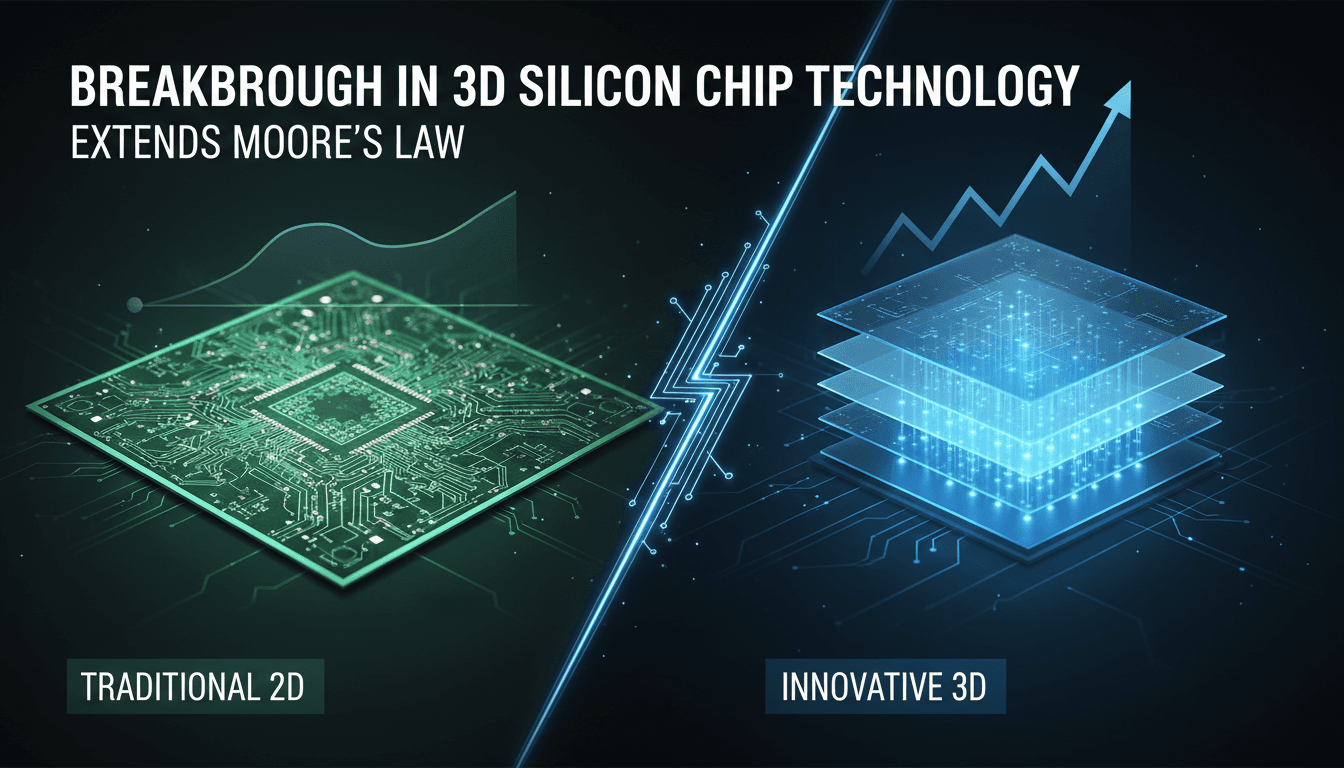
Researchers at the Grainger College of Engineering have developed a method to stack silicon chip layers, enhancing performance as traditional scaling approaches encounter limitations. This innovative technique utilizes ultra-thin silicon membranes and low-temperature manufacturing processes to create 3D silicon circuits. The transition to 3D designs represents a significant shift in semiconductor technology, potentially allowing for greater computing power in a smaller footprint.
This advancement addresses a major obstacle in the production of true 3D chips, paving the way for significant improvements in computing power and efficiency in future electronic devices. The announcement of this technology marks a pivotal moment in the ongoing evolution of semiconductor manufacturing.
The Context
Moore's Law, which predicts the doubling of transistors on a chip approximately every two years, is facing both physical and economic challenges. As the semiconductor industry grapples with these limitations, the new stacking technique allows for increased circuit density by moving into the third dimension rather than expanding horizontally. This shift is crucial for sustaining advancements in computing as demand for more powerful devices continues to rise.
The implications of this technology extend beyond mere performance enhancements; they could redefine the landscape of chip manufacturing. As researchers continue to explore low-temperature manufacturing techniques and the broader impacts of 3D chip technology, the industry stands on the brink of a potential revolution.
Takeaway
The advancement in 3D silicon chip technology is poised to transform the semiconductor landscape. This stacking technology could redefine chip manufacturing and sustain advancements in computing for years to come. As developments unfold, it will be essential to watch for further research on the implications of 3D chip technology in consumer electronics and the evolution of low-temperature manufacturing techniques.
The future of chip technology looks promising, with the potential for more compact and powerful devices that can meet modern computing demands. Stakeholders should remain vigilant as this innovation progresses.
Tech news, hardware, and AI tools coverage.
"PC/tech site increasingly covering AI hardware and apps."
— A47 Editor
Moore's law is hitting a wall, so researchers are stacking silicon chip layers instead of shrinking them
<a href="https://www.techspot.com/news/112591-moore-law-hitting-wall-researchers-stacking-silicon-chip.html" target="_blank"><img src="https://www.techspot.com/images2/news/ts3_thumbs/2026/05/2026-05-31-ts3_thumbs-4c8.jpg" width="800" height="560" st...
Tech startup news, programming trends, and discussions shared by the developer community.
"Hacker News is a community-driven source highlighting influential tech discussions, startup launches, and programming insights."
— A47 Editor
A new way to build chips: Sequentially stacking silicon to extend Moore's Law
Researchers have introduced a novel technique for chip manufacturing that involves sequentially stacking silicon layers, aiming to extend Moore's Law, which predicts the doubling of transistors on integrated circuits approximately every two years. Th...
Research news on robotics and intelligent systems.
"Aggregated robotics research relevant to AI applications."
— A47 Editor
New 3D silicon chip breakthrough could extend Moore’s Law for years
Researchers have achieved a significant breakthrough in chip technology by developing a method to stack silicon circuits in multiple layers, utilizing ultra-thin silicon membranes and low-temperature manufacturing techniques. This innovation addresse...