
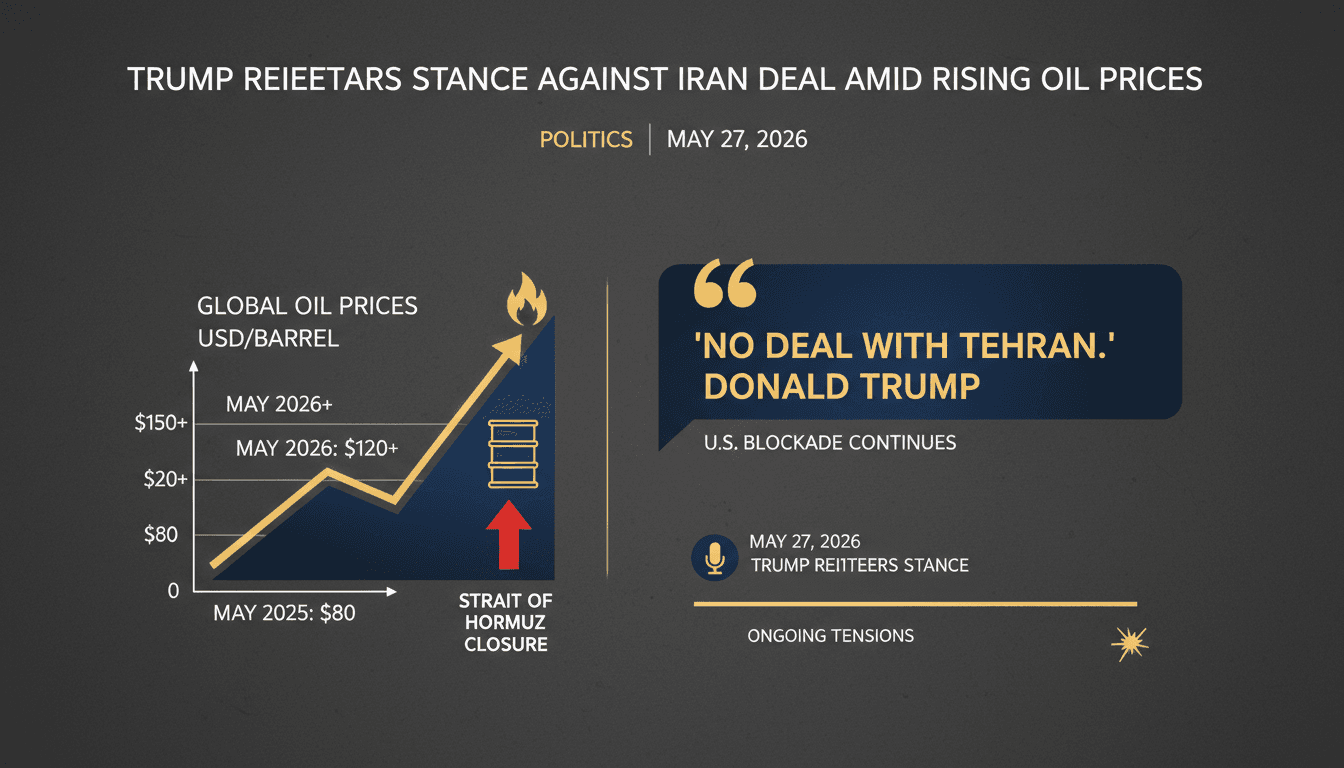
Trump Reiterates Stance Against Iran Deal Amid Rising Oil Prices
Here's what it means for you.
Rising oil prices and geopolitical tensions could impact global markets and your investment strategies.
What happened
On May 27, 2026, President Trump declared that economic pressures from rising oil prices would not lead to negotiations with Iran.
The Context
- Geopolitical tensions: The U.S. withdrew from the Iran nuclear deal in 2018, escalating conflicts and affecting global oil supply chains.
- Economic impact: The closure of the Strait of Hormuz has led to increased oil prices, influencing markets worldwide.
- Political landscape: Trump's firm stance comes amid criticism from various factions as midterm elections approach, with potential implications for U.S. foreign policy.
The Number
— This figure represents potential sanctions relief and the unlocking of frozen assets in negotiations with Iran, which could significantly affect global oil markets.
Takeaway
Expect continued volatility in oil prices and investor sentiment as negotiations unfold and geopolitical dynamics evolve.
Editor-curated FT homepage stories spanning markets, business, world, and opinion.
"The Financial Times is a globally respected business publication with a centrist/center-left tone and strong markets focus."
— A47 Editor
Trump says rising economic costs will not force him into Iran deal
President Trump stated that rising economic costs will not compel him to enter into a deal with Iran, despite recent fluctuations in oil prices influenced by geopolitical tensions. His comments come as optimism regarding a potential peace agreement h...
Macro commentary, policy analysis, growth/inflation themes, and global outlooks.
"Contextual macro coverage that complements day-to-day market headlines."
— A47 Editor
US denies Iranian report on draft Strait of Hormuz peace deal
The United States has denied an Iranian report regarding a draft peace deal aimed at reopening the strategically important Strait of Hormuz. This denial comes amid ongoing tensions between the U.S. and Iran, which have persisted for several months, a...
UAE-based English-language newspaper covering regional politics, economics, and global affairs.
"The National reflects Emirati policy perspectives while maintaining international editorial standards."
— A47 Editor
Oil prices slide on hopes of Strait of Hormuz reopening within month
Oil prices have declined amid growing optimism that the Strait of Hormuz, a crucial maritime route for global oil shipping, may reopen within a month, contingent upon an agreement between Iran and the United States. This development follows reports o...
Oil, metals, and agriculture: supply/demand headlines, OPEC chatter, inventories, and price action.
"Solid tape for energy and metals traders tracking macro and micro catalysts."
— A47 Editor
Oil prices mixed, Brent under $100 as U.S. strikes offset Hormuz reopening hopes
Oil prices are currently mixed, with Brent crude trading below $100 per barrel as recent U.S. military strikes on Iran have dampened optimism regarding the potential reopening of the Strait of Hormuz. This situation reflects ongoing geopolitical tens...
Oil, metals, and agriculture: supply/demand headlines, OPEC chatter, inventories, and price action.
"Solid tape for energy and metals traders tracking macro and micro catalysts."
— A47 Editor
Oil tumbles nearly 7% as US and Iran seen moving closer to deal
Oil prices have experienced a significant decline of nearly 7% as optimism grows regarding a potential peace deal between the U.S. and Iran, with Brent crude futures dropping below $100 a barrel. This shift in market sentiment reflects traders' react...
Oil, metals, and agriculture: supply/demand headlines, OPEC chatter, inventories, and price action.
"Solid tape for energy and metals traders tracking macro and micro catalysts."
— A47 Editor
Iran would open Strait of Hormuz 30 days after peace deal, Nikkei reports citing source
Iran has indicated that it would reopen the strategically significant Strait of Hormuz 30 days following a peace deal, as reported by Nikkei. This development comes amid ongoing negotiations aimed at resolving tensions between Iran and the United Sta...
Markets desk coverage, trading insights, and investor updates.
"WSJ’s markets reporting provides in-depth analysis and context for investors."
— A47 Editor
Oil Futures Fall Below $100 on Optimism Over U.S.-Iran Talks
Oil prices have fallen below $100 a barrel, driven by optimism surrounding ongoing negotiations between the U.S. and Iran, which suggest a potential peace deal is nearing completion. This development has led to a significant shift in market sentiment...