
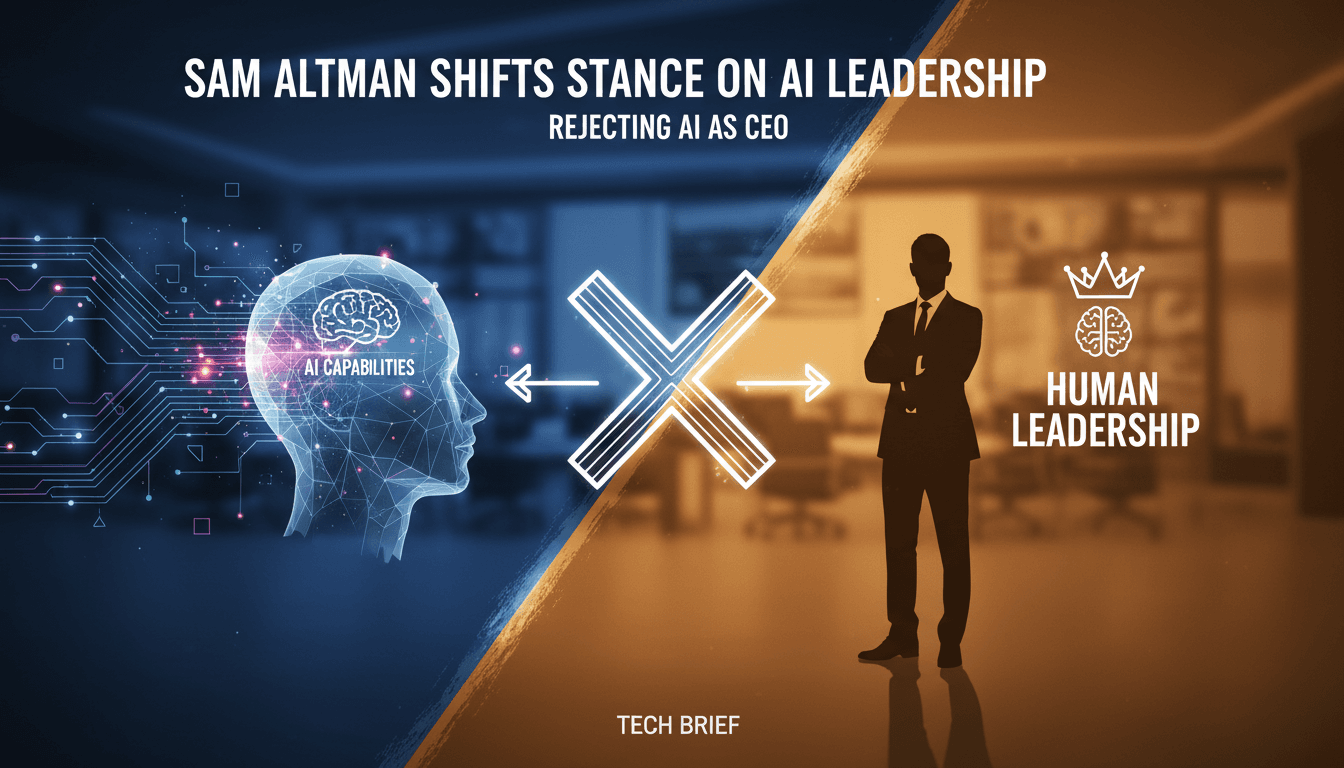
Sam Altman shifts stance on AI leadership rejecting AI as CEO
What happened
Sam Altman, CEO of OpenAI, has publicly stated that people prefer human leadership over AI in corporate roles. This marks a significant change from his previous advocacy for an AI CEO, which he once viewed as a groundbreaking milestone. Altman emphasized that individuals value their roles and identities more than the capabilities of AI, highlighting a fundamental aspect of human nature in the workplace.
He noted that despite the advancements in AI technology, the anticipated reduction in work hours has not occurred. Increased productivity from AI has not translated into shorter workweeks, primarily due to the competitive nature of the workforce. This acknowledgment reflects a deeper understanding of the complexities surrounding AI's integration into corporate governance.
The Context
Altman's shift in perspective comes at a time when the role of AI in leadership is under intense scrutiny. Initially, he envisioned OpenAI as a pioneer in having an AI-led company, but he has since recognized the importance of human connection in leadership. This change is significant as it aligns with broader discussions about productivity and work culture in an increasingly AI-enhanced world.
The competitive environment in the workforce has led to a scenario where employees are reluctant to embrace shorter workweeks, despite the potential for increased efficiency through AI. Altman's insights resonate with many stakeholders who are grappling with the implications of AI on job roles and corporate governance. As companies strive to adapt to technological advancements, the human element remains a critical factor.
Takeaway
The evolving perspective on AI leadership may have lasting implications for corporate governance and workforce dynamics. Companies will need to find a balance between leveraging AI's capabilities and maintaining the human elements of leadership that employees value. This shift could lead to new trends in workplace productivity and employee satisfaction, as organizations reassess their leadership structures.
As discussions around AI and leadership continue to unfold, it will be essential to monitor potential developments in AI governance and the impact on employee engagement. The future of work may hinge on how well companies can integrate technology while fostering a sense of human connection in their leadership practices.
Opinionated AI coverage for general audiences.
"TNW’s AI vertical covering tools, ethics, and trends."
— A47 Editor
Eight months ago Altman wanted an AI CEO. Now he says nobody does.
Sam Altman, CEO of OpenAI, has shifted his stance on the idea of an AI CEO, stating that people do not desire an artificial intelligence to lead a company, contrasting with his previous assertion that OpenAI should be the first major firm to be run b...
Business and tech news excluding paywalled content.
"High-volume business/tech outlet with frequent AI coverage."
— A47 Editor
Sam Altman says people don’t really want an AI to act as CEO: ‘I think the world wants to know about the person’
OpenAI CEO Sam Altman expressed that people generally prefer knowing about individuals rather than having an AI take on the role of a CEO, reflecting a shift in his views regarding AI-related layoffs. He noted that humans tend to value themselves mor...
Business and tech news excluding paywalled content.
"High-volume business/tech outlet with frequent AI coverage."
— A47 Editor
Sam Altman said AI hasn't led to 4-hour workweeks because people are competitive
Sam Altman, CEO of OpenAI, stated that advancements in artificial intelligence have not resulted in shorter workweeks, as increased productivity leads to heightened competition among workers who desire to work more.