
NASA's Swift Observatory mission jeopardized by LINK spacecraft malfunctions
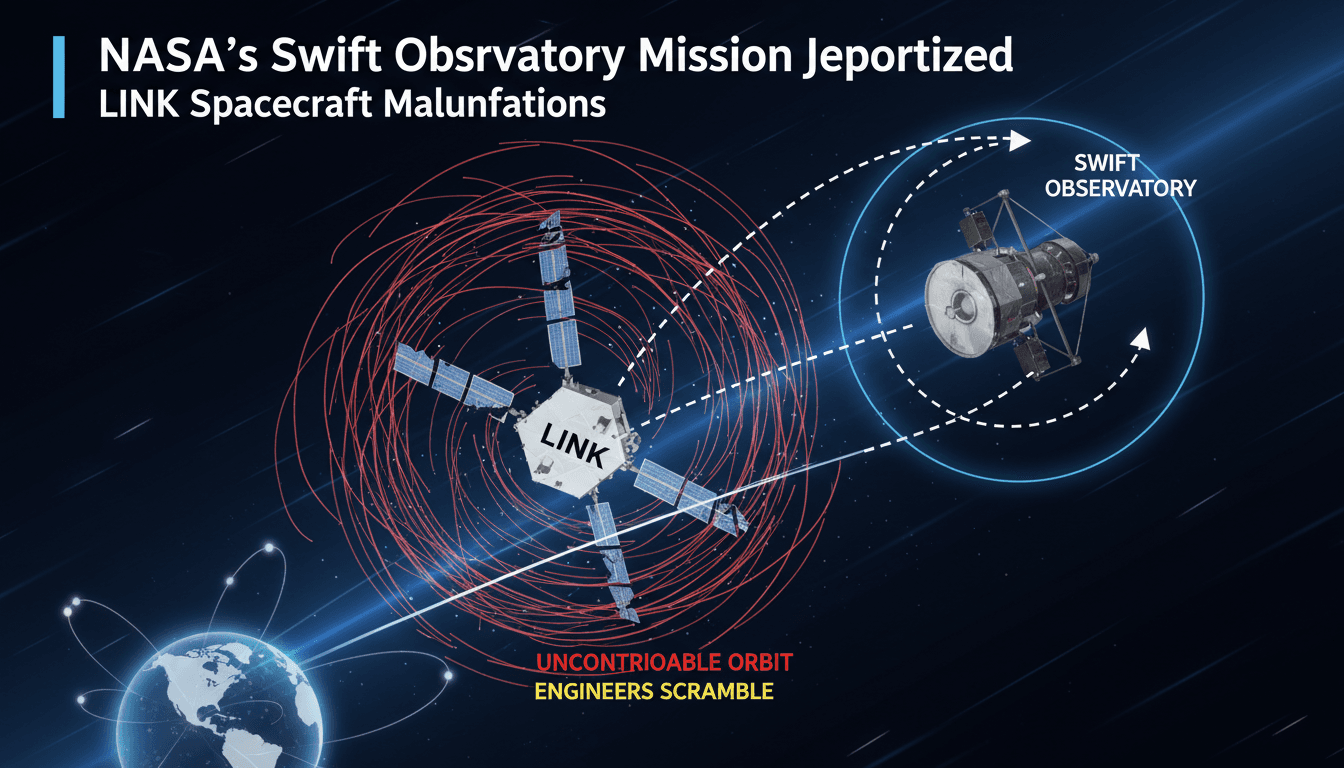
Here's what it means for you.
The current malfunction of the LINK spacecraft poses significant implications for the future of space technology and rescue missions. As engineers work to regain control, the outcome will influence how aging space assets are managed and maintained. Successful intervention could pave the way for innovative solutions in preserving critical scientific instruments in orbit.
What happened
NASA's Swift Observatory is facing a critical situation as the LINK spacecraft, launched to stabilize its orbit, is now malfunctioning. The spacecraft has begun to spin uncontrollably, complicating efforts to boost the telescope's operational status. Engineers are actively troubleshooting the issues, indicating that recovery efforts are ongoing despite the challenges.
The LINK spacecraft was launched as part of the Swift Boost mission earlier in July 2026. However, just days after its launch, it began experiencing severe control issues, raising alarms about the mission's viability. The urgency of the situation underscores the precarious nature of maintaining aging space technology.
The Context
The Swift Observatory is an aging science telescope that requires immediate intervention to sustain its operational capabilities. LINK was specifically designed to stabilize and elevate the telescope's orbit, making its current malfunction particularly concerning. The mission highlights the challenges faced by engineers in managing complex space technology and the need for innovative solutions.
As the situation unfolds, the implications extend beyond the immediate mission. The ability to recover aging space assets could redefine future approaches to satellite maintenance and rescue operations. This incident serves as a reminder of the vulnerabilities inherent in space exploration and the importance of robust engineering practices.
Takeaway
The outcome of the LINK mission remains uncertain as engineers continue to troubleshoot its issues. The situation emphasizes the critical need for effective intervention strategies in space technology. Observers should watch for updates on the engineering efforts to regain control of LINK and the potential implications for NASA's aging space observatories.
As the mission progresses, it will be essential to assess the lessons learned from this experience. The challenges faced by LINK may inform future missions and the management of aging space assets, shaping the landscape of space exploration for years to come.
Scientific discoveries, health, technology, and natural phenomena.
"Live Science reports on scientific discoveries, health, technology, and natural phenomena with a popular science tone."
— A47 Editor
'We are not giving up yet': Private mission to rescue NASA's Swift telescope is spinning out of control, and engineers are racing to fix it
Katalyst Space's LINK spacecraft is currently experiencing an unexpected spin in orbit, complicating efforts to rescue NASA's Swift observatory, which is at risk of falling out of orbit. Engineers are working urgently to stabilize the spacecraft and ...
Scientific research, space, environment, and health coverage.
"The New York Times is a globally recognized newspaper offering authoritative reporting with a center-left editorial stance."
— A47 Editor
Mission to Save Falling NASA Space Telescope Suffers Setback
NASA's mission to save the Swift Observatory has encountered a significant setback as the spacecraft designed to elevate its orbit has malfunctioned and begun to tumble. Engineers remain hopeful that the mission can still succeed despite this complic...
Consumer technology news with AI coverage.
"Gadget and tech site reporting on AI in products."
— A47 Editor
The spacecraft NASA sent to rescue the falling Swift observatory is in trouble
NASA's LINK spacecraft, launched to rescue the Swift observatory from a critical decline in its orbit, is facing challenges that jeopardize its mission. The Swift telescope, which has been vital for astronomical observations, is at risk of falling ba...
Covers consumer technology, electronics, gadgets, and product reviews.
"Engadget is a trusted source for gadget reviews and consumer tech news, known for its hands-on analysis and industry coverage."
— A47 Editor
The spacecraft NASA sent to rescue the falling Swift observatory is in trouble
NASA's LINK spacecraft, launched to rescue the Swift observatory from a critical decline in its orbit, is facing challenges that jeopardize its mission. The Swift telescope, which has been vital for astronomical observations, is at risk of falling ba...
Space science news, astronomy updates, and spaceflight developments.
"Space.com delivers space science news, astronomy updates, and spaceflight developments with engaging coverage."
— A47 Editor
NASA launched this spacecraft to save a space telescope. Now, it needs saving too
NASA launched the Swift Boost mission to rescue its aging Swift space telescope, which is currently facing control issues that threaten its operational status. The spacecraft was intended to elevate the telescope's orbit to prevent it from falling ou...
Scientific research, technology, environment, and society.
"Scientific American is one of the oldest and most authoritative science magazines, known for deep dives into science, technology, and society."
— A47 Editor
Rescue mission to save NASA’s Swift space telescope is imperiled in orbit
A private spacecraft launched to enhance the orbit of NASA's Swift Observatory is currently facing significant malfunctions that threaten the mission's success. Reports indicate that two of the three reaction wheels responsible for the telescope's al...
Science and technology stories including AI.
"Longstanding science magazine with thoughtful AI coverage."
— A47 Editor
Rescue mission to save NASA’s Swift space telescope is imperiled in orbit
A private spacecraft launched to enhance the orbit of NASA's Swift Observatory is currently facing significant malfunctions that threaten the mission's success. Reports indicate that two of the three reaction wheels responsible for the telescope's al...