
OpenAI's Astra model solves ten significant mathematical problems
What happened
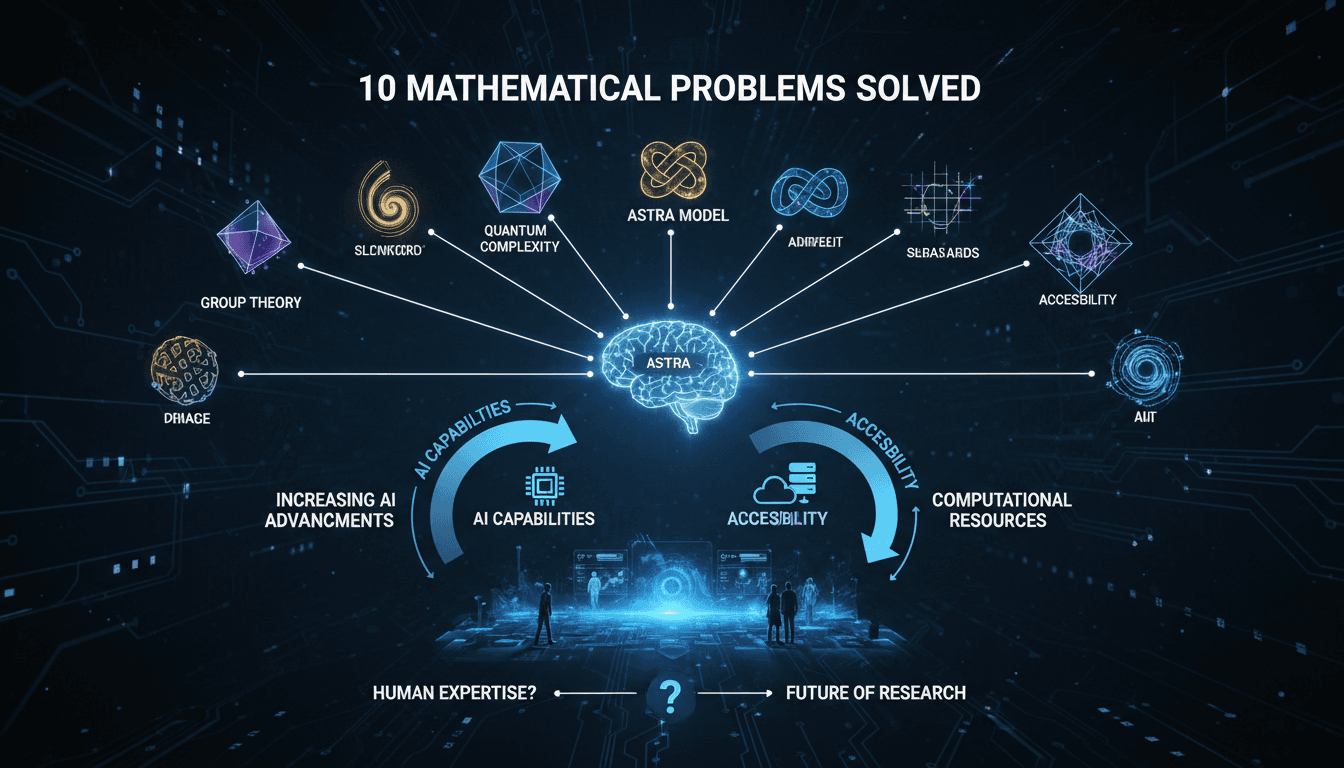
OpenAI recently announced that its Astra model has successfully solved ten open mathematical problems, showcasing its prowess in advanced mathematics and theoretical computer science. Among the notable achievements are significant advancements in group theory, quantum complexity, and lattice cryptography. The solutions were formalized into Lean certificates, ensuring machine-checkable verification of the proofs.
The total cost for the computational resources utilized in solving these problems was approximately $2,000, underscoring the accessibility of AI-assisted research. This affordability allows smaller labs and individuals to engage in advanced mathematical inquiries that were previously out of reach.
The Context
The announcement of Astra's achievements has sparked discussions within the mathematical community, with mixed reactions regarding the role of AI in research. Prominent mathematicians have expressed both excitement and concern about the implications of AI-generated solutions. The timing of this breakthrough coincides with a growing interest in the intersection of AI and mathematics, raising questions about the preservation of traditional mathematical expertise.
As AI continues to evolve, its integration into mathematical research could lead to a significant shift in how problems are approached and solved. The implications of this shift extend beyond academia, potentially influencing educational practices and the future workforce in mathematics-related fields.
Takeaway
The advancements made by OpenAI's Astra model suggest a future where AI plays a crucial role in mathematical research. As the community navigates this new landscape, it will be essential to balance the benefits of AI tools with the need to maintain foundational skills and knowledge. Ongoing developments in Astra and its applications will be closely monitored, particularly in how they influence research practices and responses from mathematicians.
Future discussions will likely focus on the integration of AI in mathematics and the potential for collaboration between human expertise and machine-generated solutions. The mathematical community stands at a crossroads, where embracing AI could lead to unprecedented discoveries while also challenging traditional methodologies.
Community posts including AI/ML tutorials and news.
"Open platform where developers share AI learnings."
— A47 Editor
OpenAI's Astra Solved 10 Open Math Problems — and the Price Tag Is the Real Story
OpenAI's internal model Astra has successfully solved ten significant mathematical problems, including topics in high-dimensional geometry and quantum complexity, marking a notable achievement in the field of artificial intelligence and theoretical c...
Daily AI news: models, tools, and policy.
"Independent outlet tracking the fast pace of AI."
— A47 Editor
AI keeps cracking unsolved math problems, and mathematicians have mixed feelings
OpenAI's recent success with its GPT-5.6 Pro model, which solved the Unit Distance Conjecture and other complex math problems, has generated mixed reactions among mathematicians, including concerns about the potential decline of mathematical culture ...
Daily AI news: models, tools, and policy.
"Independent outlet tracking the fast pace of AI."
— A47 Editor
OpenAI announces its "next major model" Astra by dropping ten previously unsolved math solutions
OpenAI has announced the development of its new AI model family, Astra, which is designed to enable multiple agents to collaboratively solve complex problems over extended periods. This announcement follows a demonstration of Astra to policymakers in...