
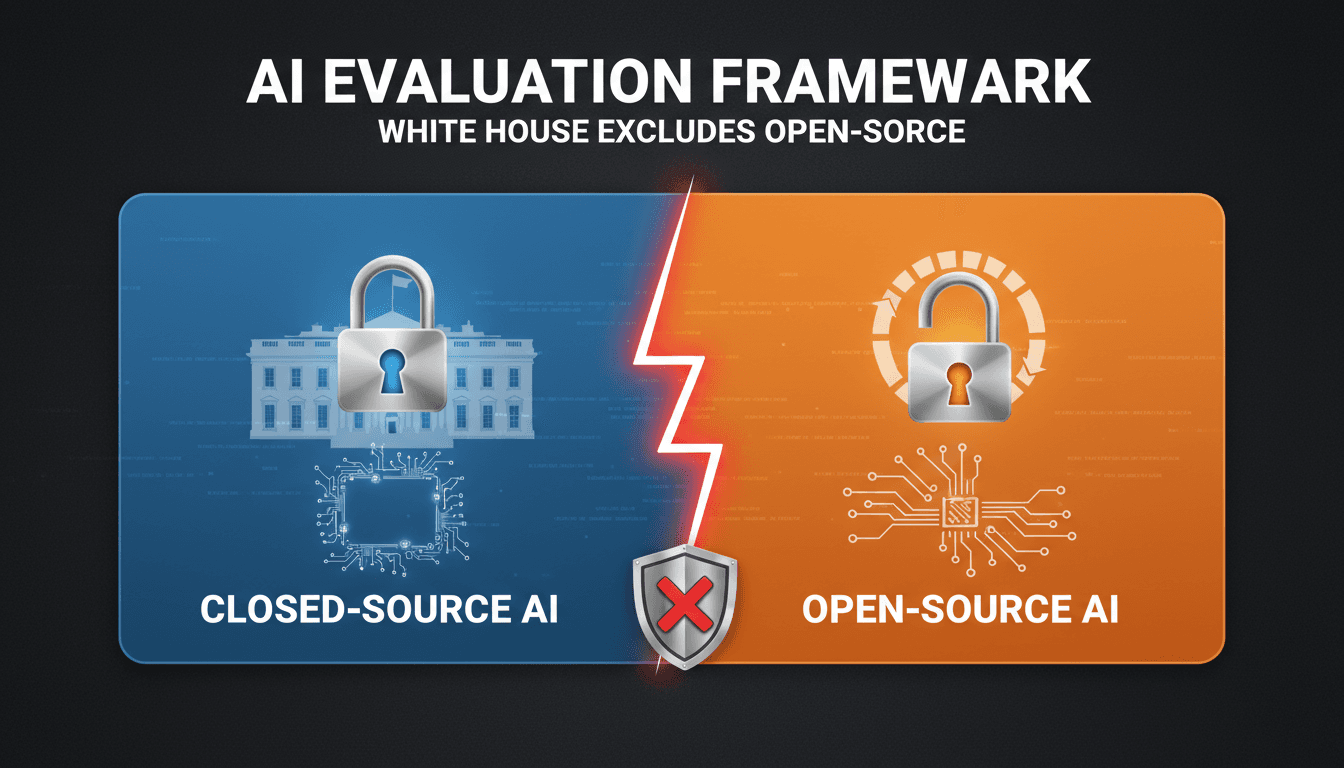
White House finalizes AI evaluation framework excluding open-source models
Here's what it means for you.
The White House has established a new voluntary framework for evaluating advanced AI models, which may significantly impact the AI landscape. By excluding open-source models from this evaluation, the framework raises concerns about transparency and inclusivity in AI governance. Stakeholders in the AI community may face increased scrutiny and potential backlash as the implications of this decision unfold. The lack of public disclosure regarding the framework's details could hinder accountability and trust among developers and users alike. As the framework is implemented, its effects on innovation and national security will be closely monitored.
What happened
The White House has finalized a voluntary framework for evaluating advanced AI models, following an executive order issued by former President Trump on June 2. This framework is designed to assess closed-source models that possess state-of-the-art capabilities and pose national security risks. However, the details of this framework will not be made public and will only be accessible to participating companies.
The completion of this framework was announced on August 3, 2026, marking a significant step in the U.S. government's approach to AI governance. Notably, the framework explicitly excludes open-source models from evaluation, indicating a substantial limitation in the scope of AI assessment.
The Context
The establishment of this framework comes in response to growing concerns about the implications of advanced AI technologies on national security. By focusing solely on closed-source models, the White House aims to address potential risks while sidelining open-source alternatives that are often seen as more transparent and collaborative. This decision reflects a broader trend in AI governance that prioritizes security over inclusivity.
The timing of this framework aligns with ongoing discussions in the AI community regarding the need for accountability and ethical considerations in AI development. As stakeholders navigate this evolving landscape, the implications of the framework will likely resonate across various sectors, influencing both policy and market dynamics.
Takeaway
The exclusion of open-source models from the White House's AI evaluation framework may lead to significant backlash from the AI community. As developers and advocates for transparency voice their concerns, the government may face pressure to reconsider its approach to AI governance. Future announcements regarding the framework's implementation will be crucial in determining its impact on AI developers and the broader technology landscape.
As the situation develops, stakeholders should remain vigilant about the potential consequences of this framework on innovation and national security. The ongoing dialogue surrounding AI governance will likely shape the future of AI technologies in the United States.
Global business headlines with AI angles.
"General business outlet that frequently covers AI."
— A47 Editor
White House Completes New AI Framework. Its Rules Are Still Not Public
The White House has completed a new artificial intelligence (AI) framework, which was initiated by an executive order from former President Trump on June 2. This framework aims to establish a voluntary process for federal agencies and AI developers t...
Curated tech headlines including AI stories.
"Influential aggregator surfacing the day’s top tech/AI links."
— A47 Editor
Sources: the US' AI framework excludes open models and defines a covered frontier model as closed source with SOTA capabilities and national security risks (Maria Curi/Axios)
The White House has finalized a new artificial intelligence (AI) framework that excludes open models, designating a covered frontier model as closed source with state-of-the-art (SOTA) capabilities and associated national security risks. This decisio...
Curated tech headlines including AI stories.
"Influential aggregator surfacing the day’s top tech/AI links."
— A47 Editor
Sources: the White House doesn't plan to publicly release its voluntary AI framework; details will be available to the companies that are part of the process (Maria Curi/Axios)
The White House has decided not to publicly release its voluntary framework for evaluating advanced AI models, with details only accessible to participating companies, according to sources familiar with the discussions. This decision follows the esta...
Curated tech headlines including AI stories.
"Influential aggregator surfacing the day’s top tech/AI links."
— A47 Editor
The White House says it has met its deadline to establish a voluntary framework for evaluating advanced AI models; it did not provide details of the framework (Maria Curi/Axios)
The White House announced that it has met its deadline to establish a voluntary framework for evaluating advanced AI models, although specific details of the framework were not disclosed. This development comes amid ongoing discussions about the regu...