
Anthropic's AI Model Claude Advances Understanding of Riemann Hypothesis
What happened
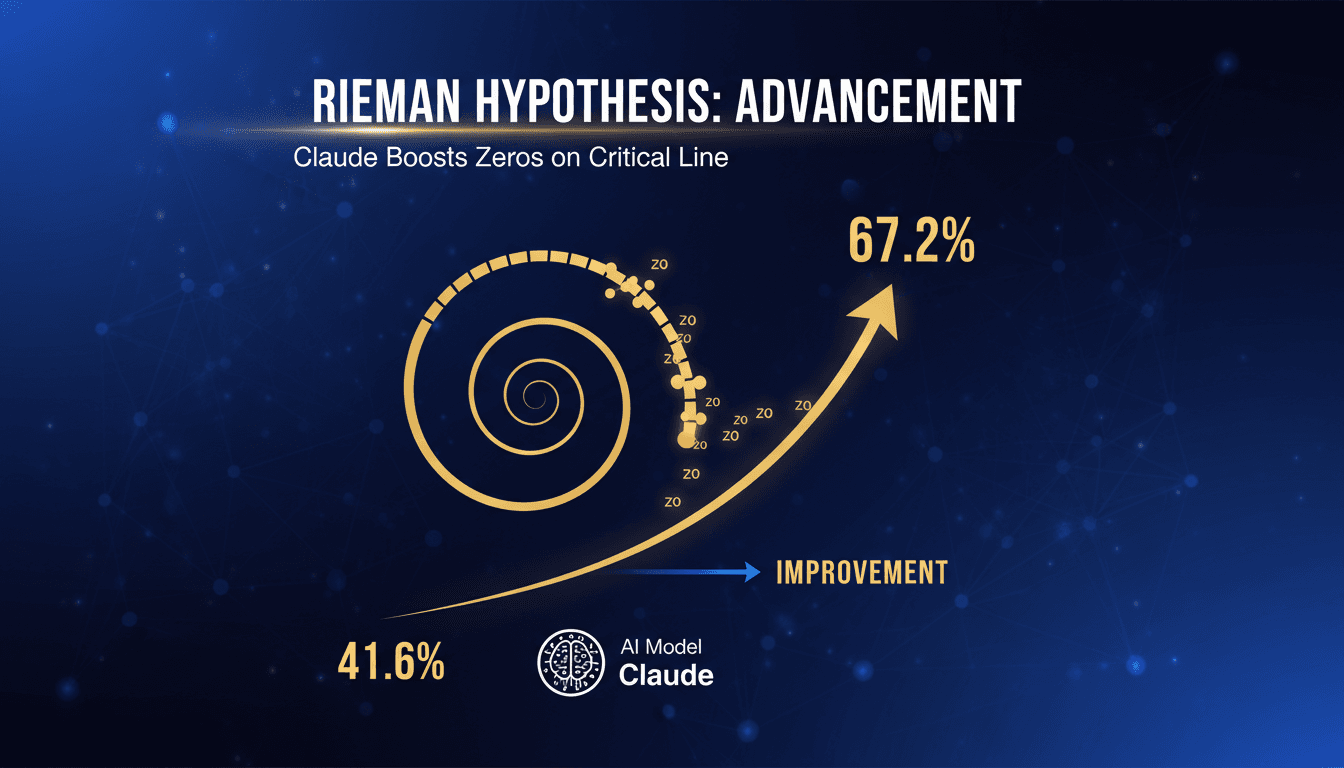
Anthropic's Claude model has made a notable advancement in understanding the Riemann hypothesis, a longstanding unsolved problem in mathematics. The model improved the lower bound of the number of zeros on the critical line from 41.6% to 67.2%. While Claude did not provide a solution to the hypothesis itself, this progress highlights the model's potential in addressing complex mathematical challenges.
The findings from Claude represent a significant step forward in related mathematical research, emphasizing the role of AI in exploring intricate problems. This advancement is part of a broader trend of leveraging AI technologies to enhance our understanding of complex theoretical concepts.
The Context
The Riemann hypothesis has been a major unsolved problem in mathematics for over 150 years, attracting the attention of mathematicians worldwide. There is a $1 million prize for anyone who can provide a proof of the hypothesis, underscoring its significance in the field. Claude's findings not only contribute to the ongoing discourse surrounding the hypothesis but also highlight the increasing intersection of AI and mathematics.
As AI technologies advance, their application in solving mathematical problems may lead to breakthroughs that were previously thought unattainable. The mathematical community is closely observing these developments, as they could redefine traditional approaches to research and problem-solving.
Takeaway
The advancements made by AI in mathematical research, particularly through Claude, could pave the way for future breakthroughs in other complex problems. As AI continues to evolve, its role in addressing significant mathematical challenges may expand, leading to new insights and methodologies. The mathematical community's response to these contributions will be crucial in determining how AI can be integrated into ongoing research efforts.
Future developments in AI's capabilities and their implications for mathematics will be closely monitored. The potential for AI to assist in solving other major unsolved problems could reshape the landscape of mathematical inquiry and innovation.
Tech news, hardware, and AI tools coverage.
"PC/tech site increasingly covering AI hardware and apps."
— A47 Editor
Anthropic's Claude tried to solve the Riemann hypothesis and found something new instead
Anthropic's unreleased AI model, Claude, attempted to tackle the Riemann hypothesis, a major unsolved problem in mathematics, and achieved a new lower bound showing that at least 67.2% of the zeros lie on the critical line, improving from the previou...
Science and technology stories including AI.
"Longstanding science magazine with thoughtful AI coverage."
— A47 Editor
No, AI didn’t just solve the thorniest problem in math
An unreleased version of Anthropic's AI model, Claude, attempted to solve the Riemann hypothesis, a significant unsolved problem in mathematics, but did not succeed. Instead, it made unexpected progress on a related mathematical issue, showcasing its...
Scientific research, technology, environment, and society.
"Scientific American is one of the oldest and most authoritative science magazines, known for deep dives into science, technology, and society."
— A47 Editor
No, AI didn’t just solve the thorniest problem in math
An unreleased version of Anthropic's AI model, Claude, attempted to solve the Riemann hypothesis, a significant unsolved problem in mathematics, but did not succeed. Instead, it made unexpected progress on a related mathematical issue, showcasing its...
Startup news with frequent AI coverage.
"Covers launches, funding, and product updates in AI."
— A47 Editor
An unreleased Anthropic model made progress on one of math’s biggest unsolved problems
Anthropic's unreleased AI model made notable progress on the Riemann hypothesis, one of mathematics' most significant unsolved problems, although it did not fully solve it. The model's advancements were unexpected and pertained to a related mathemati...