
MBZUAI Launches Benchmark for AI Understanding of Arabic Dialects
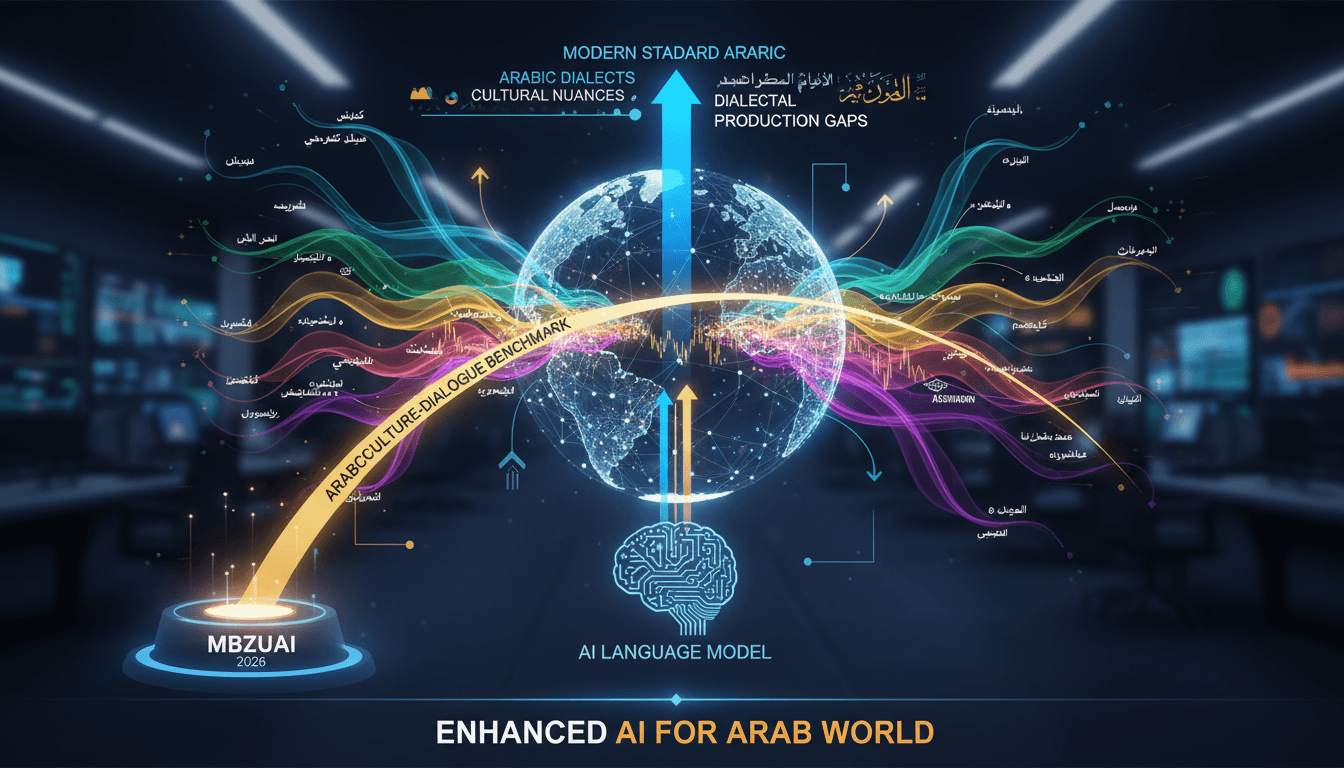
Why it matters
This initiative addresses a critical gap in AI's understanding of Arabic cultural nuances, impacting industries reliant on accurate language processing.
What happened (in 30 seconds)
- On August 17, 2026, MBZUAI launched the ArabCulture-Dialogue benchmark to evaluate AI's grasp of Arabic dialects.
- The benchmark includes assessments across Modern Standard Arabic and 13 regional dialects, focusing on cultural context and dialogue.
- Initial results show a 95% comprehension accuracy in culturally appropriate responses, but significant challenges remain in dialect production.
The context you actually need
- Arabic NLP has favored Modern Standard Arabic, neglecting the diverse dialects spoken by over 400 million Arabic speakers.
- Cultural comprehension gaps in AI models have led to performance disparities, particularly in conversational contexts.
- The benchmark was developed with input from 26 native speakers across 13 Arab countries, ensuring authentic representation.
What's really happening
The ArabCulture-Dialogue benchmark represents a significant advancement in Arabic natural language processing (NLP). Historically, AI models have been trained predominantly on Modern Standard Arabic (MSA), which, while unifying, does not reflect the linguistic diversity of the Arabic-speaking population. This oversight has resulted in AI systems that can understand MSA but falter when faced with the rich tapestry of regional dialects used in everyday conversation.
The benchmark was meticulously crafted by researchers at MBZUAI, who recognized the need for a tool that could assess not just linguistic accuracy but also cultural relevance. By involving native speakers from 13 different Arab countries, the project ensured that the dialogues generated for testing were rooted in real-life contexts, covering topics such as weddings, food, and child-rearing. This approach highlights the importance of cultural nuances in language processing, which is often overlooked in traditional AI training datasets.
The benchmark evaluates AI models on three key tasks: selecting culturally appropriate responses, translating between MSA and dialects, and continuing dialogues in specified dialects. The impressive 95% comprehension accuracy achieved by leading models indicates a strong understanding of cultural context. However, the sharp decline in dialect production and identity preservation reveals a critical area for improvement. This disparity suggests that while AI can recognize and respond to cultural cues, it struggles to authentically replicate the dialects that embody those cues.
The implications of this benchmark extend beyond academic research; they have practical applications in various sectors, including customer service, education, and cultural heritage. For instance, AI tools developed using this benchmark could enhance communication in Dubai's diverse population, where understanding local dialects is crucial for effective interaction. As businesses and institutions increasingly rely on AI for customer engagement, the ability to navigate cultural and linguistic nuances will become a competitive advantage.
Moreover, the benchmark positions MBZUAI as a leader in Arabic AI research, potentially attracting further investment and collaboration in the field. As AI continues to evolve, the ArabCulture-Dialogue benchmark could serve as a foundational tool for future advancements, pushing the boundaries of what AI can achieve in understanding and generating Arabic language content.
Who feels it first (and how)
- AI Developers: Need to adapt models to incorporate dialectal understanding.
- Businesses in Dubai: Will benefit from improved customer service tools that understand local dialects.
- Educators: Can leverage AI tools for teaching Arabic in a culturally relevant manner.
- Cultural Institutions: May use AI to preserve and promote local dialects and cultural heritage.
What to watch next
- Adoption of the benchmark: Monitor how quickly AI developers integrate this benchmark into their training processes, as it could reshape Arabic NLP.
- Performance improvements: Look for advancements in dialect production capabilities in AI models, which will indicate progress in cultural fidelity.
- Market response: Pay attention to how businesses in the UAE and beyond adapt their AI strategies in light of this benchmark, particularly in customer-facing applications.
The benchmark has been released and initial evaluations show high comprehension accuracy.
AI models will improve in cultural and dialectal understanding as developers adopt this benchmark.
The long-term impact on the market and how quickly businesses will adapt to these advancements.
Frequently Asked Questions
- Why it matters?
- This initiative addresses a critical gap in AI's understanding of Arabic cultural nuances, impacting industries reliant on accurate language processing.
- What happened (in 30 seconds)?
- On August 17, 2026, MBZUAI launched the ArabCulture-Dialogue benchmark to evaluate AI's grasp of Arabic dialects. The benchmark includes assessments across Modern Standard Arabic and 13 regional dialects, focusing on cultural context and dialogue. Initial results show a 95% comprehension accuracy in culturally appropriate responses, but significant challenges remain in dialect production.
- What's really happening?
- The ArabCulture-Dialogue benchmark represents a significant advancement in Arabic natural language processing (NLP). Historically, AI models have been trained predominantly on Modern Standard Arabic (MSA), which, while unifying, does not reflect the linguistic diversity of the Arabic-speaking population. This oversight has resulted in AI systems that can understand MSA but falter when faced with the rich tapestry of regional dialects used in everyday conversation. The benchmark was meticulously
- Who feels it first (and how)?
- AI Developers: Need to adapt models to incorporate dialectal understanding. Businesses in Dubai: Will benefit from improved customer service tools that understand local dialects. Educators: Can leverage AI tools for teaching Arabic in a culturally relevant manner. Cultural Institutions: May use AI to preserve and promote local dialects and cultural heritage.
- What to watch next?
- Adoption of the benchmark: Monitor how quickly AI developers integrate this benchmark into their training processes, as it could reshape Arabic NLP. Performance improvements: Look for advancements in dialect production capabilities in AI models, which will indicate progress in cultural fidelity. Market response: Pay attention to how businesses in the UAE and beyond adapt their AI strategies in light of this benchmark, particularly in customer-facing applications.
Arabic-language local coverage focused on UAE domestic issues, civic affairs, and community reporting.
"Emarat Al Youm local coverage emphasizes UAE institutions, public services, and community-level developments."
— A47 Editor
جامعة محمد بن زايد للذكاء الاصطناعي تطوّر معياراً مرجعياً لفهم 13 لهجة عربية جامعة محمد بن زايد للذكاء الاصطناعي تطوّر معياراً مرجعياً لفهم 13 لهجة عربية
Researchers at Mohammed bin Zayed University for Artificial Intelligence have developed the first reference standard to measure AI models' ability to understand 13 Arabic dialects. This initiative aims to enhance the interaction between AI systems an...
UAE-based English-language newspaper covering regional politics, economics, and global affairs.
"The National reflects Emirati policy perspectives while maintaining international editorial standards."
— A47 Editor
UAE's MBZUAI leads project to help AI understand Arab culture and regional dialects
The Mohamed bin Zayed University of Artificial Intelligence (MBZUAI) is spearheading a project aimed at enhancing artificial intelligence's understanding of Arab culture and regional dialects. This initiative includes the development of the ArabCultu...
English-language coverage focused on UAE news, government updates, and domestic affairs.
"Emirates 24|7 reflects a mainstream UAE editorial perspective with strong emphasis on official and domestic developments."
— A47 Editor
UAE researchers create first tool to measure artificial intelligence understanding of Arab culture
Researchers at Mohamed bin Zayed University of Artificial Intelligence have developed the ArabCulture-Dialogue benchmark, the first tool to assess how well AI models understand Arab culture and communicate in various Arabic dialects. This tool evalua...