
Big Tech's Off-Balance-Sheet AI Commitments Reach $3 Trillion
Why it matters
The staggering $3 trillion in off-balance-sheet AI commitments signals a pivotal shift in how tech giants are positioning themselves for future growth, raising concerns about financial stability.
What happened (in 30 seconds)
- Big Tech companies disclosed approximately $3 trillion in off-balance-sheet AI-related commitments as of mid-2026.
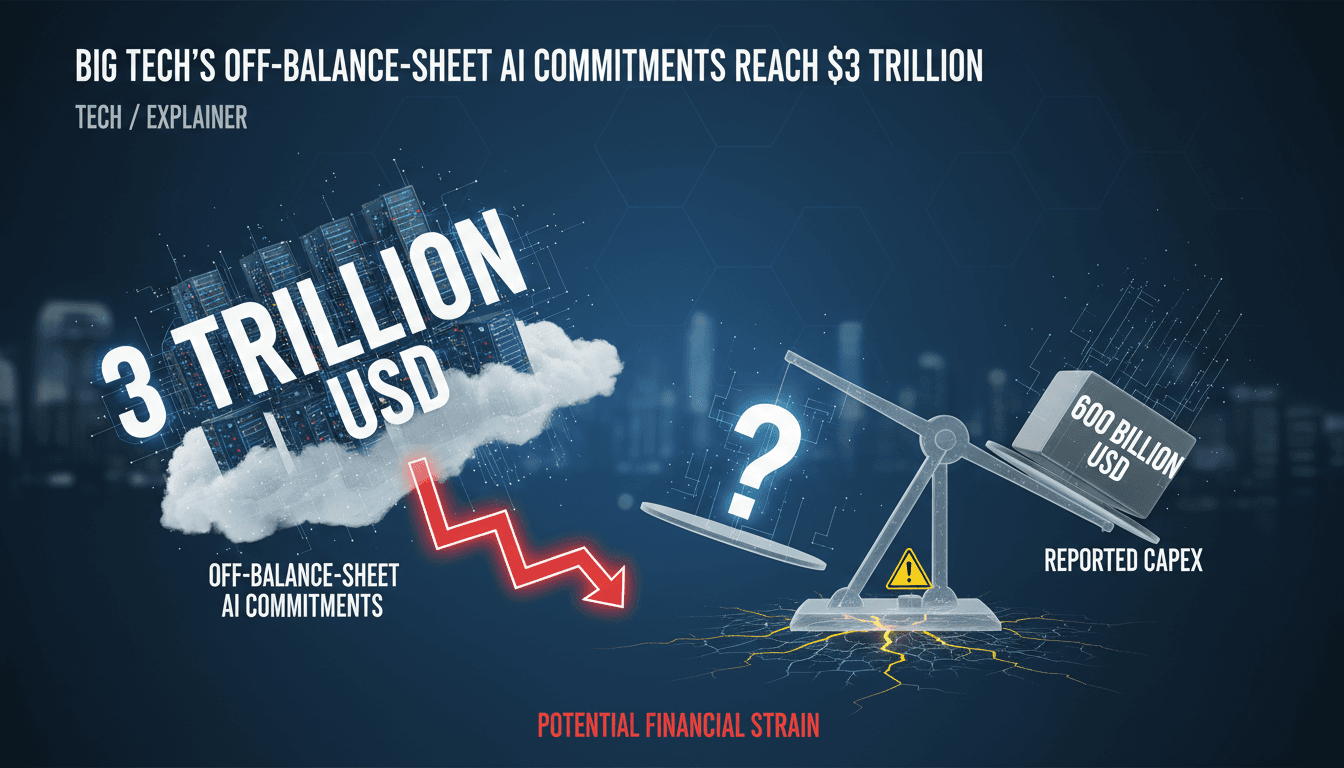
- These commitments far exceed the roughly $600 billion in traditional capital expenditures reported over the prior year.
- Concerns are rising about long-term demand sustainability and potential financial strain if revenue projections falter.
The context you actually need
- Rapid advancements in generative AI technologies since 2022-2023 have driven hyperscale tech firms to invest heavily in infrastructure.
- Accounting rules allow these future obligations to remain off corporate balance sheets until payments commence, complicating financial assessments.
- Geopolitical factors and supply chain constraints have further incentivized companies to secure capacity through advance commitments.
What's really happening
As of mid-2026, a Wall Street Journal analysis revealed that nine major tech firms, including Alphabet, Amazon, and Microsoft, have committed a staggering $3 trillion towards AI-related infrastructure. This figure encompasses $1.2 trillion in signed but uncommenced leases and $1.9 trillion in purchase commitments for hardware and energy. Notably, Alphabet's purchase obligations alone surged to $811 billion by June 30, 2026.
These commitments are significant because they remain off-balance-sheet under current accounting standards, meaning they do not immediately impact reported financial health. This creates a misleading picture of a company's financial stability, as traditional capital expenditures (capex) reported were only around $600 billion annually.
The implications of this off-balance-sheet accounting are profound. Analysts from Morgan Stanley and researchers at the European Central Bank have raised alarms about the increasing complexity in assessing leverage. They warn that the tech sector could face boom-bust cycles in asset prices, particularly if AI demand does not meet the lofty expectations set by these commitments.
Moreover, the rapid pace of investment in AI infrastructure is driven by the need to stay competitive in a market that is evolving quickly. Companies are racing to build data centers, acquire advanced chips, and secure energy resources to support their AI ambitions. However, this aggressive spending strategy raises questions about long-term sustainability. If the anticipated revenue from AI innovations does not materialize, these firms may find themselves in a precarious financial position, potentially requiring additional borrowing to meet their non-cancellable obligations.
The current market scrutiny and regulatory monitoring surrounding these commitments reflect a growing concern among investors and analysts. Some firms are already reporting negative free cash flow amid their spending, indicating that the financial strain is beginning to show.
Who feels it first (and how)
- Investors in tech stocks may experience volatility as market perceptions shift based on these commitments.
- Employees in the tech sector could face job security concerns if companies scale back on AI projects due to financial pressures.
- Consumers relying on AI-driven products and services may see changes in availability or pricing as companies reassess their investments.
What to watch next
- Regulatory scrutiny: Keep an eye on potential regulatory actions as governments may begin to investigate the financial implications of these off-balance-sheet commitments.
- Market corrections: Watch for signs of stock price corrections in major tech firms, which could indicate broader financial instability.
- AI demand trends: Monitor the actual demand for AI technologies, as underperformance could trigger a reevaluation of these massive commitments.
Big Tech's off-balance-sheet AI commitments total $3 trillion, significantly exceeding reported capex.
Increased market scrutiny and potential regulatory actions will emerge as concerns about financial stability grow.
The long-term sustainability of AI demand and its impact on these companies' financial health remains uncertain.
Frequently Asked Questions
- Why it matters?
- The staggering $3 trillion in off-balance-sheet AI commitments signals a pivotal shift in how tech giants are positioning themselves for future growth, raising concerns about financial stability.
- What happened (in 30 seconds)?
- Big Tech companies disclosed approximately $3 trillion in off-balance-sheet AI-related commitments as of mid-2026. These commitments far exceed the roughly $600 billion in traditional capital expenditures reported over the prior year. Concerns are rising about long-term demand sustainability and potential financial strain if revenue projections falter.
- What's really happening?
- As of mid-2026, a Wall Street Journal analysis revealed that nine major tech firms, including Alphabet, Amazon, and Microsoft, have committed a staggering $3 trillion towards AI-related infrastructure. This figure encompasses $1.2 trillion in signed but uncommenced leases and $1.9 trillion in purchase commitments for hardware and energy. Notably, Alphabet's purchase obligations alone surged to $811 billion by June 30, 2026. These commitments are significant because they remain off-balance-shee
- Who feels it first (and how)?
- Investors in tech stocks may experience volatility as market perceptions shift based on these commitments. Employees in the tech sector could face job security concerns if companies scale back on AI projects due to financial pressures. Consumers relying on AI-driven products and services may see changes in availability or pricing as companies reassess their investments.
- What to watch next?
- Regulatory scrutiny: Keep an eye on potential regulatory actions as governments may begin to investigate the financial implications of these off-balance-sheet commitments. Market corrections: Watch for signs of stock price corrections in major tech firms, which could indicate broader financial instability. AI demand trends: Monitor the actual demand for AI technologies, as underperformance could trigger a reevaluation of these massive commitments.
Regional and international reporting focused on Middle Eastern politics, diplomacy, and economics.
"Asharq Al-Awsat is a Saudi-owned international newspaper reflecting mainstream Gulf political perspectives."
— A47 Editor
Big Tech’s AI Bill $3 Trillion Bigger Than It Looks
Big Tech's recent AI investment, estimated at $3 trillion, has raised eyebrows regarding its actual impact and effectiveness in the market. This substantial financial commitment reflects the industry's ongoing push to dominate the artificial intellig...
Curated tech headlines including AI stories.
"Influential aggregator surfacing the day’s top tech/AI links."
— A47 Editor
Analysis: nine top tech companies including Alphabet and Meta had ~$3T of AI-related off-balance-sheet commitments, far exceeding their $600B in reported capex (Wall Street Journal)
Nine leading tech companies, including Alphabet and Meta, have reported approximately $3 trillion in AI-related off-balance-sheet commitments, significantly surpassing their $600 billion in reported capital expenditures. This discrepancy highlights t...
Pan-Arab news coverage spanning politics, business, sports, and regional affairs.
"Asharq Al-Awsat reflects a broad Arab editorial perspective with strong attention to regional geopolitics."
— A47 Editor
3 تريليونات دولار... فاتورة الذكاء الاصطناعي الخفية
Major technology companies, referred to as 'Big Tech', are revealing their substantial investments in artificial intelligence infrastructure, amounting to billions of dollars every three months. This trend highlights the growing financial commitment ...
Tech business coverage, major deals, product launches, and Silicon Valley trends.
"WSJ’s tech section offers authoritative reporting on the intersection of technology and business, including exclusive industry analysis."
— A47 Editor
Why Big Tech’s AI Spending Is $3 Trillion Higher Than It Seems
Big Tech's reported AI spending is significantly understated, with commitments for data-center leases and chips amounting to $3 trillion that are not reflected on balance sheets. This discrepancy highlights the hidden financial burdens associated wit...