
Astronomers Detect Fastest Star S301, Enabling Future Measurement of Black Hole Spin
Why it matters
Understanding the spin of Sagittarius A* could lead to new insights into the fundamental laws of physics and the behavior of matter under extreme conditions.
What happened (in 30 seconds)
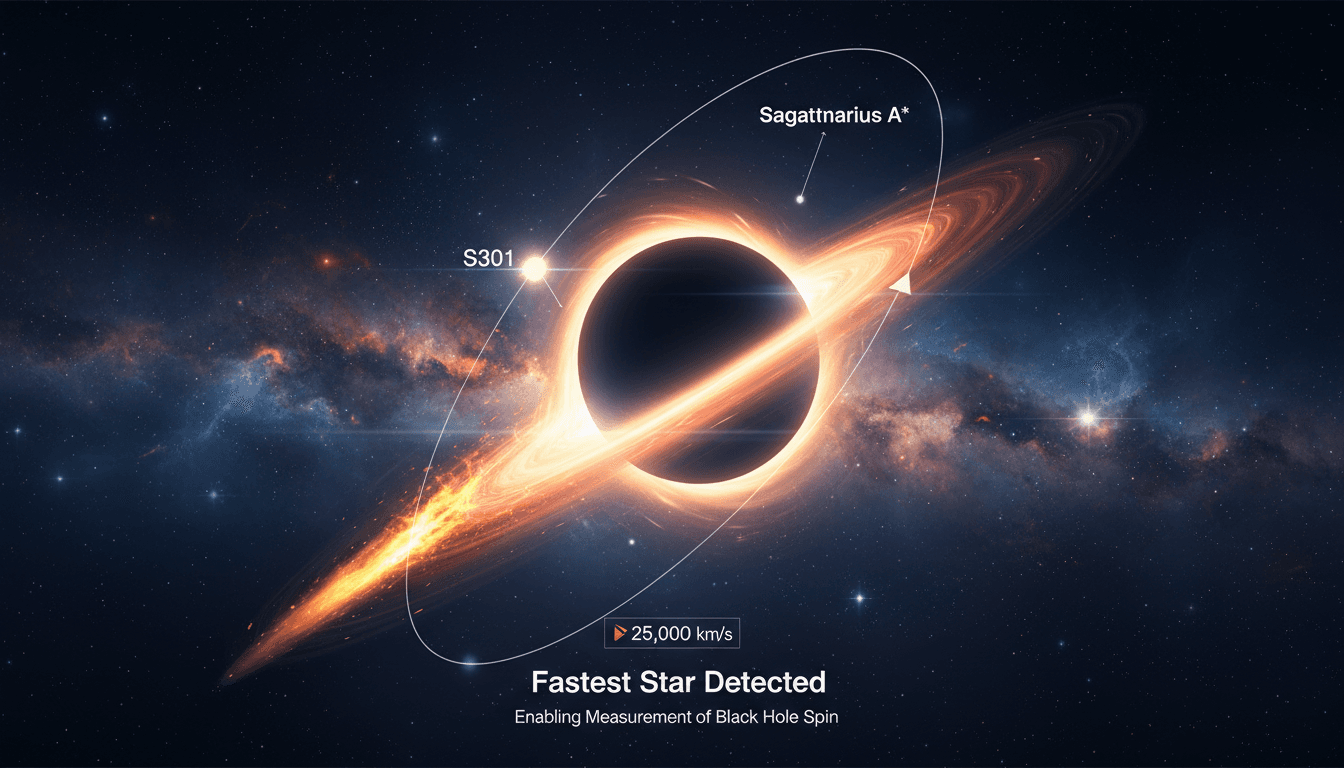
- Astronomers detected star S301, the fastest-known star in the Milky Way, orbiting Sagittarius A* at speeds up to 25,000 km/s.
- The discovery was made using the GRAVITY instrument on the Very Large Telescope Interferometer in Chile, revealing an elongated 8.7-year orbit.
- Future measurements of Sgr A*'s spin are anticipated within the next decade, enhancing our understanding of black hole physics and general relativity.
The context you actually need
- S301's orbit is highly elliptical, bringing it extremely close to Sagittarius A*, allowing for precise measurements of relativistic effects.
- Previous studies focused on star S2, which established the mass of Sgr A* but lacked the necessary data to measure its spin.
- The discovery builds on decades of research into S-stars and hypervelocity stars, enhancing our understanding of the dynamics at the Milky Way's center.
What's really happening
The detection of star S301 marks a significant advancement in astrophysical research, particularly in the study of supermassive black holes. S301 orbits Sagittarius A*—a black hole with a mass equivalent to four million suns—at an astonishing speed of 25,000 km/s, which is about 8% of the speed of light. This speed is not just a remarkable feat; it is crucial for the upcoming measurements of the black hole's spin.
The star's orbit is highly elongated, taking approximately 8.7 years to complete a full revolution around Sagittarius A*. Its closest approach, akin to the distance between Saturn and the Sun, allows astronomers to observe frame-dragging effects predicted by general relativity. These effects arise from the rotation of the black hole, which influences the space-time around it, causing the orbit of S301 to deviate from what would be expected if the black hole were not spinning.
The implications of measuring the spin of Sagittarius A* are profound. It could validate or challenge existing theories of general relativity and provide insights into the nature of black holes. The research team, including prominent institutions like the Max Planck Institute for Extraterrestrial Physics and the European Southern Observatory, is now focused on ongoing orbital monitoring of S301. They anticipate that the next close approach in 2031 will yield critical data for measuring the black hole's spin.
Moreover, the discovery of S301 is linked to the broader context of hypervelocity stars—stars that are ejected from their parent systems due to gravitational interactions. S301 likely originated from a binary star system that was disrupted by the tidal forces of Sagittarius A*, with one star being ejected at high velocity while S301 was captured into its current orbit. This understanding not only enriches our knowledge of stellar dynamics but also enhances our grasp of the processes occurring in the galactic center.
As researchers continue to monitor S301, they expect to observe measurable deviations in its orbit over the next decade, which will provide the necessary data to determine the spin of Sagittarius A*. This could lead to new tests of general relativity and deepen our understanding of the universe's most enigmatic objects.
Who feels it first (and how)
- Astrophysicists and researchers in the field of black hole physics will directly benefit from the findings, as they will have new data to analyze.
- Academic institutions involved in astrophysics will see increased interest and funding opportunities for related research.
- Technology developers in fields like imaging and data analysis may leverage advancements from this research to improve observational tools.
What to watch next
- Upcoming close approaches of S301 in 2031 will be critical for gathering data on the black hole's spin, which could lead to groundbreaking discoveries.
- Publications in scientific journals such as Nature will provide insights into the ongoing research and its implications for general relativity.
- Technological advancements in observational instruments may emerge as a result of this research, influencing various scientific fields.
S301 is the fastest-known star in the Milky Way, orbiting Sagittarius A* at extreme speeds.
The measurement of Sagittarius A*'s spin will occur within the next decade, enhancing our understanding of black holes.
The broader implications of these findings on existing theories of physics remain to be fully understood.
Frequently Asked Questions
- Why it matters?
- Understanding the spin of Sagittarius A* could lead to new insights into the fundamental laws of physics and the behavior of matter under extreme conditions.
- What happened (in 30 seconds)?
- Astronomers detected star S301, the fastest-known star in the Milky Way, orbiting Sagittarius A* at speeds up to 25,000 km/s. The discovery was made using the GRAVITY instrument on the Very Large Telescope Interferometer in Chile, revealing an elongated 8.7-year orbit. Future measurements of Sgr A*'s spin are anticipated within the next decade, enhancing our understanding of black hole physics and general relativity.
- What's really happening?
- The detection of star S301 marks a significant advancement in astrophysical research, particularly in the study of supermassive black holes. S301 orbits Sagittarius A*—a black hole with a mass equivalent to four million suns—at an astonishing speed of 25,000 km/s, which is about 8% of the speed of light. This speed is not just a remarkable feat; it is crucial for the upcoming measurements of the black hole's spin. The star's orbit is highly elongated, taking approximately 8.7 years to complete
- Who feels it first (and how)?
- Astrophysicists and researchers in the field of black hole physics will directly benefit from the findings, as they will have new data to analyze. Academic institutions involved in astrophysics will see increased interest and funding opportunities for related research. Technology developers in fields like imaging and data analysis may leverage advancements from this research to improve observational tools.
- What to watch next?
- Upcoming close approaches of S301 in 2031 will be critical for gathering data on the black hole's spin, which could lead to groundbreaking discoveries. Publications in scientific journals such as Nature will provide insights into the ongoing research and its implications for general relativity. Technological advancements in observational instruments may emerge as a result of this research, influencing various scientific fields.
Emerging technologies, digital transformation, IT, and cultural impact of tech.
"WIRED covers the intersection of technology, culture, and politics with a progressive, forward-looking editorial stance."
— A47 Editor
The Galaxy’s Fastest Star Could Reveal the Secrets of a Supermassive Black Hole
The star S301 is observed passing extremely close to the supermassive black hole Sagittarius A*, with its orbit potentially revealing insights into how the black hole's rotation affects the surrounding spacetime. This close proximity allows for uniqu...
Space science news, astronomy updates, and spaceflight developments.
"Space.com delivers space science news, astronomy updates, and spaceflight developments with engaging coverage."
— A47 Editor
Scientists just found the fastest known star in the Milky Way. It zooms around our black hole at 15,500 miles per second
Astronomers have identified the fastest known star in the Milky Way, a faint object named S301, which orbits the supermassive black hole Sagittarius A* at an astonishing speed of 15,500 miles per second. This discovery marks a significant milestone i...
Science and technology stories including AI.
"Longstanding science magazine with thoughtful AI coverage."
— A47 Editor
The Milky Way’s fastest star could expose our black hole’s spin
The star S301 is making a close approach to the Milky Way's supermassive black hole, Sagittarius A*, which could allow astronomers to measure the black hole's spin for the first time. This unprecedented observation is expected to provide critical ins...
Scientific research, technology, environment, and society.
"Scientific American is one of the oldest and most authoritative science magazines, known for deep dives into science, technology, and society."
— A47 Editor
The Milky Way’s fastest star could expose our black hole’s spin
The star S301 is making a close approach to the Milky Way's supermassive black hole, Sagittarius A*, which could allow astronomers to measure the black hole's spin for the first time. This unprecedented observation is expected to provide critical ins...
News in science and technology, with a focus on consumer and innovation stories.
"Popular Science simplifies complex scientific topics for general audiences and celebrates innovation."
— A47 Editor
A star spinning at 15,000 miles per second tests Einstein theory of relativity
A star known as S301, located near the Milky Way's supermassive black hole, has been observed spinning at an astonishing speed of 15,000 miles per second, providing a unique opportunity to test Einstein's theory of relativity. This discovery highligh...