
Astronomers Confirm Discovery of S301, Fastest Star Orbiting Sagittarius A*
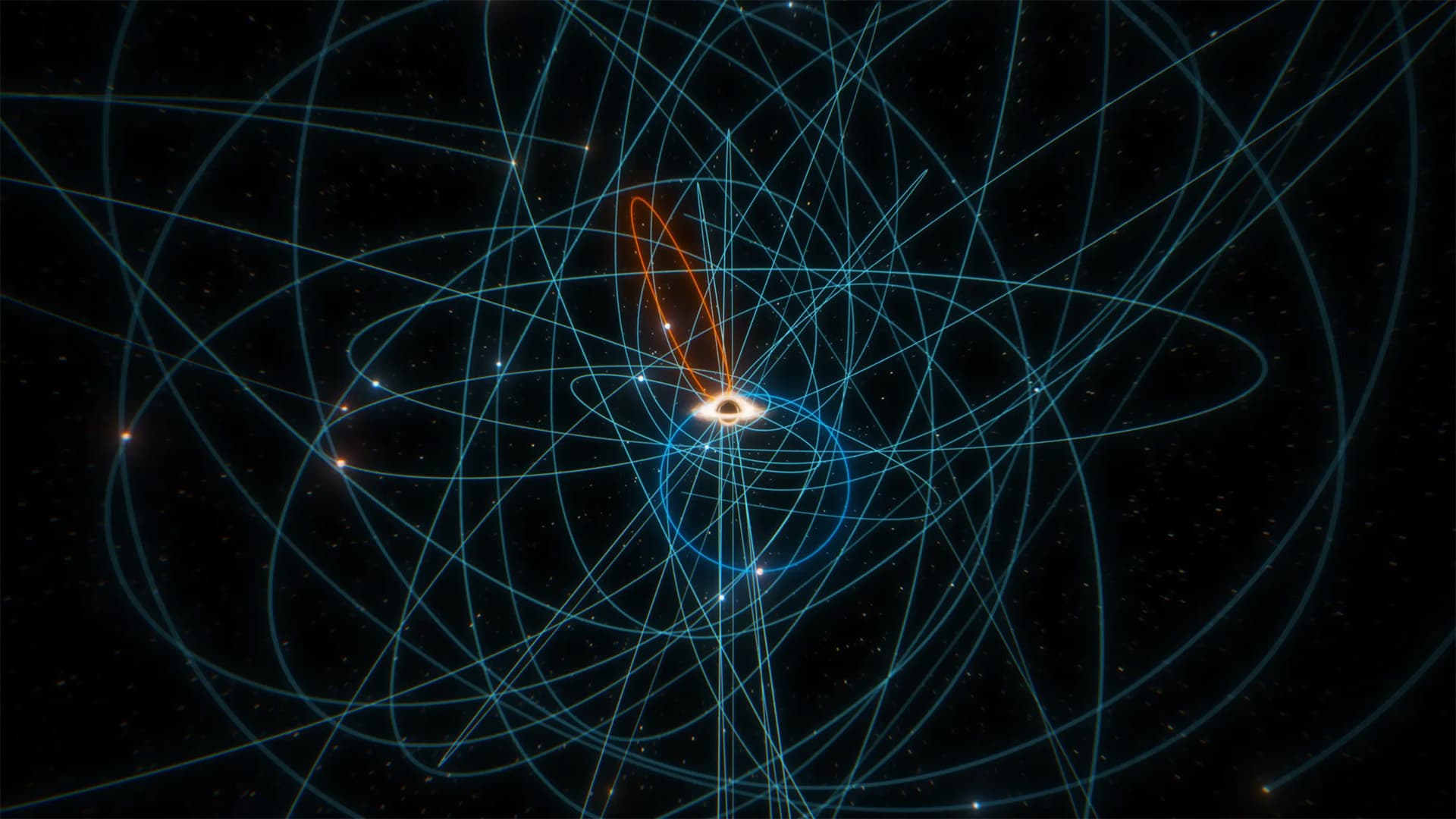
Why it matters
The discovery of S301 enhances our ability to measure black hole properties, which could lead to advancements in astrophysics and related technologies.
What happened (in 30 seconds)
- Astronomers announced the discovery of star S301, orbiting Sagittarius A* with an 8.7-year period.
- S301 reaches speeds of approximately 25,000 km/s, making it the fastest known star in this orbit.
- This finding enables new measurements of the black hole's spin and tests of general relativity in extreme conditions.
The context you actually need
- Prior observations of S-stars like S2 and S55 established the mass and distance of Sagittarius A*, confirming general relativity effects.
- The GRAVITY+ Collaboration utilized advanced observational techniques at ESO's VLTI to detect S301, marking a significant leap in stellar orbit studies.
- S301's extreme proximity (12 AU) and high velocity allow for unprecedented sensitivity to the effects of the black hole's rotation, known as frame-dragging.
What's really happening
The discovery of S301 is a pivotal moment in astrophysics, driven by decades of technological advancements in observational astronomy. The GRAVITY+ Collaboration, leveraging the capabilities of the European Southern Observatory's Very Large Telescope Interferometer (VLTI), identified S301 as a faint star with a magnitude of 19.3. This star's orbital characteristics were meticulously modeled, revealing an 8.7-year period and an eccentricity of approximately 0.98, which indicates a highly elongated orbit.
The significance of S301 lies not just in its speed and proximity but also in its potential to provide insights into the nature of Sagittarius A*, the supermassive black hole at the center of our galaxy. With a mass of 4.3 million solar masses, Sagittarius A* has long been a subject of fascination for scientists. The ability to measure its spin directly through the behavior of S301 opens new avenues for testing general relativity in extreme gravitational fields. This is crucial because black holes challenge our understanding of physics, particularly in reconciling quantum mechanics with general relativity.
The implications extend beyond theoretical physics. Understanding black holes can influence various fields, including technology development, as insights gained from astrophysics often lead to innovations in materials science, computing, and even telecommunications. The ongoing monitoring of S301 and similar stars will likely yield data that could refine our models of black hole behavior and their role in galaxy formation and evolution.
As the scientific community continues to analyze S301's orbit, the next decade will be critical for confirming predictions about black hole spin and testing the limits of our current understanding of physics. This research could lead to breakthroughs that resonate far beyond the realm of astronomy, potentially impacting technologies that rely on gravitational physics.
Who feels it first (and how)
- Astrophysicists: Directly involved in research and analysis of black hole properties.
- Technology developers: Innovations in materials and computing may arise from astrophysical research.
- Educational institutions: Increased interest in astrophysics could lead to more funding and research opportunities.
What to watch next
- Ongoing monitoring of S301: Continued observations will provide data crucial for measuring black hole spin, impacting theoretical physics.
- Future ELT spectroscopy: The European Extremely Large Telescope's capabilities may enhance our understanding of black holes and their environments.
- Public interest in astrophysics: Increased media coverage and educational outreach could lead to a surge in STEM engagement.
S301 has the shortest confirmed orbital period around Sagittarius A* at 8.7 years.
Direct measurements of black hole spin will be possible within the next decade.
The broader technological impacts of this discovery on industries outside of astrophysics.
Frequently Asked Questions
- Why it matters?
- The discovery of S301 enhances our ability to measure black hole properties, which could lead to advancements in astrophysics and related technologies.
- What happened (in 30 seconds)?
- Astronomers announced the discovery of star S301, orbiting Sagittarius A* with an 8.7-year period. S301 reaches speeds of approximately 25,000 km/s, making it the fastest known star in this orbit. This finding enables new measurements of the black hole's spin and tests of general relativity in extreme conditions.
- What's really happening?
- The discovery of S301 is a pivotal moment in astrophysics, driven by decades of technological advancements in observational astronomy. The GRAVITY+ Collaboration, leveraging the capabilities of the European Southern Observatory's Very Large Telescope Interferometer (VLTI), identified S301 as a faint star with a magnitude of 19.3. This star's orbital characteristics were meticulously modeled, revealing an 8.7-year period and an eccentricity of approximately 0.98, which indicates a highly elongate
- Who feels it first (and how)?
- Astrophysicists: Directly involved in research and analysis of black hole properties. Technology developers: Innovations in materials and computing may arise from astrophysical research. Educational institutions: Increased interest in astrophysics could lead to more funding and research opportunities.
- What to watch next?
- Ongoing monitoring of S301: Continued observations will provide data crucial for measuring black hole spin, impacting theoretical physics. Future ELT spectroscopy: The European Extremely Large Telescope's capabilities may enhance our understanding of black holes and their environments. Public interest in astrophysics: Increased media coverage and educational outreach could lead to a surge in STEM engagement.
Latest tech news, product reviews, and analysis for consumers and professionals.
"CNET delivers accessible and detailed technology reporting, including trusted product reviews and how-to guides."
— A47 Editor
This Star Whips Around the Milky Way’s Black Hole Faster and Closer Than Any Other Known Star
A newly discovered star is orbiting the Milky Way's supermassive black hole at an unprecedented speed of 15,500 miles per second, making it the fastest known star in the galaxy. This remarkable finding highlights the star's proximity to the black hol...
Emerging technologies, digital transformation, IT, and cultural impact of tech.
"WIRED covers the intersection of technology, culture, and politics with a progressive, forward-looking editorial stance."
— A47 Editor
The Galaxy’s Fastest Star Could Reveal the Secrets of a Supermassive Black Hole
The star S301 is observed passing extremely close to the supermassive black hole Sagittarius A*, with its orbit potentially revealing insights into how the black hole's rotation affects the surrounding spacetime. This close proximity allows for uniqu...
Pan-Arab news coverage spanning politics, business, sports, and regional affairs.
"Asharq Al-Awsat reflects a broad Arab editorial perspective with strong attention to regional geopolitics."
— A47 Editor
علماء يكتشفون أسرع نجم في مجرّة درب التبانة
A team of astronomers has discovered the fastest star in the Milky Way galaxy, which orbits the supermassive black hole at the center of the galaxy at an astonishing speed of 25,000 kilometers per second. This remarkable finding sheds light on the dy...
Regional and international reporting focused on Middle Eastern politics, diplomacy, and economics.
"Asharq Al-Awsat is a Saudi-owned international newspaper reflecting mainstream Gulf political perspectives."
— A47 Editor
Fastest-known Star Zooms Under Milky Way Black Hole's Influence
The fastest-known star has been observed moving under the influence of the Milky Way's black hole, providing significant insights into the dynamics of our galaxy. This discovery highlights the complex gravitational interactions that govern stellar mo...