
NASA study reveals potential survival of Earth microbes at lunar south pole
Why it matters
This study highlights the risks of forward contamination during crewed lunar missions, which could affect scientific research and planetary protection protocols.
What happened (in 30 seconds)
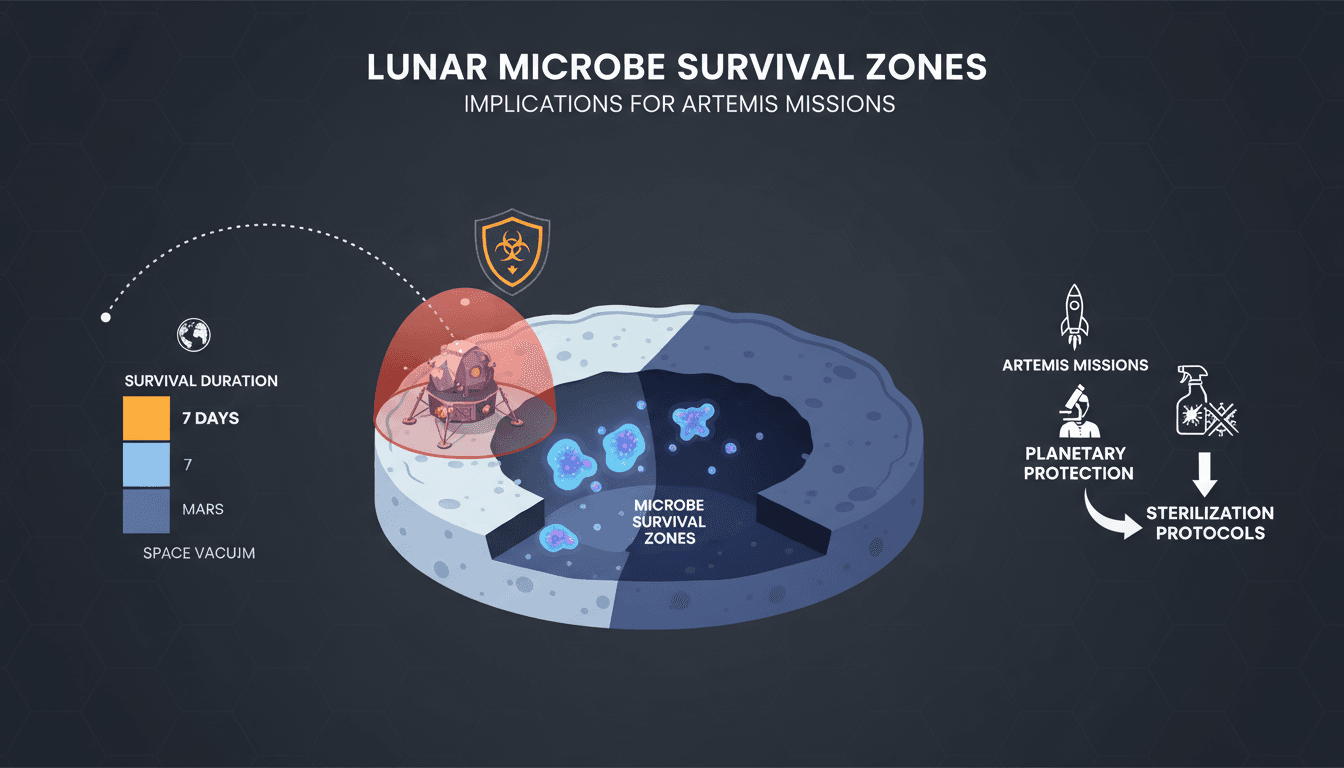
- NASA scientists published a study revealing that certain Earth microbes can survive for up to seven days in shadowed areas of the Moon's south pole.
- The research utilized advanced modeling techniques to identify potential survival zones near Artemis landing sites, addressing contamination risks.
- The findings emphasize the need for stringent planetary protection measures as human presence on the Moon becomes a reality.
The context you actually need
- NASA's Artemis program aims for sustained human operations at the lunar south pole, where water ice may be present in permanently shadowed regions.
- Previous assumptions deemed the lunar surface inhospitable to life due to extreme conditions, but this study challenges that notion by identifying survivable niches.
- Planetary protection is increasingly critical as space agencies prepare for long-term lunar missions, necessitating a reevaluation of spacecraft sterilization protocols.
What's really happening
NASA's recent study, published on August 19, 2026, in *Science Advances*, reveals that select Earth microbes can endure harsh lunar conditions for up to seven days. This research is pivotal as it identifies specific shadowed regions at the Moon's south pole where these microbes can survive, particularly in craters and micro-permanently shadowed regions (PSRs). The study focused on five common spacecraft-associated organisms, including *Aspergillus niger*, which demonstrated the highest resilience.
The implications of this research extend beyond mere survival; they raise significant concerns about forward contamination during crewed lunar missions. As humanity prepares to establish a permanent presence on the Moon, the risk of introducing Earth microbes into the lunar environment could compromise scientific integrity and the search for extraterrestrial life. The study's findings suggest that microbes would enter a state of cryptobiosis rather than actively grow or replicate, which complicates the understanding of how life might exist beyond Earth.
NASA's Artemis program is designed to facilitate sustained human operations on the Moon, with the lunar south pole being a focal point due to its potential water ice reserves. The study's results necessitate a reassessment of current planetary protection protocols, as the presence of resilient microbes could lead to unintended consequences for lunar exploration and research. The scientific community is now tasked with enhancing tracking mechanisms for microbial transfer to ensure the integrity of lunar samples and the preservation of the Moon's pristine environment.
As the Artemis missions approach, the findings from this study will likely influence spacecraft sterilization procedures and contamination mitigation strategies. The need for rigorous planetary protection measures is underscored by the potential for microbial survival, which could alter the trajectory of lunar exploration and our understanding of life's resilience in extreme environments.
Who feels it first (and how)
- Space agencies: NASA and international partners will need to revise contamination protocols.
- Researchers: Scientists studying lunar samples will face challenges in ensuring sample integrity.
- Private space companies: Organizations involved in lunar missions may need to adapt their technologies and practices to comply with new standards.
What to watch next
- Revisions to planetary protection protocols: Watch for updates from NASA and other space agencies regarding new guidelines for lunar missions.
- Scientific discussions: Monitor ongoing conversations in the scientific community about microbial transfer and its implications for extraterrestrial research.
- Technological advancements: Keep an eye on innovations in spacecraft sterilization techniques as the Artemis missions approach.
Certain Earth microbes can survive in shadowed regions of the Moon for up to seven days.
NASA will implement revised planetary protection measures ahead of Artemis missions.
The long-term effects of microbial contamination on lunar research and exploration remain to be fully understood.
Frequently Asked Questions
- Why it matters?
- This study highlights the risks of forward contamination during crewed lunar missions, which could affect scientific research and planetary protection protocols.
- What happened (in 30 seconds)?
- NASA scientists published a study revealing that certain Earth microbes can survive for up to seven days in shadowed areas of the Moon's south pole. The research utilized advanced modeling techniques to identify potential survival zones near Artemis landing sites, addressing contamination risks. The findings emphasize the need for stringent planetary protection measures as human presence on the Moon becomes a reality.
- What's really happening?
- NASA's recent study, published on August 19, 2026, in *Science Advances*, reveals that select Earth microbes can endure harsh lunar conditions for up to seven days. This research is pivotal as it identifies specific shadowed regions at the Moon's south pole where these microbes can survive, particularly in craters and micro-permanently shadowed regions (PSRs). The study focused on five common spacecraft-associated organisms, including *Aspergillus niger*, which demonstrated the highest resilienc
- Who feels it first (and how)?
- Space agencies: NASA and international partners will need to revise contamination protocols. Researchers: Scientists studying lunar samples will face challenges in ensuring sample integrity. Private space companies: Organizations involved in lunar missions may need to adapt their technologies and practices to comply with new standards.
- What to watch next?
- Revisions to planetary protection protocols: Watch for updates from NASA and other space agencies regarding new guidelines for lunar missions. Scientific discussions: Monitor ongoing conversations in the scientific community about microbial transfer and its implications for extraterrestrial research. Technological advancements: Keep an eye on innovations in spacecraft sterilization techniques as the Artemis missions approach.
Space science news, astronomy updates, and spaceflight developments.
"Space.com delivers space science news, astronomy updates, and spaceflight developments with engaging coverage."
— A47 Editor
Microbes from Earth may survive on the moon, scientists find
Recent research indicates that microbes from Earth may have the potential to survive on the moon, suggesting that even small disturbances like a bootprint or rover's tread could create habitable areas. This finding raises important questions about th...
Tech news, hardware, and AI tools coverage.
"PC/tech site increasingly covering AI hardware and apps."
— A47 Editor
NASA study finds Earth fungi could survive up to 7 days near lunar south pole
A recent NASA study published in Science Advances indicates that certain Earth fungi could survive for up to seven days in the extreme conditions near the lunar south pole, particularly in areas like Nobile Rim and Connecting Ridge. Researchers utili...
Science and technology stories including AI.
"Longstanding science magazine with thoughtful AI coverage."
— A47 Editor
Some microbes could survive on the moon—that’s a big problem for NASA
A recent study has revealed that five common microorganisms from Earth could potentially survive in the harsh conditions of the lunar south pole, posing a significant contamination risk for NASA's future human missions to the Moon.
Scientific research, technology, environment, and society.
"Scientific American is one of the oldest and most authoritative science magazines, known for deep dives into science, technology, and society."
— A47 Editor
Some microbes could survive on the moon—that’s a big problem for NASA
A recent study has revealed that five common microorganisms from Earth could potentially survive in the harsh conditions of the lunar south pole, posing a significant contamination risk for NASA's future human missions to the Moon.