
IBM Achieves Key Milestone in Modular Cryogenic Systems for Quantum Computing
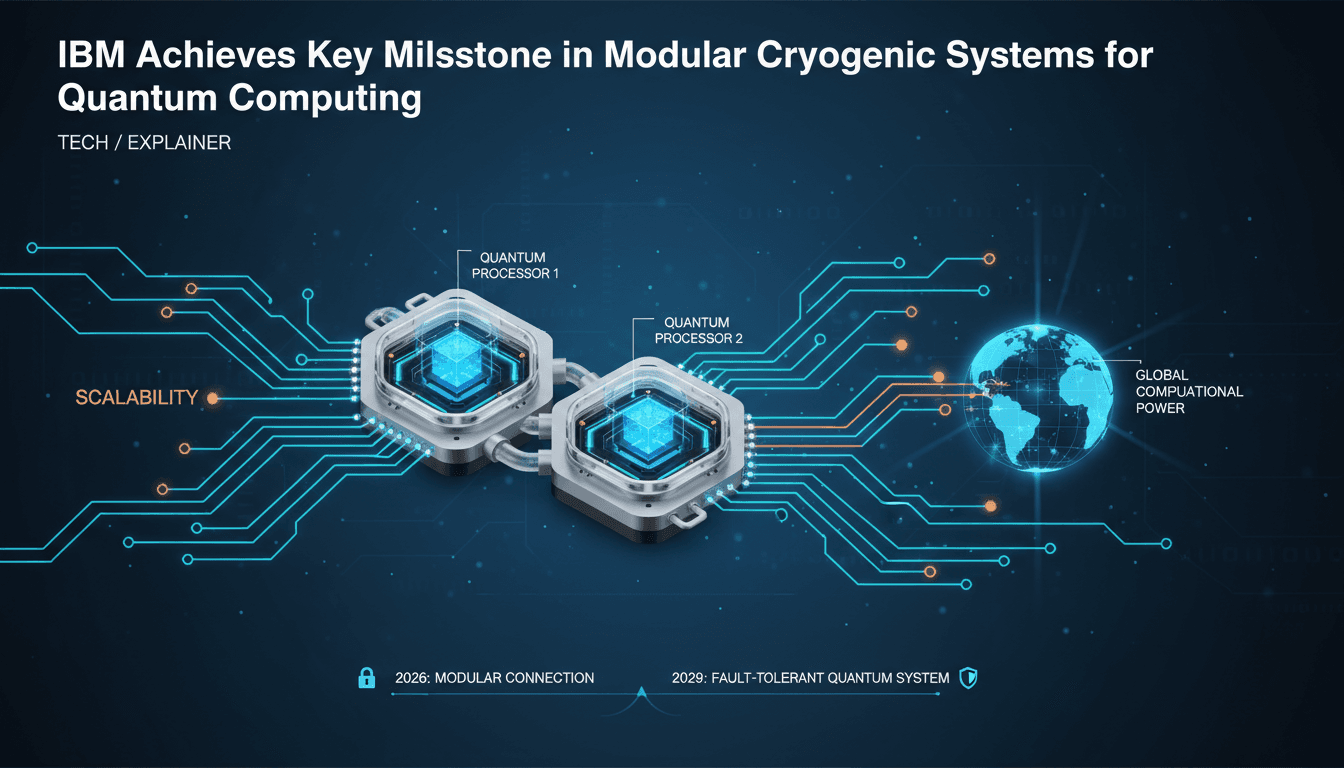
Why it matters
This milestone represents a significant step toward overcoming the limitations of current quantum computing systems, potentially transforming sectors like finance, healthcare, and logistics.
What happened (in 30 seconds)
- On August 19, 2026, IBM announced the successful connection of two modular cryogenic systems at its New York facilities.
- The systems achieved temperatures below 15 millikelvin, enabling a shared ultra-cold environment for quantum chips.
- This development supports IBM's roadmap to deliver a fault-tolerant quantum computing system by 2029.
The context you actually need
- Cryogenic cooling has been a bottleneck in scaling quantum computing, limiting the number of qubits that can be effectively managed.
- IBM's modular approach allows for more efficient wiring and interconnectivity between chips, addressing previous infrastructure challenges.
- The company aims to install Nighthawk processors later in 2026, targeting 1,000 programmable qubits by 2027.
What's really happening
IBM's recent achievement in connecting two modular cryogenic systems marks a pivotal moment in the evolution of quantum computing. The design of these systems, each measuring over 8 feet tall and wide, allows for a significant increase in wiring space—up to 12 times more than previous models. This expanded capacity is crucial for the interconnectivity of quantum chips, which must operate in a shared ultra-cold environment to maintain coherence and minimize error rates.
Achieving temperatures below 15 millikelvin—more than 180 times colder than deep space—enables the quantum processors to function optimally. This cooling capability is essential for the operation of qubits, the fundamental units of quantum information. The successful cooling of these modules in under five days demonstrates IBM's engineering prowess and commitment to overcoming the technical challenges that have historically hindered quantum scaling.
The modular architecture is designed to facilitate the integration of hundreds of quantum chips, paving the way for larger, multi-chip systems capable of tackling complex problems that current single-processor systems cannot solve. IBM's roadmap includes the ambitious goal of delivering the IBM Quantum Starling system by 2029, which promises fault tolerance—a critical feature for practical quantum computing applications.
This milestone is not just a technical achievement; it reflects a broader trend in the quantum computing landscape. As companies like IBM push the boundaries of what is possible, the implications for various industries are profound. Enhanced computational power could lead to breakthroughs in drug discovery, optimization problems in logistics, and advanced financial modeling, among other applications.
Moreover, IBM's acquisition of HRL Laboratories for expertise in silicon-spin qubits further underscores its commitment to advancing quantum technology. This strategic move is likely to accelerate the development of more efficient quantum processors, enhancing the overall scalability of quantum systems.
Who feels it first (and how)
- Tech companies: Those developing quantum algorithms and applications will benefit from increased computational power.
- Financial institutions: Enhanced modeling capabilities could lead to better risk assessment and investment strategies.
- Healthcare providers: Improved drug discovery processes may lead to faster development of treatments.
- Logistics firms: Optimization of supply chains and routing problems could significantly reduce costs.
What to watch next
- Nighthawk processor installation: Scheduled for later in 2026, this will be a critical test of the modular systems' capabilities.
- Progress toward 1,000 programmable qubits: Achieving this target by 2027 will indicate the pace of quantum advancements.
- Competitor developments: Watch for responses from other tech companies in the quantum space, as they may accelerate their own research and development efforts.
IBM has successfully connected and cooled two modular cryogenic systems.
The installation of Nighthawk processors will proceed as planned, advancing testing capabilities.
The immediate market impact and competitive responses from other quantum computing firms remain to be seen.
Frequently Asked Questions
- Why it matters?
- This milestone represents a significant step toward overcoming the limitations of current quantum computing systems, potentially transforming sectors like finance, healthcare, and logistics.
- What happened (in 30 seconds)?
- On August 19, 2026, IBM announced the successful connection of two modular cryogenic systems at its New York facilities. The systems achieved temperatures below 15 millikelvin, enabling a shared ultra-cold environment for quantum chips. This development supports IBM's roadmap to deliver a fault-tolerant quantum computing system by 2029.
- What's really happening?
- IBM's recent achievement in connecting two modular cryogenic systems marks a pivotal moment in the evolution of quantum computing. The design of these systems, each measuring over 8 feet tall and wide, allows for a significant increase in wiring space—up to 12 times more than previous models. This expanded capacity is crucial for the interconnectivity of quantum chips, which must operate in a shared ultra-cold environment to maintain coherence and minimize error rates. Achieving temperatures be
- Who feels it first (and how)?
- Tech companies: Those developing quantum algorithms and applications will benefit from increased computational power. Financial institutions: Enhanced modeling capabilities could lead to better risk assessment and investment strategies. Healthcare providers: Improved drug discovery processes may lead to faster development of treatments. Logistics firms: Optimization of supply chains and routing problems could significantly reduce costs.
- What to watch next?
- Nighthawk processor installation: Scheduled for later in 2026, this will be a critical test of the modular systems' capabilities. Progress toward 1,000 programmable qubits: Achieving this target by 2027 will indicate the pace of quantum advancements. Competitor developments: Watch for responses from other tech companies in the quantum space, as they may accelerate their own research and development efforts.
Policy and strategy for digital leaders, including AI.
"Analyzes AI in the context of enterprise strategy."
— A47 Editor
IBM links first modular cryogenic systems for quantum scaling
IBM has successfully connected and cooled two cryogenic modules into a single environment, marking a significant step in its efforts to develop fault-tolerant quantum computers. This modular cryogenic architecture aims to address critical challenges ...
Scientific discoveries, health, technology, and natural phenomena.
"Live Science reports on scientific discoveries, health, technology, and natural phenomena with a popular science tone."
— A47 Editor
IBM's new 'quantum fridges' are nearly 200 times colder than deep space and could pave the way for fault-tolerant quantum computing
IBM has unveiled a new modular cryogenic system, termed 'quantum fridges,' which operates at temperatures nearly 200 times colder than deep space. This innovation aims to link quantum chips and address significant infrastructure challenges, potential...
Electronics industry news including AI chips.
"Covers semiconductors and embedded AI trends."
— A47 Editor
IBM Makes Quantum Cryogenics Modular, but Scaling Problems Remain
IBM has introduced a modular cryogenic architecture aimed at addressing key challenges in fault-tolerant quantum computing, including issues related to wiring, control, interconnectivity, and reliability. This innovation represents a significant step...