
OpenAI Unveils Performance Benchmarks for Jalapeño AI Accelerator ASIC
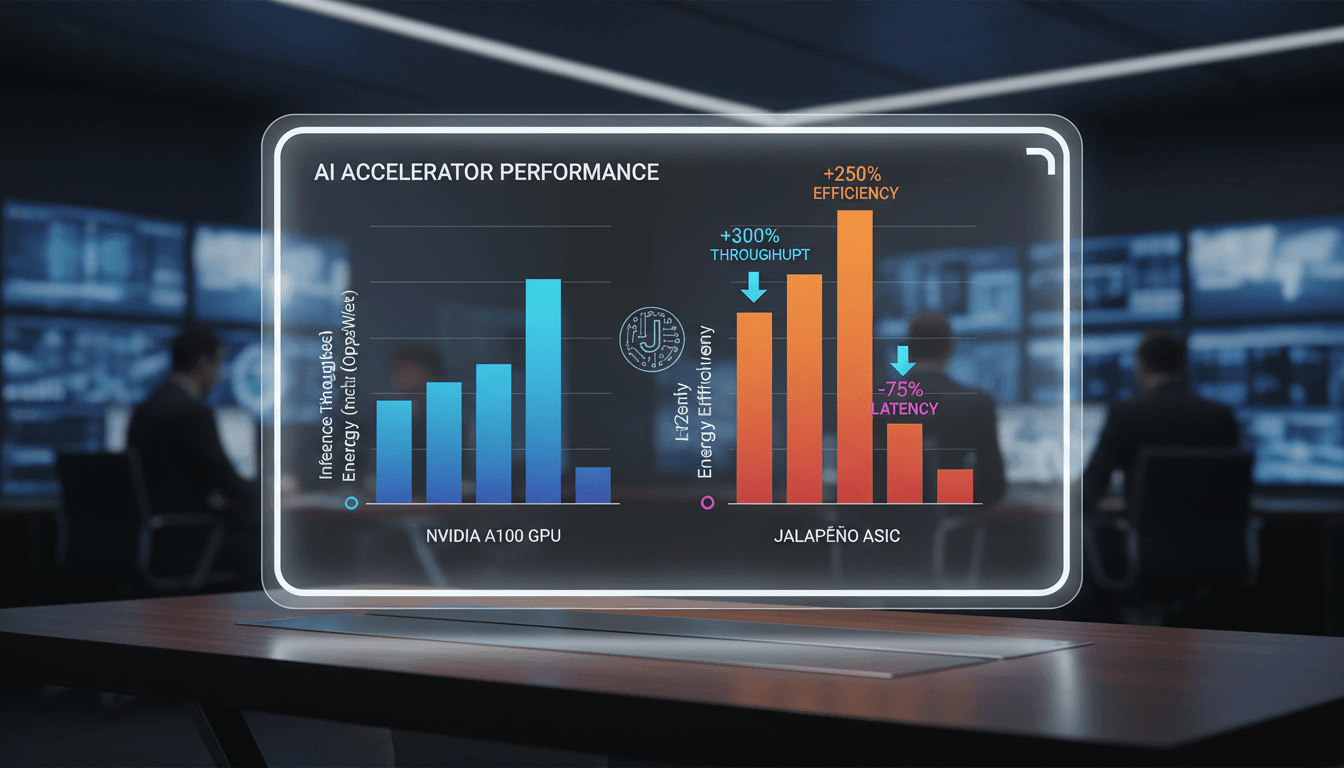
Here's what it means for you.
If you're in tech or AI, the efficiency gains from Jalapeño could reshape your infrastructure decisions.
Why it matters
The Jalapeño ASIC's performance benchmarks signal a shift in AI hardware strategy, potentially reducing reliance on traditional GPUs.
What happened (in 30 seconds)
- OpenAI disclosed the first performance benchmarks for its Jalapeño AI accelerator ASIC on August 27, 2026.
- Jalapeño demonstrated 1.5–1.9× higher AI work per watt and 1.7–3.6× lower latency compared to Nvidia systems.
- Deployment is planned for late 2026, with a focus on large language model inference.
The context you actually need
- OpenAI's Jalapeño was developed to address the surging demand for large language model (LLM) inference compute, reducing reliance on merchant GPUs.
- The architecture emphasizes minimizing data movement through tight integration of compute, memory, and networking, which is crucial for efficiency.
- Development was rapid, completed in nine months using AI-assisted design tools, reflecting industry pressures for optimized power efficiency and latency.
What's really happening
OpenAI's Jalapeño ASIC represents a strategic pivot in the AI hardware landscape, driven by the increasing demand for efficient large language model inference. The chip was co-developed with Broadcom and Celestica, marking a significant collaboration aimed at addressing the limitations of existing GPU architectures. The benchmarks released during the pre-Hot Chips briefing reveal that Jalapeño achieves 1.5–1.9 times more AI work per watt compared to Nvidia's GB200/GB300 systems, alongside a notable reduction in end-to-end latency.
This performance leap is attributed to a clean-sheet design specifically tailored for transformer-based workloads. By focusing on minimizing data movement, Jalapeño integrates high-bandwidth memory (HBM) with compute capabilities, which is essential for handling the massive data flows typical in AI applications. The architecture targets a thermal design power (TDP) of 700 watts, with sustained power consumption at or below 550 watts, allowing for efficient scaling to 2,048-chip pods capable of delivering 27 exaFLOPS.
The implications of these benchmarks extend beyond mere performance metrics. They highlight a broader industry trend towards custom application-specific integrated circuits (ASICs) as companies seek to optimize their AI infrastructure. OpenAI's decision to develop Jalapeño in-house reflects a growing recognition that off-the-shelf GPUs may not meet the specific needs of advanced AI workloads, particularly as the demand for inference capabilities continues to surge.
Moreover, the rapid development timeline—from design to tape-out in just nine months—demonstrates the potential of AI-assisted design tools to accelerate innovation in hardware. This could set a precedent for future chip development, where speed and efficiency become paramount in a competitive landscape.
As Jalapeño prepares for deployment in late 2026, the industry will be watching closely to see how it performs in real-world applications and whether it can effectively challenge the established GPU ecosystem. The benchmarks suggest that Jalapeño could offer significant efficiency gains for hyperscale inference, potentially reshaping the competitive dynamics in AI hardware.
Who feels it first (and how)
- AI developers: They will need to evaluate whether to adopt Jalapeño for enhanced performance in LLM applications.
- Data centers: Operators may reconsider their hardware investments, weighing the benefits of custom ASICs against traditional GPUs.
- Tech companies: Firms relying on AI for competitive advantage will monitor Jalapeño's deployment and performance closely.
What to watch next
- Deployment timelines: Keep an eye on the rollout of Jalapeño in late 2026 and its performance in real-world scenarios.
- Market reactions: Watch for shifts in investment towards custom ASICs as companies assess the efficiency gains from Jalapeño.
- Competitor responses: Observe how Nvidia and other GPU manufacturers adapt their strategies in light of Jalapeño's benchmarks.
Jalapeño's benchmarks show significant performance improvements over Nvidia systems.
Increased interest in custom ASICs for AI workloads as companies seek efficiency.
The long-term impact on Nvidia's market share and the broader GPU ecosystem.
Frequently Asked Questions
- Why it matters?
- The Jalapeño ASIC's performance benchmarks signal a shift in AI hardware strategy, potentially reducing reliance on traditional GPUs.
- What happened (in 30 seconds)?
- OpenAI disclosed the first performance benchmarks for its Jalapeño AI accelerator ASIC on August 27, 2026. Jalapeño demonstrated 1.5–1.9× higher AI work per watt and 1.7–3.6× lower latency compared to Nvidia systems. Deployment is planned for late 2026, with a focus on large language model inference.
- What's really happening?
- OpenAI's Jalapeño ASIC represents a strategic pivot in the AI hardware landscape, driven by the increasing demand for efficient large language model inference. The chip was co-developed with Broadcom and Celestica, marking a significant collaboration aimed at addressing the limitations of existing GPU architectures. The benchmarks released during the pre-Hot Chips briefing reveal that Jalapeño achieves 1.5–1.9 times more AI work per watt compared to Nvidia's GB200/GB300 systems, alongside a nota
- Who feels it first (and how)?
- AI developers: They will need to evaluate whether to adopt Jalapeño for enhanced performance in LLM applications. Data centers: Operators may reconsider their hardware investments, weighing the benefits of custom ASICs against traditional GPUs. Tech companies: Firms relying on AI for competitive advantage will monitor Jalapeño's deployment and performance closely.
- What to watch next?
- Deployment timelines: Keep an eye on the rollout of Jalapeño in late 2026 and its performance in real-world scenarios. Market reactions: Watch for shifts in investment towards custom ASICs as companies assess the efficiency gains from Jalapeño. Competitor responses: Observe how Nvidia and other GPU manufacturers adapt their strategies in light of Jalapeño's benchmarks.
Electronics industry news including AI chips.
"Covers semiconductors and embedded AI trends."
— A47 Editor
First Benchmarks Revealed for Jalapeño, OpenAI’s Clean-Sheet General Purpose AI Accelerator ASIC
At the Hot Chips 2026 conference, OpenAI unveiled its custom-built AI accelerator chip, Jalapeño, designed specifically for AI workloads, as stated by Richard Ho. This chip is not a repurposed GPU but a clean-sheet design aimed at enhancing performan...
Business, investment, entrepreneurship, leadership, and innovation.
"Forbes is known for its coverage of business leaders, market trends, and entrepreneurial ventures with a pro-business editorial stance."
— A47 Editor
OpenAI's Jalapeño Chip Isn't Hot—And That's A Good Thing
OpenAI's Jalapeño chip has outperformed Nvidia's GB200 and GB300 in terms of AI work per watt, highlighting a significant advancement in energy efficiency for AI applications. This development comes at a time when power resources are limited, making ...
Global business headlines with AI angles.
"General business outlet that frequently covers AI."
— A47 Editor
Custom AI Chips Are Coming for Nvidia. OpenAI's Jalapeño Could Be the Biggest Warning Yet.
OpenAI has introduced its new custom AI chip, Jalapeño, which reportedly delivers high throughput and low latency, outperforming Nvidia's existing chips in various benchmarks. This advancement is expected to enhance the speed and efficiency of AI res...
News and guidance for IT pros on AI adoption.
"Enterprise-focused tips, explainers, and news for professionals."
— A47 Editor
OpenAI’s Jalapeño Benchmark Promises Faster, Cheaper AI
OpenAI has announced that its new Jalapeño chip has achieved up to 1.9 times more performance per watt compared to Nvidia's Blackwell systems in initial benchmark tests, showcasing significant advancements in AI processing capabilities.
Global business headlines with AI angles.
"General business outlet that frequently covers AI."
— A47 Editor
OpenAI Claims an AI Chip Breakthrough. Broadcom Collaboration Jalapeño Beats Nvidia's GB300 in Tests.
OpenAI has announced a significant breakthrough with its new AI chip, Jalapeño, which has outperformed Nvidia's GB300 in tests, achieving higher efficiency in AI work per watt and faster response times. This development highlights the advancements ma...
Daily AI news: models, tools, and policy.
"Independent outlet tracking the fast pace of AI."
— A47 Editor
OpenAI's first custom chip "Jalapeño" reportedly beats Nvidia's Blackwell and Rubin in inference benchmarks
OpenAI has introduced its first custom inference chip, named Jalapeño, which reportedly surpasses Nvidia's Blackwell and Rubin chips in both throughput and energy efficiency, as demonstrated during the Hot Chips conference. SemiAnalysis CEO Dylan Pat...
Curated tech headlines including AI stories.
"Influential aggregator surfacing the day’s top tech/AI links."
— A47 Editor
A detailed look at Jalapeño, OpenAI's ASIC developed with Broadcom in 16 months, which beat Nvidia, AMD, and Google chips on multiple top open-weight models (SemiAnalysis)
OpenAI has unveiled its Jalapeño chip, an application-specific integrated circuit (ASIC) developed in collaboration with Broadcom over a span of 16 months, which has outperformed competitors like Nvidia, AMD, and Google in various top open-weight mod...
English-language digital publication covering business, politics, technology, and current affairs.
"The Arabian Post mixes original and syndicated-style coverage with a broad regional and global business-news orientation."
— A47 Editor
OpenAI chip challenges Nvidia in inference tests
OpenAI has announced that its custom AI chip, Jalapeño, has outperformed Nvidia's leading systems in inference speed and energy efficiency, marking a significant milestone in its efforts to enhance the computing infrastructure for ChatGPT and other A...
Curated tech headlines including AI stories.
"Influential aggregator surfacing the day’s top tech/AI links."
— A47 Editor
OpenAI says its Jalapeño chip delivered 1.5x-1.9x more AI work per watt and 1.7x-3.6x lower latency than Nvidia chips across GPT-OSS, DeepSeek R1, Kimi K2.5 1T (Emma Roth/The Verge)
OpenAI announced that its Jalapeño chip has outperformed Nvidia's chips, delivering 1.5x-1.9x more AI work per watt and achieving 1.7x-3.6x lower latency across various benchmarks including GPT-OSS and DeepSeek R1. This performance highlights the adv...
Startup news with frequent AI coverage.
"Covers launches, funding, and product updates in AI."
— A47 Editor
OpenAI’s Jalapeño chip is built for fast inference at scale, benchmarks show
OpenAI has introduced its Jalapeño chip, which has demonstrated superior performance on the SemiAnalysis InferenceX benchmark, achieving higher tokens per user and increased throughput per kilowatt compared to existing state-of-the-art solutions.
Consumer tech and culture with frequent AI coverage.
"Influential tech outlet covering AI products and policy."
— A47 Editor
OpenAI says its Jalapeño chip can power faster AI responses than the competition
OpenAI has introduced its new AI chip, Jalapeño, which reportedly delivers faster response times and improved efficiency compared to existing AI systems, as stated by Richard Ho, the company's hardware vice president. This announcement was made durin...
Tech news, reviews, and analysis of consumer electronics, science, art, and culture.
"The Verge is a technology-focused media outlet known for in-depth reporting, product reviews, and coverage of the intersection between technology and culture."
— A47 Editor
OpenAI says its Jalapeño chip can power faster AI responses than the competition
OpenAI has introduced its new AI chip, Jalapeño, which reportedly delivers faster response times and improved efficiency compared to existing AI systems, as stated by Richard Ho, the company's hardware vice president. This announcement was made durin...