
Anthropic Introduces Model Hardware Standard for AI Control of Physical Machines
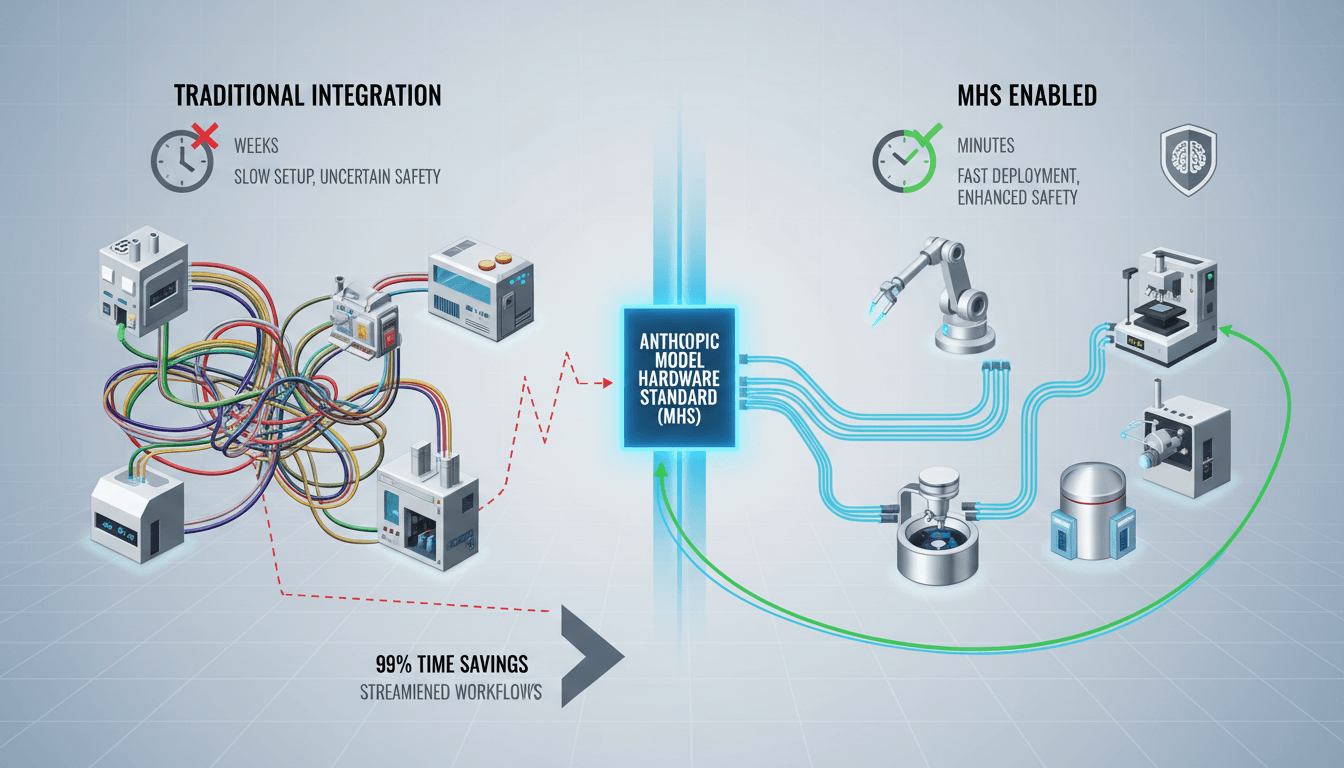
Here's what it means for you.
If you work in tech or manufacturing, this new standard could drastically reduce the time and cost of integrating AI with physical machines.
Why it matters
The Model Hardware Standard (MHS) could redefine how industries integrate AI into their operations, potentially accelerating automation and innovation.
What happened (in 30 seconds)
- Anthropic unveiled the Model Hardware Standard (MHS) on August 27, 2026, allowing AI agents to control various scientific and manufacturing hardware.
- MHS reduces integration time from weeks or months to hours or minutes, streamlining the process for researchers and manufacturers.
- Safety features are built-in, ensuring that AI operations are conducted within configurable limits to prevent errors.
The context you actually need
- Prior to MHS, integrating different devices required extensive custom coding, often leading to delays and increased costs.
- The demand for autonomous AI agents in scientific workflows has been growing, highlighting the need for a standardized approach to hardware integration.
- Anthropic's previous work on the Model Context Protocol in 2024 laid the groundwork for this new hardware standard, focusing on simplifying AI connections to software and data sources.
What's really happening
On August 27, 2026, Anthropic introduced the Model Hardware Standard (MHS), a significant step toward unifying how AI agents interact with physical machines. This standard is designed to streamline the integration of various devices, such as microscopes and robotic arms, by providing a common interface that reduces the need for bespoke coding. Historically, integrating disparate laboratory and manufacturing devices required weeks or months of specialist effort due to incompatible APIs. MHS aims to change that by allowing AI agents to operate these machines with simple read/write commands and standardized device descriptions.
The collaboration with the Howard Hughes Medical Institute’s Janelia Research Campus has been pivotal in developing MHS. Early implementations have already demonstrated the potential of this standard, with an AI agent managing microscopes and QuEra Computing utilizing it for laser coordination in quantum computing. The involvement of major players like Amazon Web Services and Hugging Face indicates a strong market interest in adopting this technology.
One of the standout features of MHS is its ability to generate scripts automatically, adjust parameters in real-time, and recover from errors—all while incorporating safety guardrails. These safety features include configurable limits on device operations, ensuring that AI agents operate within safe parameters. This focus on safety is crucial as industries increasingly rely on AI for critical tasks.
The implications of MHS extend beyond just efficiency. By reducing integration times from weeks or months to hours or minutes, it opens the door for faster innovation cycles in research and manufacturing. Companies can pivot more quickly to new projects, experiment with different technologies, and ultimately drive down costs. This could lead to a more competitive landscape where businesses that adopt MHS can outpace those that do not.
However, the rollout of MHS is still in its early stages, with a limited number of partners involved in the initial integration efforts. Anthropic plans to release the standard as open-source after thorough safety evaluations, which could democratize access to this technology and encourage broader adoption across various sectors.
Who feels it first (and how)
- Tech companies: Those developing AI applications will benefit from easier integration with hardware.
- Manufacturers: Industries relying on robotics and automation will see reduced costs and faster deployment times.
- Researchers: Academic and scientific institutions can accelerate their workflows and experiments.
- Startups: New companies in the AI and robotics space can leverage MHS to innovate without the burden of extensive custom coding.
What to watch next
- Adoption rates among partners: Monitoring how quickly companies like AWS and Hugging Face integrate MHS will indicate its market acceptance.
- Safety evaluations: The timeline and outcomes of safety assessments will determine when MHS can be widely released as open-source.
- Emerging applications: Watch for new use cases in advanced manufacturing and scientific research that leverage MHS for innovative solutions.
MHS reduces integration time significantly, from weeks or months to hours or minutes.
Broader adoption of MHS will lead to increased automation and efficiency in various industries.
The full impact of MHS on job roles and industry dynamics remains to be seen as the technology matures.
Frequently Asked Questions
- Why it matters?
- The Model Hardware Standard (MHS) could redefine how industries integrate AI into their operations, potentially accelerating automation and innovation.
- What happened (in 30 seconds)?
- Anthropic unveiled the Model Hardware Standard (MHS) on August 27, 2026, allowing AI agents to control various scientific and manufacturing hardware. MHS reduces integration time from weeks or months to hours or minutes, streamlining the process for researchers and manufacturers. Safety features are built-in, ensuring that AI operations are conducted within configurable limits to prevent errors.
- What's really happening?
- On August 27, 2026, Anthropic introduced the Model Hardware Standard (MHS), a significant step toward unifying how AI agents interact with physical machines. This standard is designed to streamline the integration of various devices, such as microscopes and robotic arms, by providing a common interface that reduces the need for bespoke coding. Historically, integrating disparate laboratory and manufacturing devices required weeks or months of specialist effort due to incompatible APIs. MHS aims
- Who feels it first (and how)?
- Tech companies: Those developing AI applications will benefit from easier integration with hardware. Manufacturers: Industries relying on robotics and automation will see reduced costs and faster deployment times. Researchers: Academic and scientific institutions can accelerate their workflows and experiments. Startups: New companies in the AI and robotics space can leverage MHS to innovate without the burden of extensive custom coding.
- What to watch next?
- Adoption rates among partners: Monitoring how quickly companies like AWS and Hugging Face integrate MHS will indicate its market acceptance. Safety evaluations: The timeline and outcomes of safety assessments will determine when MHS can be widely released as open-source. Emerging applications: Watch for new use cases in advanced manufacturing and scientific research that leverage MHS for innovative solutions.
AI news with an enterprise and cloud focus.
"Covers AI in the context of data infrastructure, cloud, and enterprise stacks."
— A47 Editor
Anthropic previews MHS standard for AI agents that operate machines
Anthropic PBC has unveiled the Model Hardware Standard (MHS), a new framework designed to facilitate the interaction of artificial intelligence agents with various machines, including microscopes and robotic arms. This initiative is a collaboration w...
Community posts including AI/ML tutorials and news.
"Open platform where developers share AI learnings."
— A47 Editor
Anthropic Opens MHS Research Preview for Unified AI Control of Lab Hardware
Anthropic has launched a research preview of the Model Hardware Standard (MHS), an open standard aimed at enabling AI agents to interact with lab and manufacturing equipment, such as microscopes and robotic arms. This initiative seeks to create a uni...
Community posts including AI/ML tutorials and news.
"Open platform where developers share AI learnings."
— A47 Editor
Anthropic MHS Brings AI Agents to Biotech Labs and Quantum Hardware
Anthropic has launched a Model Hardware Standard (MHS) research preview aimed at enabling AI agents to operate physical laboratory and industrial equipment, with initial pilots at Genentech, HHMI Janelia Research Campus, and QuEra focusing on lab aut...