
OpenAI's Jalapeño ASIC Achieves Benchmarking Superiority Over Major Competitors
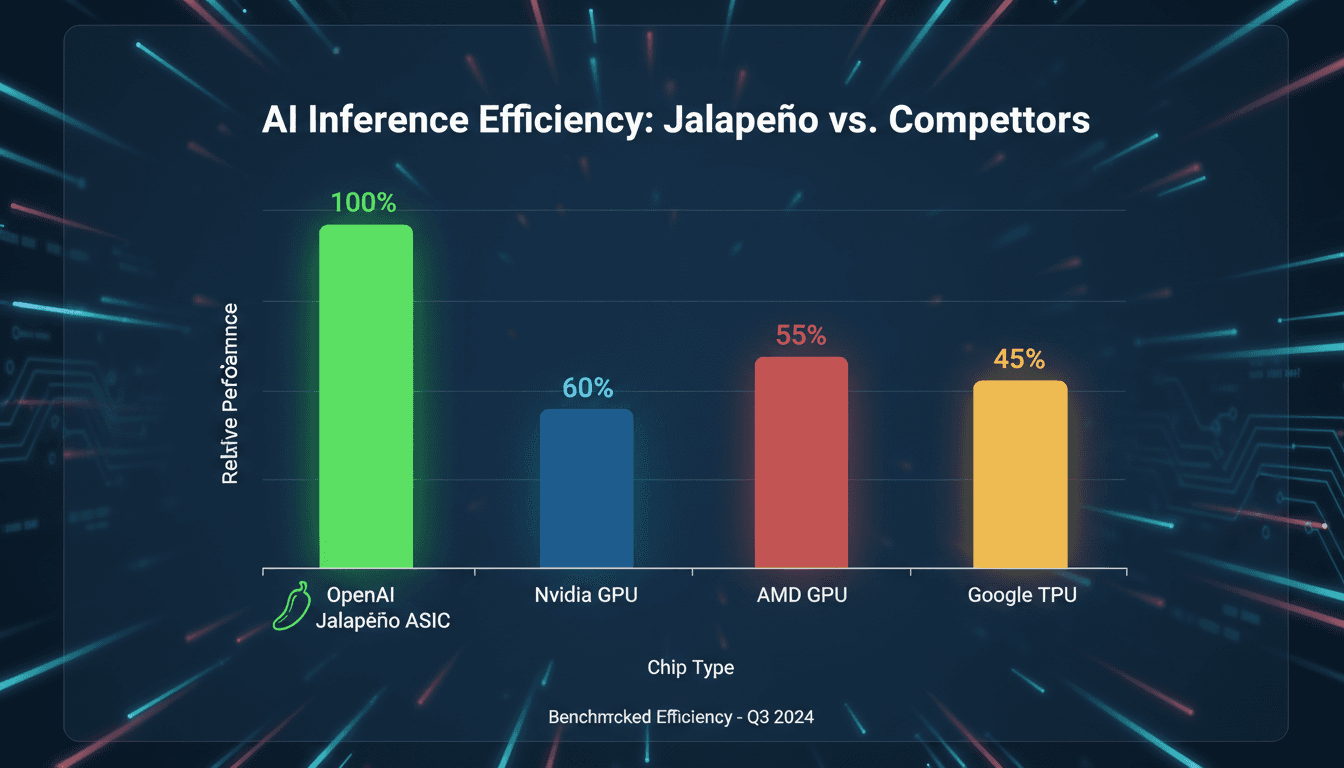
Here's what it means for you.
If you're in tech or data-intensive industries, expect a shift in how AI workloads are processed, impacting costs and performance.
Why it matters
The Jalapeño ASIC's efficiency could redefine the competitive landscape for AI hardware, influencing cost structures and operational strategies across sectors.
What happened (in 30 seconds)
- On August 25, 2026, SemiAnalysis released benchmarks showing OpenAI's Jalapeño ASIC outperforms Nvidia, AMD, and Google chips in efficiency.
- Developed in partnership with Broadcom, Jalapeño is OpenAI's first custom chip designed specifically for AI inference workloads.
- Achieving over 700 tokens/sec/user, Jalapeño sets a new standard for performance per watt, crucial for power-constrained datacenters.
The context you actually need
- OpenAI's initiative to create custom silicon stems from the need to address power limitations in datacenters, which are increasingly critical as AI models grow in complexity.
- The industry trend is moving towards specialized ASICs for inference, driven by rising energy demands and the limitations of general-purpose GPUs.
- Jalapeño's development was accelerated through hardware-software co-design, showcasing the potential for rapid innovation in AI hardware.
What's really happening
OpenAI's Jalapeño ASIC represents a significant leap in the efficiency of AI inference processing, a critical factor as the demand for AI capabilities surges across industries. The chip was co-developed with Broadcom, marking a strategic partnership aimed at addressing the growing energy constraints faced by datacenters. Traditional GPUs, while powerful, are becoming less viable due to their high energy consumption and costs associated with scaling up operations.
The Jalapeño ASIC was designed from the ground up, with a focus on optimizing performance per watt—a metric that has become increasingly important as companies seek to balance operational costs with performance. The benchmarks released by SemiAnalysis indicate that Jalapeño not only surpasses existing competitors like Nvidia's Blackwell and Rubin chips but does so while maintaining a lower power footprint. This is particularly relevant for organizations that rely on AI for real-time data processing and decision-making, as it allows for greater throughput without the corresponding increase in energy costs.
The implications of this development extend beyond just performance metrics. As companies look to implement more AI-driven solutions, the cost of hardware becomes a critical factor in their overall total cost of ownership (TCO). Jalapeño's efficiency could lead to a shift in purchasing decisions, favoring lower-margin custom solutions over high-margin general-purpose GPUs. This could disrupt existing supply chains and market dynamics, as companies reassess their hardware strategies in light of these new capabilities.
Furthermore, the rapid development cycle of Jalapeño—from concept to tape-out in just 16 months—highlights the potential for accelerated innovation in the semiconductor industry. This could inspire other tech companies to pursue similar paths, leading to a wave of new custom silicon solutions tailored for specific applications. As the industry evolves, the focus will likely shift towards creating chips that not only meet performance benchmarks but also align with sustainability goals, given the increasing scrutiny on energy consumption in tech.
Who feels it first (and how)
- Tech companies: Those relying on AI for data processing will benefit from reduced operational costs and improved performance.
- Datacenter operators: Facilities managing power constraints will find Jalapeño's efficiency crucial for scaling operations.
- AI developers: Enhanced performance metrics will allow for more complex models to be deployed without prohibitive costs.
- Investors in semiconductor technology: A shift towards custom ASICs could reshape investment strategies in the tech sector.
What to watch next
- Production deployment timelines: Keep an eye on when Jalapeño will move from engineering samples to full production, as this will signal broader market availability.
- Competitor responses: Watch how Nvidia, AMD, and Google adapt their strategies in light of Jalapeño's performance, particularly in terms of pricing and product development.
- Adoption rates in datacenters: Monitor how quickly datacenters begin integrating Jalapeño into their operations, as this will indicate market acceptance and potential shifts in TCO models.
Jalapeño outperforms existing chips in efficiency metrics.
The market will see a shift towards custom ASICs for AI workloads.
The full impact on TCO models and competitor strategies remains to be seen.
Frequently Asked Questions
- Why it matters?
- The Jalapeño ASIC's efficiency could redefine the competitive landscape for AI hardware, influencing cost structures and operational strategies across sectors.
- What happened (in 30 seconds)?
- On August 25, 2026, SemiAnalysis released benchmarks showing OpenAI's Jalapeño ASIC outperforms Nvidia, AMD, and Google chips in efficiency. Developed in partnership with Broadcom, Jalapeño is OpenAI's first custom chip designed specifically for AI inference workloads. Achieving over 700 tokens/sec/user, Jalapeño sets a new standard for performance per watt, crucial for power-constrained datacenters.
- What's really happening?
- OpenAI's Jalapeño ASIC represents a significant leap in the efficiency of AI inference processing, a critical factor as the demand for AI capabilities surges across industries. The chip was co-developed with Broadcom, marking a strategic partnership aimed at addressing the growing energy constraints faced by datacenters. Traditional GPUs, while powerful, are becoming less viable due to their high energy consumption and costs associated with scaling up operations. The Jalapeño ASIC was designed
- Who feels it first (and how)?
- Tech companies: Those relying on AI for data processing will benefit from reduced operational costs and improved performance. Datacenter operators: Facilities managing power constraints will find Jalapeño's efficiency crucial for scaling operations. AI developers: Enhanced performance metrics will allow for more complex models to be deployed without prohibitive costs. Investors in semiconductor technology: A shift towards custom ASICs could reshape investment strategies in the tech sector.
- What to watch next?
- Production deployment timelines: Keep an eye on when Jalapeño will move from engineering samples to full production, as this will signal broader market availability. Competitor responses: Watch how Nvidia, AMD, and Google adapt their strategies in light of Jalapeño's performance, particularly in terms of pricing and product development. Adoption rates in datacenters: Monitor how quickly datacenters begin integrating Jalapeño into their operations, as this will indicate market acceptance and pote
Curated tech headlines including AI stories.
"Influential aggregator surfacing the day’s top tech/AI links."
— A47 Editor
A detailed look at Jalapeño, OpenAI's ASIC developed with Broadcom in 16 months, which beat Nvidia, AMD, and Google chips on multiple top open-weight models (SemiAnalysis)
OpenAI has unveiled its Jalapeño chip, an application-specific integrated circuit (ASIC) developed in collaboration with Broadcom over a span of 16 months, which has outperformed competitors like Nvidia, AMD, and Google in various top open-weight mod...
Curated tech headlines including AI stories.
"Influential aggregator surfacing the day’s top tech/AI links."
— A47 Editor
OpenAI says its Jalapeño chip delivered 1.5x-1.9x more AI work per watt and 1.7x-3.6x lower latency than Nvidia chips across GPT-OSS, DeepSeek R1, Kimi K2.5 1T (Emma Roth/The Verge)
OpenAI announced that its Jalapeño chip has outperformed Nvidia's chips, delivering 1.5x-1.9x more AI work per watt and achieving 1.7x-3.6x lower latency across various benchmarks including GPT-OSS and DeepSeek R1. This performance highlights the adv...
Startup news with frequent AI coverage.
"Covers launches, funding, and product updates in AI."
— A47 Editor
OpenAI’s Jalapeño chip is built for fast inference at scale, benchmarks show
OpenAI has introduced its Jalapeño chip, which has demonstrated superior performance on the SemiAnalysis InferenceX benchmark, achieving higher tokens per user and increased throughput per kilowatt compared to existing state-of-the-art solutions.
Consumer tech and culture with frequent AI coverage.
"Influential tech outlet covering AI products and policy."
— A47 Editor
OpenAI says its Jalapeño chip can power faster AI responses than the competition
OpenAI has introduced its new AI chip, Jalapeño, which reportedly delivers faster response times and improved efficiency compared to existing AI systems, as stated by Richard Ho, the company's hardware vice president. This announcement was made durin...
Tech news, reviews, and analysis of consumer electronics, science, art, and culture.
"The Verge is a technology-focused media outlet known for in-depth reporting, product reviews, and coverage of the intersection between technology and culture."
— A47 Editor
OpenAI says its Jalapeño chip can power faster AI responses than the competition
OpenAI has introduced its new AI chip, Jalapeño, which reportedly delivers faster response times and improved efficiency compared to existing AI systems, as stated by Richard Ho, the company's hardware vice president. This announcement was made durin...