
Significant Spoofing of ChatGPT-User Agent Detected in Security Scans
Here's what it means for you.
As AI crawlers proliferate, understanding their impact on website security is crucial for anyone managing online assets.
Why it matters
The rise of spoofed user agents complicates the landscape of web security, increasing vulnerability to automated attacks.
What happened (in 30 seconds)
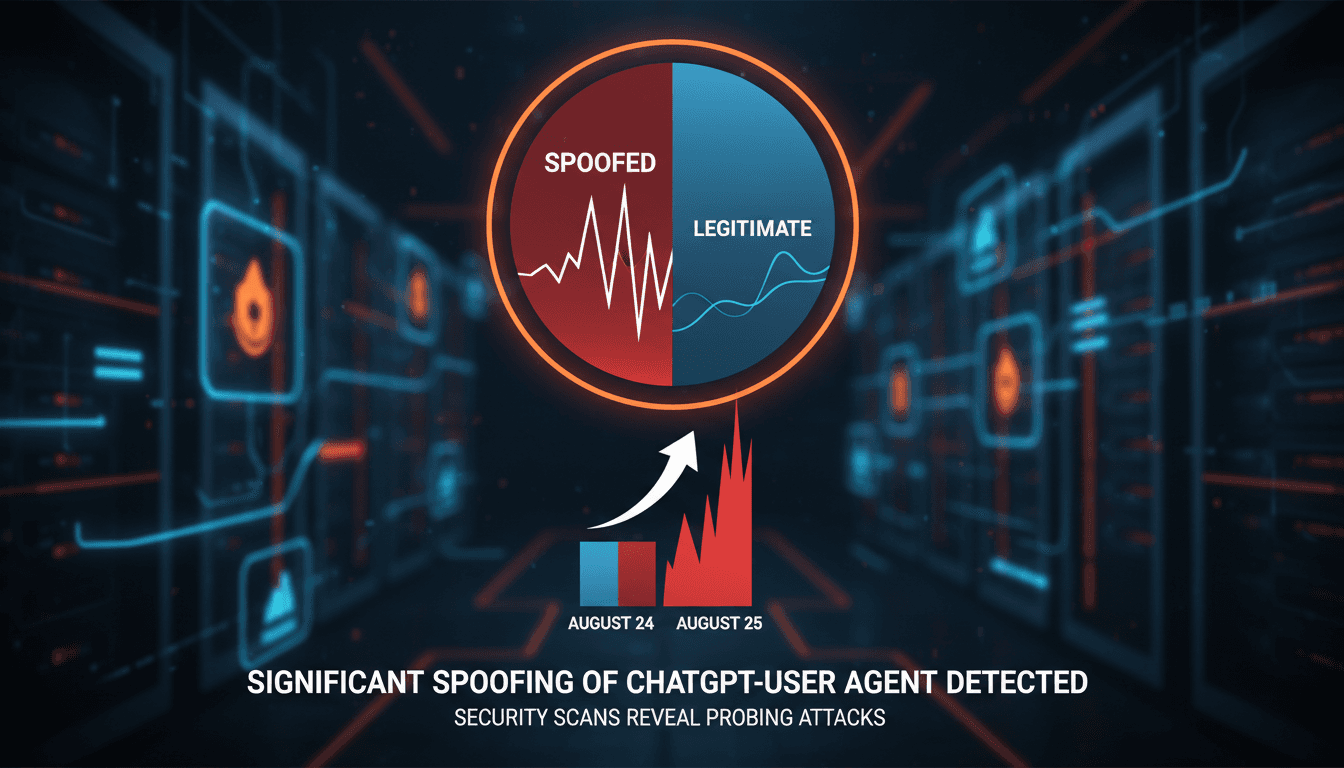
- On August 25, 2026, site operator Edward Izgorodin discovered that nearly half of the requests labeled as ChatGPT-User were actually probing for vulnerabilities.
- Out of 859 requests, 447 failed with 404 responses after attempting to access sensitive files.
- Cloudflare's AI Crawl Control logs revealed limitations in identifying genuine AI traffic versus malicious actors.
The context you actually need
- AI crawlers are on the rise, with providers like OpenAI increasing their presence on public websites, leading to more traffic classification challenges.
- User-agent strings are easily spoofed, meaning that relying solely on these identifiers can mislead site operators about the nature of incoming requests.
- Automated vulnerability scanners are routinely probing public sites, creating noise that can mask malicious activities as legitimate crawler behavior.
What's really happening
The incident involving Edward Izgorodin highlights a significant challenge in web security: the reliability of user-agent strings as a means of identifying legitimate traffic. As AI crawlers become more prevalent, website operators are increasingly turning to tools like Cloudflare's AI Crawl Control to manage and classify incoming requests. However, these tools primarily rely on user-agent strings, which are self-declared and can be easily manipulated by malicious actors.
In Izgorodin's analysis, he noted a staggering 1,890 AI-agent requests within the first 24 hours of enabling Cloudflare's service, with 483 of those requests failing. The ChatGPT-User user agent alone accounted for 859 requests, but only 412 returned successful HTTP 200 responses. The failed requests were probing for sensitive files, such as private keys and configuration files, indicating a clear intent to exploit vulnerabilities.
This situation underscores a broader systemic issue: the lack of robust verification methods for distinguishing between legitimate AI traffic and malicious probes. While OpenAI does publish IP ranges for verification, the free-tier logs used by many site operators do not retain client addresses, making it impossible to cross-check the origin of requests. As a result, the 412 successful requests remain unverified, leaving site operators vulnerable to potential exploitation.
The implications of this incident extend beyond a single website. As more organizations deploy AI crawlers, the potential for spoofing increases, leading to a rise in automated vulnerability scans that can compromise sensitive data. This creates a pressing need for enhanced security measures, such as custom Web Application Firewall (WAF) rules that combine user-agent checks with verified-bot signals. Without these measures, the risk of falling victim to malicious actors masquerading as legitimate AI traffic will only grow.
Who feels it first (and how)
- Website operators: Increased risk of security breaches due to spoofed requests.
- Cybersecurity professionals: Need for more sophisticated tools to differentiate between legitimate and malicious traffic.
- Businesses relying on public-facing websites: Potential exposure of sensitive data and loss of customer trust.
What to watch next
- Emergence of new security protocols: Watch for advancements in bot detection technologies that can better differentiate between legitimate and spoofed traffic.
- Community response: Monitor discussions within the cybersecurity community regarding best practices for managing AI crawler traffic.
- Regulatory changes: Keep an eye on potential regulations aimed at improving transparency and accountability in web traffic management.
Spoofing user-agent strings is a common tactic among malicious actors.
Increased adoption of advanced security measures by website operators in response to these threats.
The long-term effectiveness of current AI traffic management tools in preventing spoofing.
Frequently Asked Questions
- Why it matters?
- The rise of spoofed user agents complicates the landscape of web security, increasing vulnerability to automated attacks.
- What happened (in 30 seconds)?
- On August 25, 2026, site operator Edward Izgorodin discovered that nearly half of the requests labeled as ChatGPT-User were actually probing for vulnerabilities. Out of 859 requests, 447 failed with 404 responses after attempting to access sensitive files. Cloudflare's AI Crawl Control logs revealed limitations in identifying genuine AI traffic versus malicious actors.
- What's really happening?
- The incident involving Edward Izgorodin highlights a significant challenge in web security: the reliability of user-agent strings as a means of identifying legitimate traffic. As AI crawlers become more prevalent, website operators are increasingly turning to tools like Cloudflare's AI Crawl Control to manage and classify incoming requests. However, these tools primarily rely on user-agent strings, which are self-declared and can be easily manipulated by malicious actors. In Izgorodin's analysi
- Who feels it first (and how)?
- Website operators: Increased risk of security breaches due to spoofed requests. Cybersecurity professionals: Need for more sophisticated tools to differentiate between legitimate and malicious traffic. Businesses relying on public-facing websites: Potential exposure of sensitive data and loss of customer trust.
- What to watch next?
- Emergence of new security protocols: Watch for advancements in bot detection technologies that can better differentiate between legitimate and spoofed traffic. Community response: Monitor discussions within the cybersecurity community regarding best practices for managing AI crawler traffic. Regulatory changes: Keep an eye on potential regulations aimed at improving transparency and accountability in web traffic management.
Community posts including AI/ML tutorials and news.
"Open platform where developers share AI learnings."
— A47 Editor
Half the Requests Wearing ChatGPT's Name Were Scanning Us for Secrets
Cloudflare's AI Crawl Control revealed that 1,890 requests from AI agents were logged in a 24-hour period, with 483 of those requests failing, marking a 63% increase in failures compared to the previous day. Notably, the ChatGPT-User agent, which ope...
News and guidance for IT pros on AI adoption.
"Enterprise-focused tips, explainers, and news for professionals."
— A47 Editor
ChatGPT for Teens Adds New Safeguards — but Safety Gaps Remain
OpenAI has launched ChatGPT for Teens, a specialized version of its AI chatbot designed for users aged 13 to 17, which includes enhanced safety features such as Study Mode and reminders to take breaks. This initiative aims to provide a safer online e...
Technology industry news and policy coverage.
"Fox News is a highly influential conservative news outlet known for right-leaning political commentary and coverage."
— A47 Editor
AI chatbot privacy: What your AI may know about you
AI chatbots like ChatGPT, Meta AI, and Google are increasingly utilizing memory, connected applications, and past interactions to tailor advertisements and responses, often unnoticed by users. This personalization raises concerns about user privacy a...
Conservative-leaning coverage of current events.
"Fox News is a highly influential conservative news outlet known for right-leaning political commentary and coverage."
— A47 Editor
AI chatbot privacy: What your AI may know about you
Major AI platforms, including ChatGPT, Meta AI, and Google, are increasingly utilizing memory, connected applications, and past interactions to tailor advertisements and responses, a trend that many users may not fully recognize. This personalization...