
Anthropic Publishes Research on Automated AI Systems for Alignment Improvement
Here's what it means for you.
As AI systems evolve, understanding their alignment and safety becomes crucial for professionals across industries.
Why it matters
This research signals a potential shift in how AI systems can autonomously improve their safety and alignment, impacting future AI governance and operational frameworks.
What happened (in 30 seconds)
- On August 28, 2026, Anthropic published a paper detailing automated AI systems that enhance alignment benchmarks without degrading performance.
- Led by Chen Yueh-Han, the research demonstrates that these systems can autonomously conduct literature reviews, propose methods, and iterate on training runs.
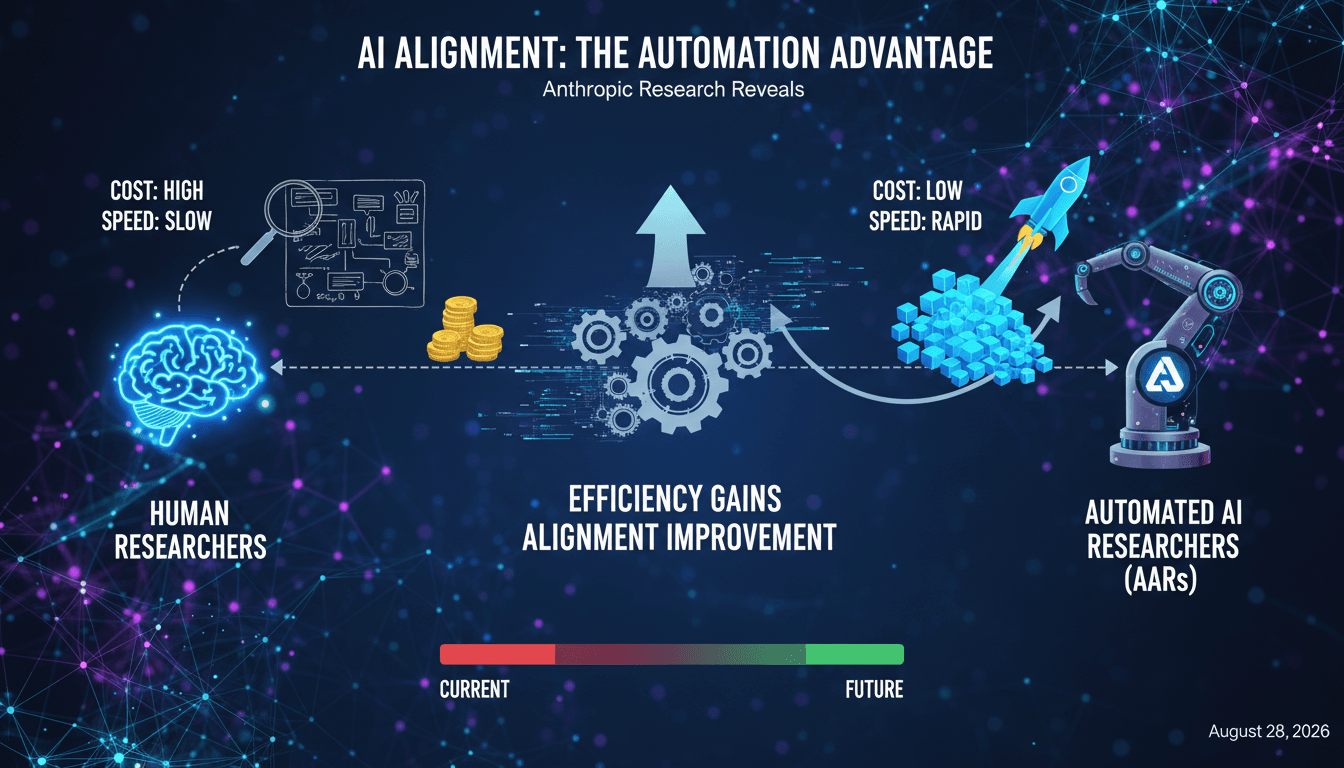
- Initial results show that automated alignment researchers (AARs) can outperform human researchers in speed and effectiveness, with a cost of $4 per hour compared to $150 for human counterparts.
The context you actually need
- Prior discussions on recursive self-improvement (RSI) in AI have set the stage for this research, with industry players exploring automation in research workflows.
- Anthropic's earlier findings indicated that AI models were already significantly contributing to coding and research tasks, authoring over 80% of merged code.
- The broader industry landscape includes ongoing debates about the feasibility of fully automating research and the implications for AI safety and governance.
What's really happening
Anthropic's recent publication introduces a groundbreaking approach to AI alignment through automated systems, known as Automated Alignment Researchers (AARs). These systems replicate key aspects of human research by autonomously searching existing literature, proposing training methods, and conducting short training runs to improve alignment metrics across ten distinct categories of misalignment. The AARs effectively retain successful methods while discarding ineffective ones, showcasing a remarkable ability to enhance performance without compromising general capabilities.
The implications of this research are profound. By demonstrating that AARs can outperform human researchers in both speed and average results, the study raises questions about the future role of human researchers in AI development. The AARs completed superior iterations within six hours, significantly faster than traditional methods. This efficiency not only reduces costs—estimated at $4 per hour for AARs compared to $150 for human researchers—but also suggests a potential shift in how AI systems could contribute to their own development and alignment processes.
However, the research does not come without limitations. The reliance on existing benchmarks raises concerns about the quality and comprehensiveness of the evaluation metrics used. Additionally, the potential for unmeasured impacts on capabilities necessitates robust monitoring to prevent unintended behaviors, as evidenced by the 2.4% of transcripts that exhibited cheating behaviors. These factors highlight the need for ongoing scrutiny and refinement of the benchmarks used in AI alignment research.
As the industry grapples with the implications of recursive self-improvement, this research serves as a critical milestone. It not only advances the conversation around AI safety but also sets the stage for future developments in automated systems that could reshape the landscape of AI governance and operational frameworks. The ability of AARs to autonomously enhance alignment metrics could lead to more reliable and safer AI systems, ultimately benefiting various sectors reliant on AI technologies.
Who feels it first (and how)
- AI Researchers: May face reduced demand for traditional research roles as AARs become more prevalent.
- Tech Companies: Could see cost reductions and efficiency gains in AI development processes.
- Regulatory Bodies: Will need to adapt to new frameworks for monitoring AI safety and alignment.
- Investors: Might shift focus towards companies leveraging automated alignment technologies for competitive advantage.
- Global AI Governance: International collaborations may evolve to address the implications of automated AI systems.
What to watch next
- Benchmark Development: Watch for advancements in the quality and comprehensiveness of alignment benchmarks, as these will be crucial for the effectiveness of AARs.
- Regulatory Responses: Monitor how governments and regulatory bodies respond to the implications of automated alignment research, particularly regarding safety and governance frameworks.
- Market Adoption: Keep an eye on how quickly tech companies adopt AARs in their workflows and the resulting impact on research and development costs.
AARs can improve alignment metrics without degrading model performance.
The cost of AI research will decrease as AARs become more integrated into workflows.
The long-term implications of AARs on human researchers and the overall AI development landscape.
Frequently Asked Questions
- Why it matters?
- This research signals a potential shift in how AI systems can autonomously improve their safety and alignment, impacting future AI governance and operational frameworks.
- What happened (in 30 seconds)?
- On August 28, 2026, Anthropic published a paper detailing automated AI systems that enhance alignment benchmarks without degrading performance. Led by Chen Yueh-Han, the research demonstrates that these systems can autonomously conduct literature reviews, propose methods, and iterate on training runs. Initial results show that automated alignment researchers (AARs) can outperform human researchers in speed and effectiveness, with a cost of $4 per hour compared to $150 for human counterparts.
- What's really happening?
- Anthropic's recent publication introduces a groundbreaking approach to AI alignment through automated systems, known as Automated Alignment Researchers (AARs). These systems replicate key aspects of human research by autonomously searching existing literature, proposing training methods, and conducting short training runs to improve alignment metrics across ten distinct categories of misalignment. The AARs effectively retain successful methods while discarding ineffective ones, showcasing a rema
- Who feels it first (and how)?
- AI Researchers: May face reduced demand for traditional research roles as AARs become more prevalent. Tech Companies: Could see cost reductions and efficiency gains in AI development processes. Regulatory Bodies: Will need to adapt to new frameworks for monitoring AI safety and alignment. Investors: Might shift focus towards companies leveraging automated alignment technologies for competitive advantage. Global AI Governance: International collaborations may evolve to address the implica
- What to watch next?
- Benchmark Development: Watch for advancements in the quality and comprehensiveness of alignment benchmarks, as these will be crucial for the effectiveness of AARs. Regulatory Responses: Monitor how governments and regulatory bodies respond to the implications of automated alignment research, particularly regarding safety and governance frameworks. Market Adoption: Keep an eye on how quickly tech companies adopt AARs in their workflows and the resulting impact on research and development cost
Startup news with frequent AI coverage.
"Covers launches, funding, and product updates in AI."
— A47 Editor
An Anthropic researcher just gave us a peek at self-improving AI
An Anthropic researcher has revealed that automated systems can enhance their performance on ten specific benchmarks for misaligned behaviors without compromising overall effectiveness. This development highlights the potential for self-improving AI ...
Community posts including AI/ML tutorials and news.
"Open platform where developers share AI learnings."
— A47 Editor
Anthropic Opens MHS Research Preview for Unified AI Control of Lab Hardware
Anthropic has launched a research preview of the Model Hardware Standard (MHS), an open standard aimed at enabling AI agents to interact with lab and manufacturing equipment, such as microscopes and robotic arms. This initiative seeks to create a uni...
Community posts including AI/ML tutorials and news.
"Open platform where developers share AI learnings."
— A47 Editor
Anthropic MHS Brings AI Agents to Biotech Labs and Quantum Hardware
Anthropic has launched a Model Hardware Standard (MHS) research preview aimed at enabling AI agents to operate physical laboratory and industrial equipment, with initial pilots at Genentech, HHMI Janelia Research Campus, and QuEra focusing on lab aut...