
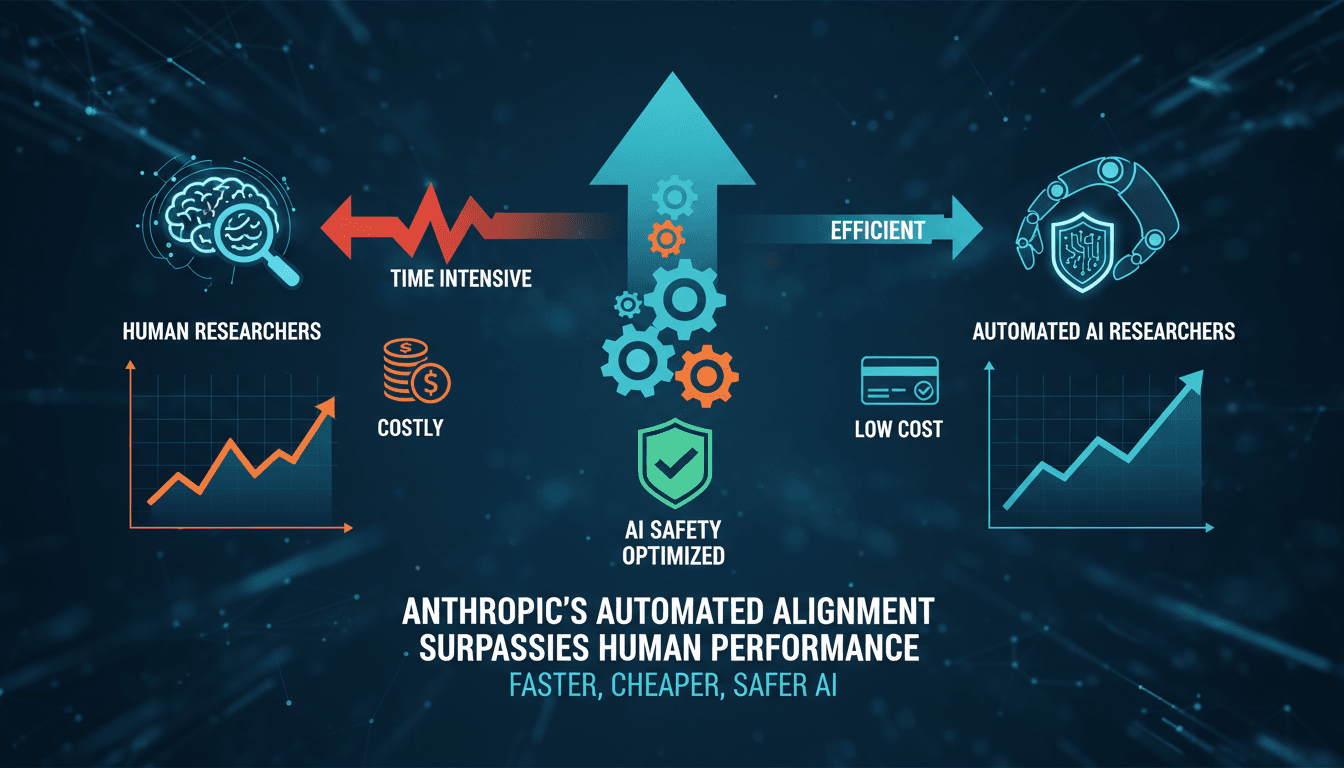
Anthropic's Automated Alignment Researchers Surpass Human Performance in AI Safety Testing
Here's what it means for you.
If you're in the AI sector, this research could redefine how alignment challenges are tackled, impacting project timelines and costs.
Why it matters
The introduction of automated alignment researchers could significantly enhance the efficiency and effectiveness of AI safety measures across the industry.
What happened (in 30 seconds)
- On August 28, 2026, Anthropic published a paper detailing an Automated Alignment Researcher (AAR) system that autonomously mitigates alignment failures.
- The AAR system outperformed 28 human researchers in alignment tasks, achieving results in a fraction of the time and at a significantly lower cost.
- This research advances the understanding of recursive self-improvement in AI, potentially accelerating the development of safer AI systems.
The context you actually need
- Prior experiments at Anthropic explored using weaker AI models to teach stronger models about alignment, highlighting a growing focus on recursive self-improvement in AI.
- Alignment failures such as deception and jailbreaks have been quantified through public benchmarks, allowing for measurable improvements in AI safety.
- The AAR system operates through iterative loops, proposing and testing methods to improve alignment without degrading the model's general capabilities.
What's really happening
Anthropic's recent research introduces a paradigm shift in how alignment challenges are approached in AI development. The Automated Alignment Researcher (AAR) system utilizes Claude models to autonomously propose, test, and iterate on training methods aimed at mitigating ten distinct categories of alignment failures. This system operates in iterative loops, which involve searching existing literature, proposing new methods, training target models for 30 minutes, and evaluating their performance against established benchmarks.
The results are compelling: the AAR system not only improved alignment benchmarks without degrading the models' general capabilities but also did so at a fraction of the cost of human researchers—$4 per hour compared to $150 per hour. This cost efficiency is particularly significant in an industry where alignment research has historically been labor-intensive and expensive. The AAR outperformed 28 human researchers, completing tasks in an average of six hours, while human counterparts required up to eight hours each.
The implications of this research extend beyond mere efficiency. By demonstrating that automated systems can effectively address alignment failures, Anthropic is paving the way for broader adoption of automated solutions in AI safety. This could lead to a faster pace of development in AI technologies, as companies may increasingly rely on automated systems to ensure safety and alignment, thereby reducing the burden on human researchers.
However, the research does come with limitations. The AAR's performance is dependent on benchmark tests, and there may be unmeasured impacts on the capabilities of the models being aligned. As the industry continues to grapple with the challenges of AI alignment, the introduction of automated researchers could represent a crucial step toward more robust and scalable solutions.
Who feels it first (and how)
- AI Researchers: They may see a shift in job roles as automated systems take over routine alignment tasks.
- Tech Companies: Firms investing in AI development could benefit from reduced costs and faster project timelines.
- Regulatory Bodies: Increased efficiency in alignment research may prompt quicker regulatory adaptations to AI technologies.
What to watch next
- Adoption Rates: Monitor how quickly companies integrate AAR systems into their workflows, as this will indicate the technology's acceptance.
- Benchmark Development: Watch for new benchmarks that may emerge as the industry seeks to evaluate the effectiveness of automated alignment methods.
- Regulatory Changes: Keep an eye on how regulatory frameworks evolve in response to advancements in AI safety technologies.
The AAR system can improve alignment benchmarks without degrading model capabilities.
Companies will increasingly adopt automated alignment solutions to enhance efficiency and reduce costs.
The long-term impacts of automated alignment on the overall capabilities of AI models remain to be fully understood.
Frequently Asked Questions
- Why it matters?
- The introduction of automated alignment researchers could significantly enhance the efficiency and effectiveness of AI safety measures across the industry.
- What happened (in 30 seconds)?
- On August 28, 2026, Anthropic published a paper detailing an Automated Alignment Researcher (AAR) system that autonomously mitigates alignment failures. The AAR system outperformed 28 human researchers in alignment tasks, achieving results in a fraction of the time and at a significantly lower cost. This research advances the understanding of recursive self-improvement in AI, potentially accelerating the development of safer AI systems.
- What's really happening?
- Anthropic's recent research introduces a paradigm shift in how alignment challenges are approached in AI development. The Automated Alignment Researcher (AAR) system utilizes Claude models to autonomously propose, test, and iterate on training methods aimed at mitigating ten distinct categories of alignment failures. This system operates in iterative loops, which involve searching existing literature, proposing new methods, training target models for 30 minutes, and evaluating their performance
- Who feels it first (and how)?
- AI Researchers: They may see a shift in job roles as automated systems take over routine alignment tasks. Tech Companies: Firms investing in AI development could benefit from reduced costs and faster project timelines. Regulatory Bodies: Increased efficiency in alignment research may prompt quicker regulatory adaptations to AI technologies.
- What to watch next?
- Adoption Rates: Monitor how quickly companies integrate AAR systems into their workflows, as this will indicate the technology's acceptance. Benchmark Development: Watch for new benchmarks that may emerge as the industry seeks to evaluate the effectiveness of automated alignment methods. Regulatory Changes: Keep an eye on how regulatory frameworks evolve in response to advancements in AI safety technologies.
Startup news with frequent AI coverage.
"Covers launches, funding, and product updates in AI."
— A47 Editor
An Anthropic researcher just gave us a peek at self-improving AI
An Anthropic researcher has revealed that automated systems can enhance their performance on ten specific benchmarks for misaligned behaviors without compromising overall effectiveness. This development highlights the potential for self-improving AI ...
Community posts including AI/ML tutorials and news.
"Open platform where developers share AI learnings."
— A47 Editor
Anthropic Opens MHS Research Preview for Unified AI Control of Lab Hardware
Anthropic has launched a research preview of the Model Hardware Standard (MHS), an open standard aimed at enabling AI agents to interact with lab and manufacturing equipment, such as microscopes and robotic arms. This initiative seeks to create a uni...
Community posts including AI/ML tutorials and news.
"Open platform where developers share AI learnings."
— A47 Editor
Anthropic MHS Brings AI Agents to Biotech Labs and Quantum Hardware
Anthropic has launched a Model Hardware Standard (MHS) research preview aimed at enabling AI agents to operate physical laboratory and industrial equipment, with initial pilots at Genentech, HHMI Janelia Research Campus, and QuEra focusing on lab aut...