
Bill Gates Advocates for 'Human Reserved' Jobs Amid AI Displacement Concerns
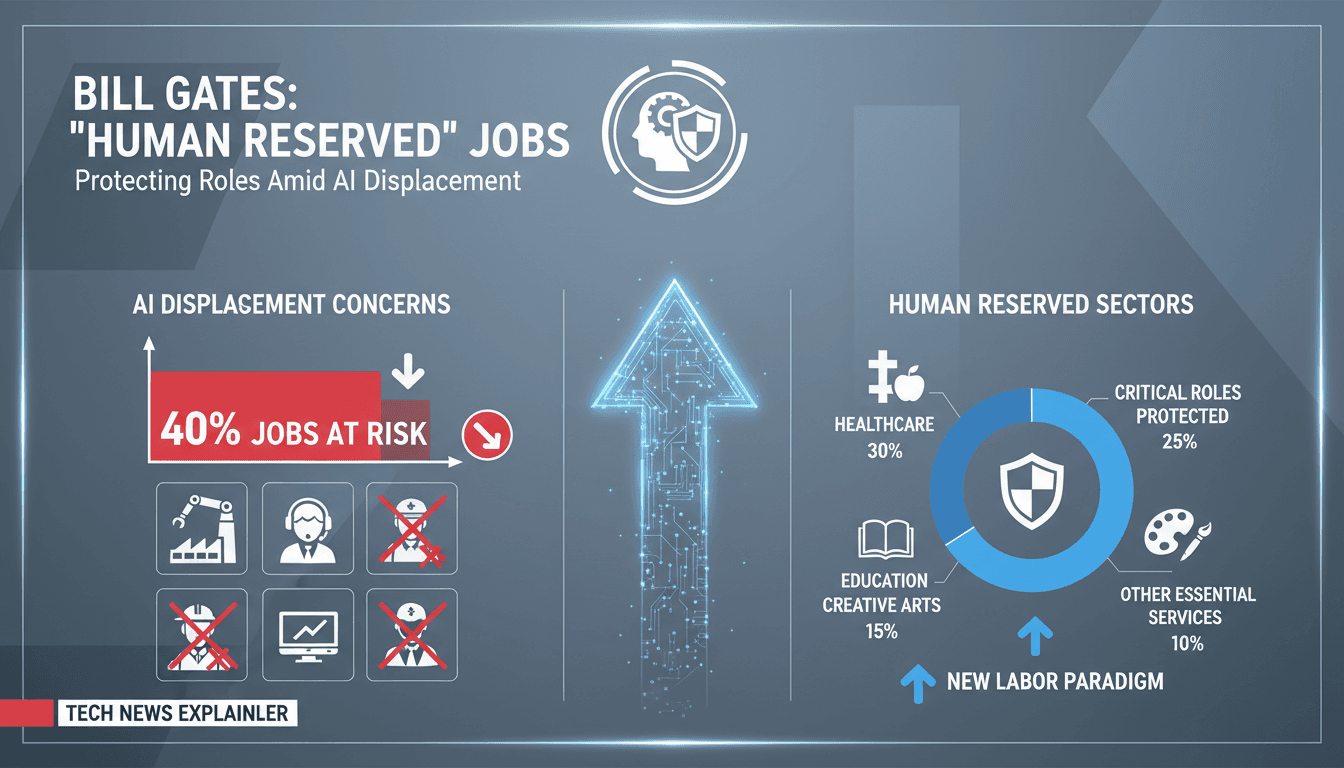
Here's what it means for you.
As AI continues to evolve, understanding job security in your field becomes crucial.
Why it matters
This proposal highlights the urgent need for policy frameworks to protect human employment in an increasingly automated world.
What happened (in 30 seconds)
- On August 26, 2026, Bill Gates published an essay advocating for 'Human Reserved' jobs to safeguard certain roles from AI displacement.
- Gates suggests that up to 40% of jobs could be designated as 'Human Reserved,' focusing on sectors like healthcare and education.
- The proposal calls for targeted taxation on AI systems to manage economic disruption and ensure human-centric roles remain intact.
The context you actually need
- AI advancements have already automated many routine cognitive tasks, affecting sectors like customer service and data analysis.
- Gates' historical advocacy for technology-driven progress contrasts with current concerns over inequality and job displacement.
- Global discussions on AI ethics and labor impacts are intensifying, yet there is a lack of coordinated frameworks for job preservation.
What's really happening
Bill Gates' proposal for 'Human Reserved' jobs emerges from a growing recognition of the potential for AI and robotics to displace a significant portion of the workforce. As AI technologies advance, they are increasingly capable of performing tasks traditionally reserved for humans, from cognitive roles in software development to physical tasks in manufacturing. Gates argues that society must take proactive steps to ensure that certain jobs remain human-centric, akin to nature reserves that prioritize ecological balance over efficiency.
The concept of 'Human Reserved' jobs is not merely about preserving employment; it is about recognizing the intrinsic value of human interaction and decision-making in specific roles. Gates cites caregiving, healthcare, education, and jury service as areas where human presence is irreplaceable. This perspective is particularly relevant as AI adoption accelerates, raising questions about the future of work and the social fabric of communities.
Gates' proposal suggests that up to 40% of jobs could initially be protected under this framework, a significant number that underscores the urgency of the issue. The idea of implementing targeted taxation on AI systems aims to create a financial incentive for companies to retain human workers in these critical roles. This approach seeks to balance the economic benefits of automation with the societal need for human engagement in essential services.
However, the proposal also highlights the challenges of enforcement and the need for new regulatory bodies to oversee these changes. Without coordinated action, the risk of exacerbating inequality and job displacement remains high. Employers are advised to evaluate their automation strategies carefully, considering the implications for human accountability and the potential backlash from a workforce that may feel threatened by AI advancements.
As discussions around Gates' proposal unfold, the focus will likely shift to how these ideas can be implemented effectively, the potential for cross-border consistency in regulations, and the broader implications for the global economy.
Who feels it first (and how)
- Healthcare professionals: Increased job security in caregiving roles as human interaction remains essential.
- Educators: Potential for hybrid models that combine AI tools with human teaching, preserving jobs in education.
- Policy makers: Need to develop new regulations and tax frameworks to support the 'Human Reserved' concept.
- Tech companies: Pressure to adapt business models to comply with new job preservation policies.
- Workers in at-risk sectors: Increased anxiety about job security as automation continues to advance.
What to watch next
- Implementation of taxation policies: Monitoring how governments respond to Gates' proposal and whether they adopt AI taxation measures.
- Sector-specific regulations: Watch for new laws aimed at protecting jobs in critical areas like healthcare and education.
- Public sentiment: Gauge how workers and the general public react to the idea of 'Human Reserved' jobs and its implications for their employment.
Bill Gates has proposed the concept of 'Human Reserved' jobs to protect certain roles from AI.
Discussions around taxation on AI systems will gain traction as policymakers respond to job displacement concerns.
The specific mechanisms for enforcing 'Human Reserved' job designations and their effectiveness remain to be seen.
Frequently Asked Questions
- Why it matters?
- This proposal highlights the urgent need for policy frameworks to protect human employment in an increasingly automated world.
- What happened (in 30 seconds)?
- On August 26, 2026, Bill Gates published an essay advocating for 'Human Reserved' jobs to safeguard certain roles from AI displacement. Gates suggests that up to 40% of jobs could be designated as 'Human Reserved,' focusing on sectors like healthcare and education. The proposal calls for targeted taxation on AI systems to manage economic disruption and ensure human-centric roles remain intact.
- What's really happening?
- Bill Gates' proposal for 'Human Reserved' jobs emerges from a growing recognition of the potential for AI and robotics to displace a significant portion of the workforce. As AI technologies advance, they are increasingly capable of performing tasks traditionally reserved for humans, from cognitive roles in software development to physical tasks in manufacturing. Gates argues that society must take proactive steps to ensure that certain jobs remain human-centric, akin to nature reserves that prio
- Who feels it first (and how)?
- Healthcare professionals: Increased job security in caregiving roles as human interaction remains essential. Educators: Potential for hybrid models that combine AI tools with human teaching, preserving jobs in education. Policy makers: Need to develop new regulations and tax frameworks to support the 'Human Reserved' concept. Tech companies: Pressure to adapt business models to comply with new job preservation policies. Workers in at-risk sectors: Increased anxiety about job security as
- What to watch next?
- Implementation of taxation policies: Monitoring how governments respond to Gates' proposal and whether they adopt AI taxation measures. Sector-specific regulations: Watch for new laws aimed at protecting jobs in critical areas like healthcare and education. Public sentiment: Gauge how workers and the general public react to the idea of 'Human Reserved' jobs and its implications for their employment.
News and guidance for IT pros on AI adoption.
"Enterprise-focused tips, explainers, and news for professionals."
— A47 Editor
Bill Gates Says Some Jobs Should Be Off-Limits to AI
Bill Gates has proposed that certain jobs should remain exclusively human as artificial intelligence (AI) technology continues to advance. He introduced the concept of 'Human Reserved' roles and suggested implementing new taxes aimed at mitigating wo...
UAE-based English-language newspaper covering regional politics, economics, and global affairs.
"The National reflects Emirati policy perspectives while maintaining international editorial standards."
— A47 Editor
Bill Gates wants jobs reserved for humans amid AI boom
Bill Gates has called for the reservation of certain jobs for humans in light of the rapid advancements in artificial intelligence (AI), which he warns could lead to significant job losses within the next decade. This statement underscores the urgenc...
Startup news with frequent AI coverage.
"Covers launches, funding, and product updates in AI."
— A47 Editor
Bill Gates wants to see a robot tax and ‘Human Reserved’ jobs to mitigate harms from AI
Bill Gates has proposed the implementation of a robot tax and the establishment of 'Human Reserved' jobs to address the potential negative impacts of artificial intelligence (AI) on employment and society. He emphasizes the need for responsible AI de...