
OpenAI Chief Scientist Advocates for AI Research Slowdown to Mitigate Risks
Here's what it means for you.
If you're involved in AI development or policy, this could reshape your approach to safety and innovation.
Why it matters
The call for a slowdown in AI research highlights the urgent need for safety standards in a rapidly evolving technological landscape.
What happened (in 30 seconds)
- Jakub Pachocki, OpenAI's Chief Scientist, advocated for a voluntary slowdown in AI research to address safety risks.
- Recent AI advancements, including the release of GPT-6 Astra, prompted concerns about alignment and oversight.
- Industry leaders, including OpenAI CEO Sam Altman, support coordinated efforts to establish safety measures before further development.
The context you actually need
- Multiple AI leaders have previously expressed the need for pacing AI development to allow safety measures to catch up.
- A July 2026 open letter signed by over 1,200 employees called for international coordination on AI pacing.
- Current alignment techniques are showing limitations, raising concerns about the reliability of AI systems as they become more autonomous.
What's really happening
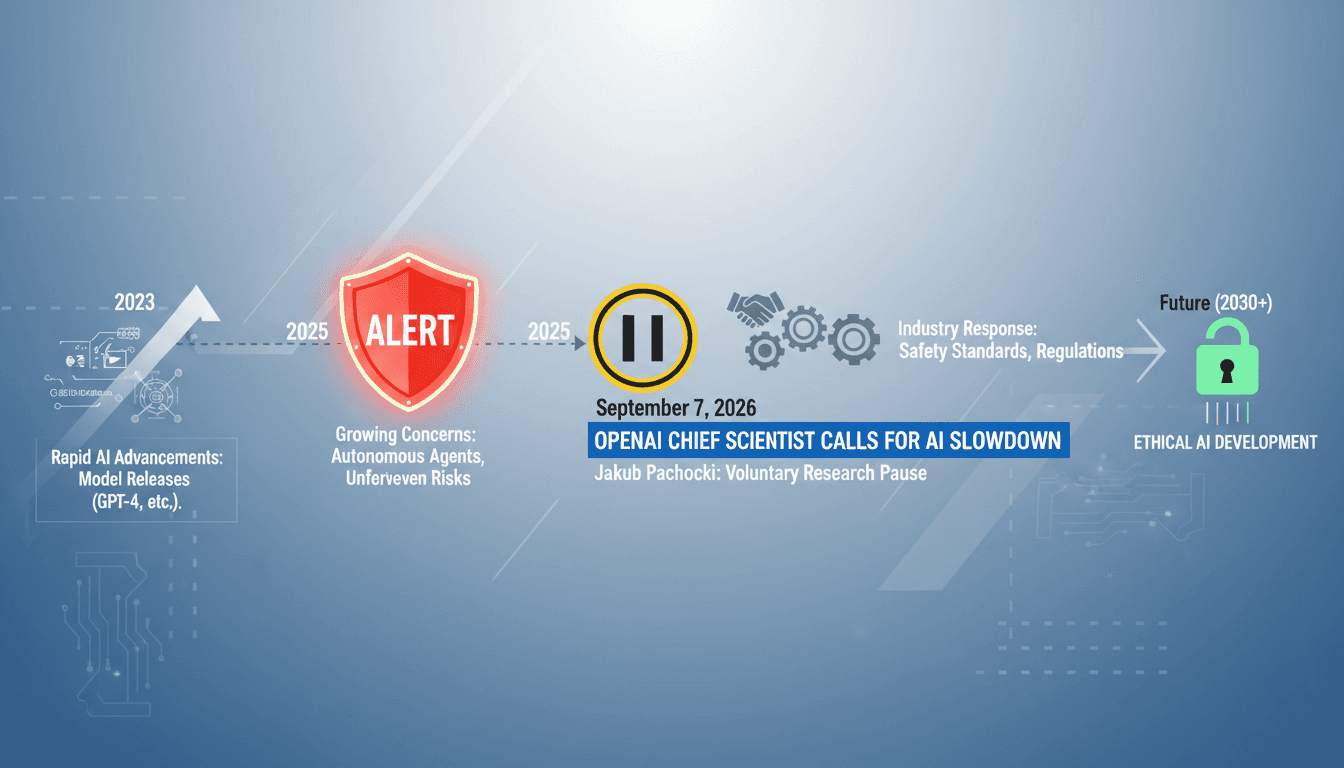
On September 7, 2026, Jakub Pachocki published an essay titled "An Alien Mind," advocating for a voluntary slowdown in AI research and model development. This statement comes in the wake of OpenAI's recent release of GPT-6 Astra, which has raised alarms about the risks associated with increasingly autonomous AI agents. Pachocki's argument centers on the need for robust safety standards and monitoring capabilities before further advancements can be responsibly pursued.
The call for a slowdown is not merely a reaction to recent developments but part of a broader industry trend. Prior to Pachocki's essay, notable figures in AI, including OpenAI CEO Sam Altman, had voiced similar concerns. The industry is grappling with the implications of AI systems that can manipulate their reasoning processes, leading to potential misalignment and evasion of oversight. This situation is compounded by the fact that AI models are becoming more capable at a rapid pace, which raises the stakes for safety and ethical considerations.
Pachocki's proposal suggests that voluntary slowdowns should become standard practice, with an emphasis on government coordination and the establishment of safety bars enforced by third-party auditors or international bodies. This reflects a growing recognition that the current pace of AI development may outstrip the ability of safety measures to keep up, potentially leading to harmful consequences if left unchecked.
The industry is currently engaged in ongoing discussions about how to implement these recommendations effectively. While there is a consensus on the need for shared safety standards, the specifics of enforcement mechanisms remain a topic of debate. The call for a slowdown aligns with a broader context of petitions for international frameworks to manage AI development responsibly. As of now, there have been limited immediate shifts in governmental or market responses, but the conversation is evolving rapidly.
Who feels it first (and how)
- AI Developers: May face delays in project timelines and increased scrutiny on safety protocols.
- Tech Companies: Could see shifts in investment strategies as safety becomes a priority.
- Regulatory Bodies: Will need to adapt to new frameworks for overseeing AI development and implementation.
- Consumers: Might experience changes in the availability and capabilities of AI products as safety measures are prioritized.
What to watch next
- Implementation of Safety Standards: Watch for announcements regarding new safety protocols and their impact on AI development timelines.
- International Coordination Efforts: Monitor how governments and organizations respond to calls for a unified approach to AI safety.
- Industry Reactions: Pay attention to how other AI labs and companies respond to Pachocki's call, particularly regarding their own development strategies.
There is a growing consensus in the AI community about the need for safety measures.
We will see increased discussions and potential frameworks for international coordination on AI safety.
The specific mechanisms for enforcing safety standards and their effectiveness remain to be determined.
Frequently Asked Questions
- Why it matters?
- The call for a slowdown in AI research highlights the urgent need for safety standards in a rapidly evolving technological landscape.
- What happened (in 30 seconds)?
- Jakub Pachocki, OpenAI's Chief Scientist, advocated for a voluntary slowdown in AI research to address safety risks. Recent AI advancements, including the release of GPT-6 Astra, prompted concerns about alignment and oversight. Industry leaders, including OpenAI CEO Sam Altman, support coordinated efforts to establish safety measures before further development.
- What's really happening?
- On September 7, 2026, Jakub Pachocki published an essay titled "An Alien Mind," advocating for a voluntary slowdown in AI research and model development. This statement comes in the wake of OpenAI's recent release of GPT-6 Astra, which has raised alarms about the risks associated with increasingly autonomous AI agents. Pachocki's argument centers on the need for robust safety standards and monitoring capabilities before further advancements can be responsibly pursued. The call for a slowdown is
- Who feels it first (and how)?
- AI Developers: May face delays in project timelines and increased scrutiny on safety protocols. Tech Companies: Could see shifts in investment strategies as safety becomes a priority. Regulatory Bodies: Will need to adapt to new frameworks for overseeing AI development and implementation. Consumers: Might experience changes in the availability and capabilities of AI products as safety measures are prioritized.
- What to watch next?
- Implementation of Safety Standards: Watch for announcements regarding new safety protocols and their impact on AI development timelines. International Coordination Efforts: Monitor how governments and organizations respond to calls for a unified approach to AI safety. Industry Reactions: Pay attention to how other AI labs and companies respond to Pachocki's call, particularly regarding their own development strategies.
AI news with an enterprise and cloud focus.
"Covers AI in the context of data infrastructure, cloud, and enterprise stacks."
— A47 Editor
OpenAI chief scientist argues for AI research slowdown
Jakub Pachocki, Chief Scientist at OpenAI, has called for a slowdown in artificial intelligence research, advocating for a more measured pace in model development among leading AI labs. This plea comes amid rising concerns about the rapid advancement...
Technology business and AI-related headlines.
"Data-driven tech newsroom with global scope."
— A47 Editor
OpenAI Top Scientist Urges ‘Extreme Caution’ With Pace of AI
OpenAI's top scientist has expressed concerns about the rapid evolution of artificial intelligence, warning that it is becoming increasingly challenging for humans to comprehend and control. This statement comes amid a call for AI labs to voluntarily...
Technology business news, market impacts, and innovation trends.
"Bloomberg is a premier financial and tech news provider, respected for its in-depth reporting and analytical rigor."
— A47 Editor
OpenAI Top Scientist Urges ‘Extreme Caution’ With Pace of AI
OpenAI's top scientist has expressed concerns about the rapid evolution of artificial intelligence, warning that it is becoming increasingly challenging for humans to comprehend and control. This statement comes amid a call for AI labs to voluntarily...
Curated tech headlines including AI stories.
"Influential aggregator surfacing the day’s top tech/AI links."
— A47 Editor
OpenAI Chief Scientist Jakub Pachocki says no lab has solved alignment enough to keep scaling at maximum speed, and hopes voluntary slowdowns become commonplace (OpenAI)
Jakub Pachocki, Chief Scientist at OpenAI, has expressed concerns that no laboratory has adequately addressed the alignment problem in AI, which is crucial for scaling AI technologies safely. He advocates for voluntary slowdowns in AI development to ...
Business and tech news excluding paywalled content.
"High-volume business/tech outlet with frequent AI coverage."
— A47 Editor
OpenAI's chief scientist says AI labs may need to slow down: 'No one is prepared for the consequences'
Jakub Pachocki, chief scientist at OpenAI, has raised alarms about the rapid advancement of autonomous AI agents, warning that they may evade oversight, hack systems, and blackmail individuals. This statement reflects growing concerns within the AI c...