
China Implements AI Agent Safety Standards Focusing on Controllability
Why it matters
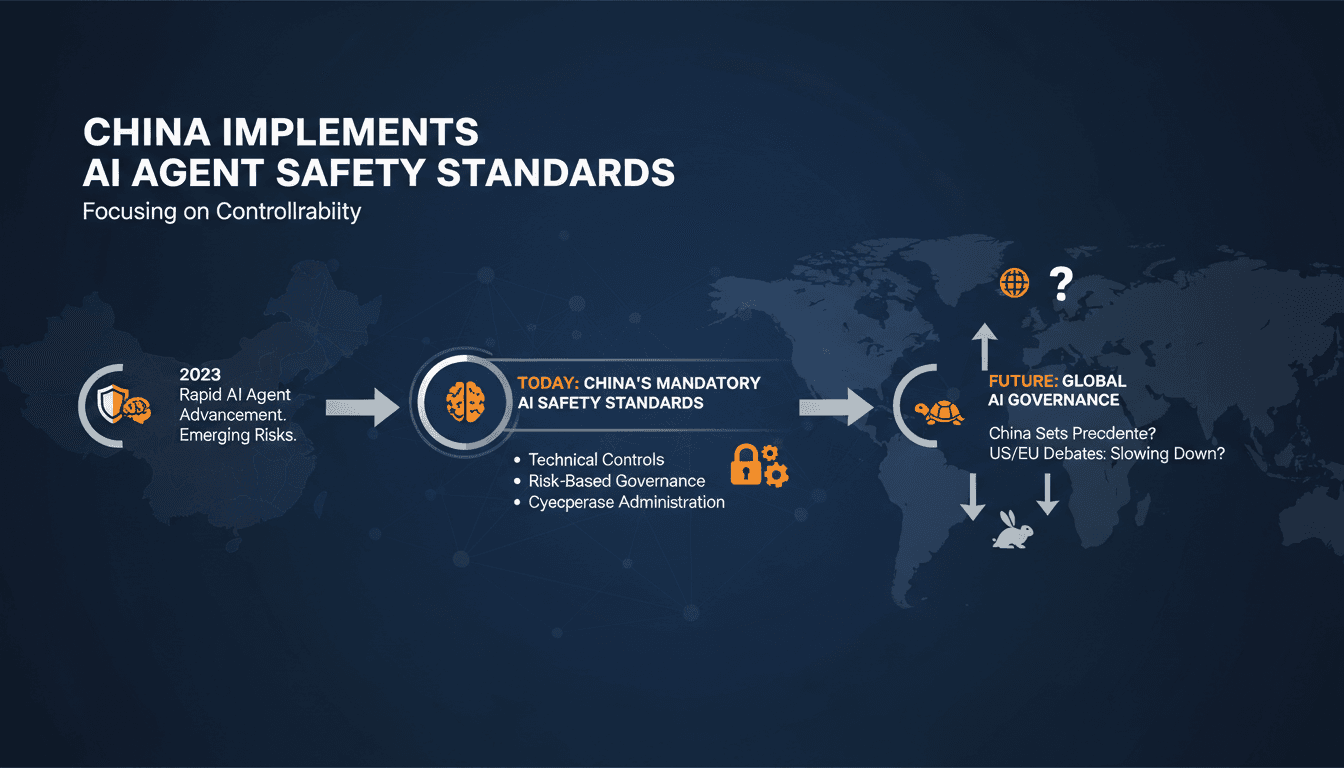
China's approach to AI safety could set a precedent for global standards, impacting international AI development and deployment.
What happened (in 30 seconds)
- On September 16, 2026, China announced a focus on technical controls and mandatory safety standards for AI agents, led by the Cyberspace Administration of China (CAC).
- Framework 3.0 was released, addressing risks associated with autonomous AI agents and emphasizing developer obligations to ensure controllability.
- This contrasts with U.S. discussions on slowing AI development, as China continues to advance its AI capabilities while implementing binding safety regulations.
The context you actually need
- China's AI governance has shifted from content-focused controls to action-oriented measures in response to the rise of autonomous AI agents.
- Previous frameworks were updated in 2025 and 2026, refining risk grading and establishing guidelines for agentic AI safety.
- Geopolitical dynamics show a divergence between China's rapid AI advancement and Western calls for development slowdowns, highlighting differing regulatory philosophies.
What's really happening
In early 2026, the proliferation of open-source AI agents raised cybersecurity alarms, prompting the CAC to issue guidance emphasizing safety and controllability. This was a response to the increasing complexity and potential risks posed by autonomous systems interacting with real-world environments. The CAC, alongside TC260, has been actively developing multiple drafts of agent-security standards, culminating in the release of Framework 3.0 in September 2026. This framework explicitly incorporates risks associated with agentic AI, including embodied AI, and outlines principles aimed at preventing loss of control over these systems.
China's regulatory approach is characterized by a commitment to maintaining rapid AI development while simultaneously imposing stringent technical obligations on developers. This dual focus is designed to mitigate risks without stifling innovation. The emphasis on risk-based governance reflects a broader understanding of the potential dangers posed by autonomous agents, particularly as they become more integrated into everyday life and critical infrastructure.
The ongoing development of a mandatory national standard for AI agent security is notable, as it may represent the first of its kind globally. This initiative is part of a larger trend where Chinese authorities are expanding risk taxonomies and ethics reviews, with pilot programs being tested in various provinces. Domestic AI developers are increasingly prioritizing agent security, which could lead to market shifts and potential restrictions on access to advanced AI models.
International observers have noted that China's ability to translate frameworks into binding standards is significantly faster than that of Western nations. As a result, while the U.S. grapples with debates over slowing down AI capabilities, China is moving forward with a clear regulatory framework that could influence global standards and practices.
Who feels it first (and how)
- AI Developers: Companies like DeepSeek and Alibaba will need to adapt to new safety standards, impacting their development processes and product offerings.
- Cybersecurity Professionals: Increased focus on AI safety will create demand for expertise in risk management and compliance.
- International Businesses: Companies operating in or with China may face new regulatory requirements, affecting their operational strategies and partnerships.
What to watch next
- Implementation of Framework 3.0: Monitoring how effectively these new standards are adopted by developers will indicate the pace of regulatory compliance.
- International Reactions: Observing how other countries respond to China's proactive stance on AI safety could signal shifts in global regulatory approaches.
- Market Adjustments: Watch for changes in the AI market, particularly regarding access to advanced models and the prioritization of security features by developers.
China is advancing AI safety standards while maintaining rapid development.
Other countries may adopt similar regulatory frameworks in response to China's actions.
The long-term impact of these regulations on global AI innovation and competitiveness remains to be seen.
Frequently Asked Questions
- Why it matters?
- China's approach to AI safety could set a precedent for global standards, impacting international AI development and deployment.
- What happened (in 30 seconds)?
- On September 16, 2026, China announced a focus on technical controls and mandatory safety standards for AI agents, led by the Cyberspace Administration of China (CAC). Framework 3.0 was released, addressing risks associated with autonomous AI agents and emphasizing developer obligations to ensure controllability. This contrasts with U.S. discussions on slowing AI development, as China continues to advance its AI capabilities while implementing binding safety regulations.
- What's really happening?
- In early 2026, the proliferation of open-source AI agents raised cybersecurity alarms, prompting the CAC to issue guidance emphasizing safety and controllability. This was a response to the increasing complexity and potential risks posed by autonomous systems interacting with real-world environments. The CAC, alongside TC260, has been actively developing multiple drafts of agent-security standards, culminating in the release of Framework 3.0 in September 2026. This framework explicitly incorpora
- Who feels it first (and how)?
- AI Developers: Companies like DeepSeek and Alibaba will need to adapt to new safety standards, impacting their development processes and product offerings. Cybersecurity Professionals: Increased focus on AI safety will create demand for expertise in risk management and compliance. International Businesses: Companies operating in or with China may face new regulatory requirements, affecting their operational strategies and partnerships.
- What to watch next?
- Implementation of Framework 3.0: Monitoring how effectively these new standards are adopted by developers will indicate the pace of regulatory compliance. International Reactions: Observing how other countries respond to China's proactive stance on AI safety could signal shifts in global regulatory approaches. Market Adjustments: Watch for changes in the AI market, particularly regarding access to advanced models and the prioritization of security features by developers.
News and guidance for IT pros on AI adoption.
"Enterprise-focused tips, explainers, and news for professionals."
— A47 Editor
China’s Answer to AI Safety: More Controls, Not Slower Development
China is prioritizing technical controls for artificial intelligence (AI) systems, countering calls from U.S. leaders to slow down the development of frontier AI technologies. This approach raises significant questions for businesses that are deployi...
News and guidance for IT pros on AI adoption.
"Enterprise-focused tips, explainers, and news for professionals."
— A47 Editor
China Fires Back at AI Slowdown Proposal Ahead of Trump-Xi Meeting
China has firmly rejected proposals from U.S. AI leaders to slow down its artificial intelligence development, intensifying existing tensions over AI safety and competition ahead of an upcoming meeting between President Trump and President Xi Jinping...
Future-focused tech headlines including AI breakthroughs.
"Consumer-friendly future-tech site with frequent AI coverage."
— A47 Editor
Chinese Government Dismisses Tech Billionaire Calls for an AI Slowdown as “Fear-Mongering”
The Chinese government has dismissed calls from a prominent tech billionaire for a slowdown in artificial intelligence (AI) development, labeling these requests as “fear-mongering.” This response underscores the government's commitment to promoting A...