
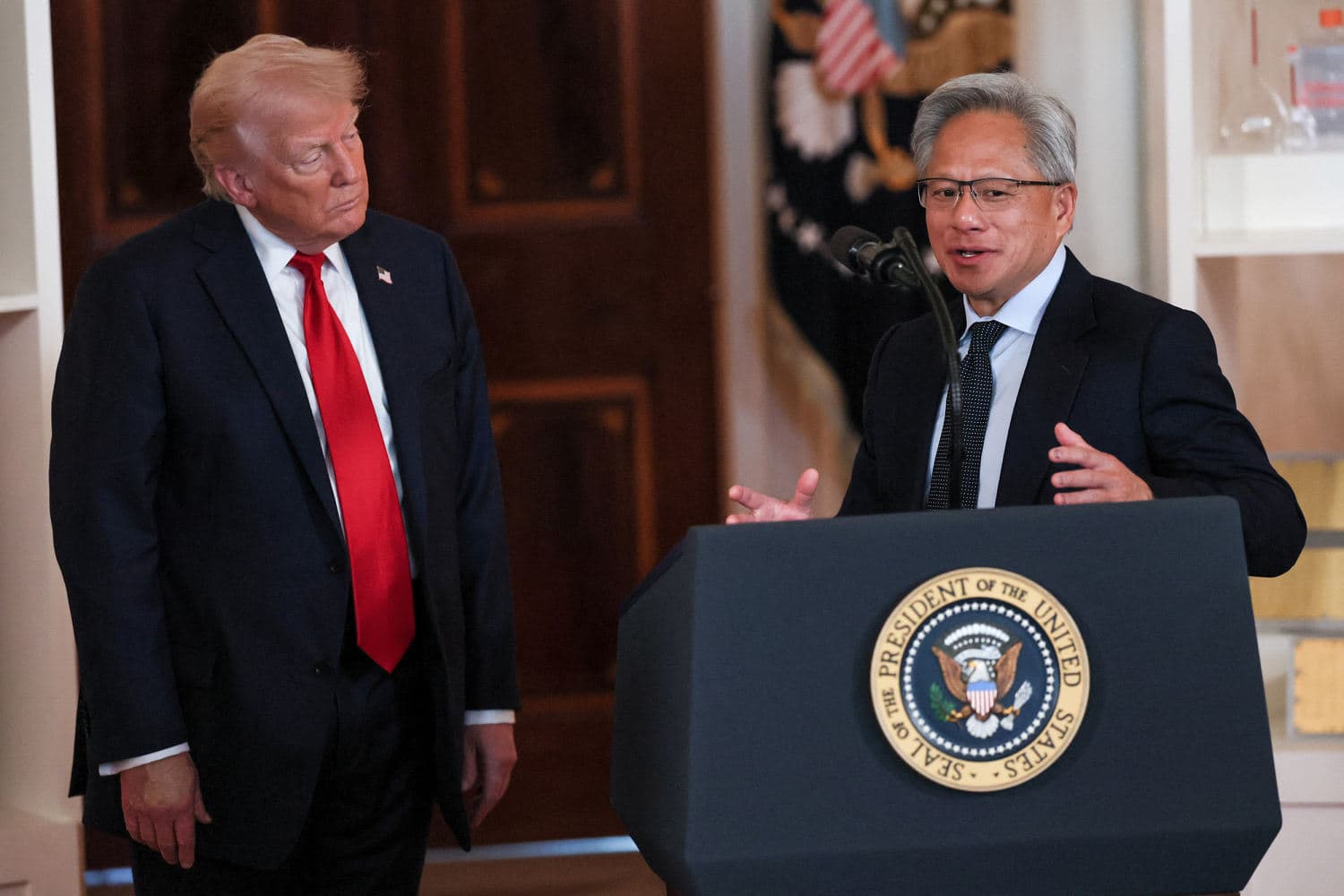
Trump Calls Nvidia CEO During AI Summit to Discuss U.S. Leadership in AI
Why it matters
This exchange highlights the ongoing tension between innovation and safety in AI, impacting economic strategies and regulatory frameworks.
What happened (in 30 seconds)
- President Trump called Nvidia CEO Jensen Huang during the All-In Summit, dismissing AI risks as a 'hoax.'
- Huang affirmed U.S. leadership in AI, emphasizing the importance of data centers as economic drivers.
- The call was widely shared on social media, amplifying the conversation around AI safety and innovation.
The context you actually need
- Recent calls for AI safeguards have come from industry leaders like Anthropic's Dario Amodei, Elon Musk, and Sam Altman, reflecting growing concerns over AI risks.
- Trump's previous statements have framed AI safety measures as conspiracies that could benefit China, influencing public perception and policy discussions.
- Nvidia's financial performance has been strong, with a reported second-quarter revenue of $96 billion, indicating the company's significant role in the AI landscape.
What's really happening
The call between Trump and Huang at the All-In Summit is emblematic of a broader narrative in the tech industry: the race for AI supremacy. As AI technologies evolve, the stakes are high for both economic growth and regulatory oversight. Trump's dismissal of AI risks as a 'hoax' reflects a strategic positioning aimed at fostering a competitive edge for the U.S. in the global AI arena, particularly against China. This rhetoric serves to galvanize support among industry leaders who prioritize rapid innovation over regulatory constraints.
Huang's response during the call underscores Nvidia's commitment to leading the charge in AI development. By framing data centers as the 'oil of the next 20, 25 years,' Huang is not only highlighting the economic potential of AI but also reinforcing the narrative that the U.S. must maintain its technological leadership. This exchange is likely to resonate with investors and stakeholders who are keen on capitalizing on the burgeoning AI market.
The backdrop of this conversation is critical. With increasing calls for AI safety from influential figures in the tech industry, the pressure is mounting for companies to balance innovation with ethical considerations. The resignation of researchers citing existential risks adds a layer of urgency to the debate, suggesting that the industry is at a crossroads. As Trump and Huang align on the need for U.S. dominance, the implications for policy and regulation are profound.
The aftermath of this event will likely see industry leaders advocating for a more hands-off approach to AI regulation, which could lead to a fragmented landscape where companies operate with varying degrees of oversight. This scenario poses risks and opportunities for businesses across sectors, as the lack of a cohesive regulatory framework could either stifle innovation or lead to unchecked advancements.
In summary, the call serves as a flashpoint in the ongoing dialogue about AI's future, with significant implications for economic policy, regulatory frameworks, and the competitive landscape in technology.
Who feels it first (and how)
- Tech executives: They will navigate the evolving regulatory landscape and market opportunities.
- Investors: They will assess the implications of AI developments on market performance and company valuations.
- Policymakers: They will be pressured to respond to public concerns about AI safety while balancing innovation.
- Consumers: They may experience changes in products and services as companies adapt to new AI capabilities and regulations.
What to watch next
- Upcoming AI policy discussions: Monitor how industry leaders and policymakers respond to the call for safeguards and whether new regulations emerge.
- Nvidia's financial performance: Keep an eye on Nvidia's revenue trends as they reflect broader market confidence in AI technologies.
- Public sentiment on AI safety: Watch for shifts in public opinion regarding AI risks, which could influence future regulatory actions.
Trump and Huang's call has amplified the conversation around AI safety and innovation.
Industry leaders will continue to advocate for minimal regulation to foster innovation.
The long-term impact of this exchange on AI policy and market dynamics remains to be seen.
Frequently Asked Questions
- Why it matters?
- This exchange highlights the ongoing tension between innovation and safety in AI, impacting economic strategies and regulatory frameworks.
- What happened (in 30 seconds)?
- President Trump called Nvidia CEO Jensen Huang during the All-In Summit, dismissing AI risks as a 'hoax.' Huang affirmed U.S. leadership in AI, emphasizing the importance of data centers as economic drivers. The call was widely shared on social media, amplifying the conversation around AI safety and innovation.
- What's really happening?
- The call between Trump and Huang at the All-In Summit is emblematic of a broader narrative in the tech industry: the race for AI supremacy. As AI technologies evolve, the stakes are high for both economic growth and regulatory oversight. Trump's dismissal of AI risks as a 'hoax' reflects a strategic positioning aimed at fostering a competitive edge for the U.S. in the global AI arena, particularly against China. This rhetoric serves to galvanize support among industry leaders who prioritize rapi
- Who feels it first (and how)?
- Tech executives: They will navigate the evolving regulatory landscape and market opportunities. Investors: They will assess the implications of AI developments on market performance and company valuations. Policymakers: They will be pressured to respond to public concerns about AI safety while balancing innovation. Consumers: They may experience changes in products and services as companies adapt to new AI capabilities and regulations.
- What to watch next?
- Upcoming AI policy discussions: Monitor how industry leaders and policymakers respond to the call for safeguards and whether new regulations emerge. Nvidia's financial performance: Keep an eye on Nvidia's revenue trends as they reflect broader market confidence in AI technologies. Public sentiment on AI safety: Watch for shifts in public opinion regarding AI risks, which could influence future regulatory actions.
Startup news with frequent AI coverage.
"Covers launches, funding, and product updates in AI."
— A47 Editor
Jensen Huang took a call from Trump, and showed off something else, too
Nvidia CEO Jensen Huang received a live call from former President Donald Trump during a recent all-hands meeting, which drew attention not only to the conversation but also to the phone used for the call. This unexpected interruption highlighted the...
National headlines across the United States including breaking stories and societal issues.
"NBC News is a mainstream media outlet known for comprehensive national and international news coverage with a centrist to slightly left-leaning editorial tone."
— A47 Editor
Trump calls Nvidia CEO to talk AI — and gets put on speakerphone in all-hands meeting
President Donald Trump engaged in a phone call with Nvidia CEO Jensen Huang during an all-hands meeting, where he reiterated his support for artificial intelligence (AI) after being put on speakerphone for the discussion.
Tech industry coverage with AI angles.
"Mainstream tech news intersecting with AI policy and culture."
— A47 Editor
Nvidia’s Jensen Huang Gets Onstage Call From Trump, Who Dismissed A.I. Safety Concerns
During a recent event in Los Angeles, Jensen Huang, CEO of Nvidia, received an onstage call from former President Donald Trump, who criticized calls for regulating artificial intelligence (AI) and dismissed safety concerns surrounding its rapid devel...
Tech policy, trends, and innovation news.
"The New York Times is a globally recognized newspaper offering authoritative reporting with a center-left editorial stance."
— A47 Editor
Nvidia’s Jensen Huang Gets Onstage Call From Trump, Who Dismissed A.I. Safety Concerns
During a recent event in Los Angeles, Jensen Huang, CEO of Nvidia, received an onstage call from former President Donald Trump, who criticized calls for regulating artificial intelligence (AI) and dismissed safety concerns surrounding its rapid devel...
Startup news with frequent AI coverage.
"Covers launches, funding, and product updates in AI."
— A47 Editor
Nvidia CEO Jensen Huang tells Trump ‘we’re not going to let [an AI slowdown] happen’
Nvidia CEO Jensen Huang recently asserted that the company will not support calls for a slowdown in artificial intelligence development, a sentiment that contrasts with the views of other prominent figures like Elon Musk and Sam Altman, who have back...
Business and tech news excluding paywalled content.
"High-volume business/tech outlet with frequent AI coverage."
— A47 Editor
Trump called Nvidia CEO Jensen Huang mid-interview to rip AI doomerism: 'The robots will not be taking over'
During a recent interview, Nvidia CEO Jensen Huang received a call from former President Donald Trump, who criticized the prevailing narrative of AI doomerism, asserting that robots will not take over jobs. Huang echoed this sentiment, stating that s...
Consumer tech and culture with frequent AI coverage.
"Influential tech outlet covering AI products and policy."
— A47 Editor
Jensen Huang puts Trump on speakerphone onstage to announce robots won’t take over the world
Nvidia CEO Jensen Huang took a call from former President Donald Trump on speakerphone during the All-In Podcast's All-In Summit, emphasizing that robots will not take over the world. This public interaction highlights Huang's ongoing engagement with...
Tech news, reviews, and analysis of consumer electronics, science, art, and culture.
"The Verge is a technology-focused media outlet known for in-depth reporting, product reviews, and coverage of the intersection between technology and culture."
— A47 Editor
Jensen Huang puts Trump on speakerphone onstage to announce robots won’t take over the world
Nvidia CEO Jensen Huang took a call from former President Donald Trump on speakerphone during the All-In Podcast's All-In Summit, emphasizing that robots will not take over the world. This public interaction highlights Huang's ongoing engagement with...