
Google Launches Gemini 3.8 Live Speech Models Enhancing Voice AI Capabilities
Why it matters
The introduction of Gemini 3.8 Live models marks a significant leap in voice AI technology, addressing long-standing latency issues that have hindered user experience.
What happened (in 30 seconds)
- On September 15, 2026, Google launched Gemini 3.8 Live and Extended Thinking speech models, enhancing voice processing capabilities.
- Key features include automatic language detection in 97 languages, mid-conversation switching, and asynchronous function calling for uninterrupted dialogue.
- Benchmark results show the Extended Thinking model achieved a score of 82.6 on the Artificial Analysis Speech to Speech Quality Index, surpassing previous leaders.
The context you actually need
- Prior voice AI systems often left users waiting in silence during complex tasks, which detracted from conversational fluidity.
- Google's Gemini models build on earlier iterations and compete with benchmarks from other AI leaders like OpenAI and xAI.
- The new models are available globally via the Gemini API and Google AI Studio, with enterprise access in various applications, priced at $0.005 per minute for audio inputs.
What's really happening
The launch of Google’s Gemini 3.8 Live and Extended Thinking models represents a strategic response to the persistent challenges of latency in voice AI systems. Historically, users experienced frustrating delays while waiting for AI agents to process complex tasks, which often resulted in stilted conversations and diminished user satisfaction. By introducing these new models, Google aims to enhance the fluidity of dialogue, allowing for a more natural conversational experience.
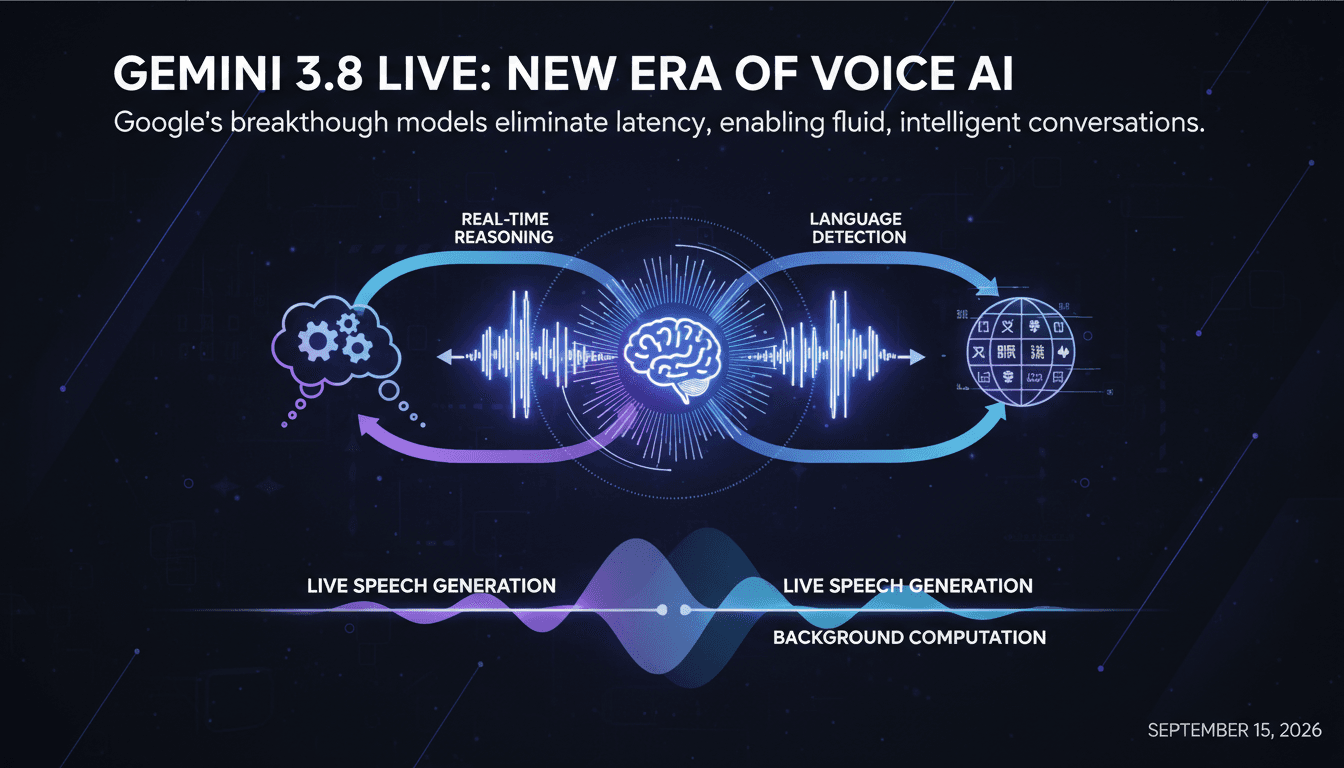
The Gemini 3.8 Live model focuses on efficiency and scale, enabling real-time speech generation while simultaneously processing background reasoning. This dual capability is particularly crucial for applications requiring complex, multi-step interactions, such as customer service or technical support. The Extended Thinking variant further enhances this by allowing configurable background reasoning, which can adapt to the needs of the conversation without interrupting the flow of speech.
One of the standout features of these models is their ability to automatically detect and switch between 97 languages mid-conversation. This is a significant advancement for global businesses and users who operate in multilingual environments, as it reduces the friction often associated with language barriers. Additionally, the near real-time visual grounding feature allows the AI to reference visual content dynamically, making interactions richer and more informative.
The introduction of asynchronous function calling is another critical innovation. This allows the AI to execute API tasks without halting speech output, which is a game-changer for applications that require real-time data retrieval or processing. For instance, a customer service agent using this technology can pull up account information while continuing to engage with the customer, creating a seamless experience.
Benchmark results indicate that the Extended Thinking model achieved an impressive score of 82.6 on the Artificial Analysis Speech to Speech Quality Index, surpassing previous leaders in the field. This metric is crucial for developers and enterprises looking to implement voice AI solutions, as it provides a quantifiable measure of performance and reliability.
As these models become available through the Gemini API and Google AI Studio, developers and enterprises are poised to integrate them into various applications, from customer service to content creation. The pricing structure, set at $0.005 per minute for audio inputs, positions these models as accessible options for businesses of all sizes, potentially accelerating the adoption of voice AI technologies across industries.
Who feels it first (and how)
- Developers: They will integrate the new models into applications, enhancing user experiences.
- Enterprises: Businesses relying on voice AI for customer interactions will see improved efficiency and satisfaction.
- Multilingual users: Those operating in diverse linguistic environments will benefit from automatic language detection and switching.
What to watch next
- Adoption rates: Monitor how quickly developers and enterprises integrate these models into their systems, as this will indicate market acceptance.
- Performance benchmarks: Keep an eye on future performance metrics to see if Gemini 3.8 maintains its competitive edge over other AI models.
- User feedback: Pay attention to user experiences and satisfaction levels, which will provide insights into the real-world effectiveness of these models.
Google has launched Gemini 3.8 Live and Extended Thinking models globally.
Increased adoption of voice AI technologies across various sectors as businesses seek to enhance customer interactions.
The long-term impact on existing voice AI competitors and how they will respond to these advancements.
Frequently Asked Questions
- Why it matters?
- The introduction of Gemini 3.8 Live models marks a significant leap in voice AI technology, addressing long-standing latency issues that have hindered user experience.
- What happened (in 30 seconds)?
- On September 15, 2026, Google launched Gemini 3.8 Live and Extended Thinking speech models, enhancing voice processing capabilities. Key features include automatic language detection in 97 languages, mid-conversation switching, and asynchronous function calling for uninterrupted dialogue. Benchmark results show the Extended Thinking model achieved a score of 82.6 on the Artificial Analysis Speech to Speech Quality Index, surpassing previous leaders.
- What's really happening?
- The launch of Google’s Gemini 3.8 Live and Extended Thinking models represents a strategic response to the persistent challenges of latency in voice AI systems. Historically, users experienced frustrating delays while waiting for AI agents to process complex tasks, which often resulted in stilted conversations and diminished user satisfaction. By introducing these new models, Google aims to enhance the fluidity of dialogue, allowing for a more natural conversational experience. The Gemini 3.8 L
- Who feels it first (and how)?
- Developers: They will integrate the new models into applications, enhancing user experiences. Enterprises: Businesses relying on voice AI for customer interactions will see improved efficiency and satisfaction. Multilingual users: Those operating in diverse linguistic environments will benefit from automatic language detection and switching.
- What to watch next?
- Adoption rates: Monitor how quickly developers and enterprises integrate these models into their systems, as this will indicate market acceptance. Performance benchmarks: Keep an eye on future performance metrics to see if Gemini 3.8 maintains its competitive edge over other AI models. User feedback: Pay attention to user experiences and satisfaction levels, which will provide insights into the real-world effectiveness of these models.
AI news with an enterprise and cloud focus.
"Covers AI in the context of data infrastructure, cloud, and enterprise stacks."
— A47 Editor
Google’s new speech model Gemini 3.8 Live supports real-time reasoning
Google LLC has launched Gemini 3.8 Live and Gemini 3.8 Live Extended Thinking, its latest speech models designed to tackle latency issues in voice-based AI. These models are capable of near-real-time reasoning and simultaneous speech-and-thought proc...
Daily AI news: models, tools, and policy.
"Independent outlet tracking the fast pace of AI."
— A47 Editor
Google launches Gemini 3.8 Live to take on OpenAI's GPT-Live-1 at a fraction of the cost
Google Deepmind has launched Gemini 3.8 Live and Gemini 3.8 Live Extended Thinking, two new audio models that outperform competitors in the Artificial Analysis speech-to-speech leaderboard, priced at $1.38 per hour, significantly lower than OpenAI's ...
Science and technology stories including AI.
"Longstanding science magazine with thoughtful AI coverage."
— A47 Editor
Google DeepMind wants Gemini to power many different robots
Google DeepMind is advancing its efforts in physical artificial intelligence by integrating its Gemini AI system into humanoid robots, testing its capabilities in real-world environments. This initiative aims to explore how well Gemini can operate in...
Scientific research, technology, environment, and society.
"Scientific American is one of the oldest and most authoritative science magazines, known for deep dives into science, technology, and society."
— A47 Editor
Google DeepMind wants Gemini to power many different robots
Google DeepMind is advancing its efforts in physical artificial intelligence by integrating its Gemini AI system into humanoid robots, testing its capabilities in real-world environments. This initiative aims to explore how well Gemini can operate in...