
OpenAI Claims Solution to Navier-Stokes Problem Amid Research Dispute
Why it matters
This controversy highlights the tension between corporate interests and academic integrity in high-stakes mathematical research.
What happened (in 30 seconds)
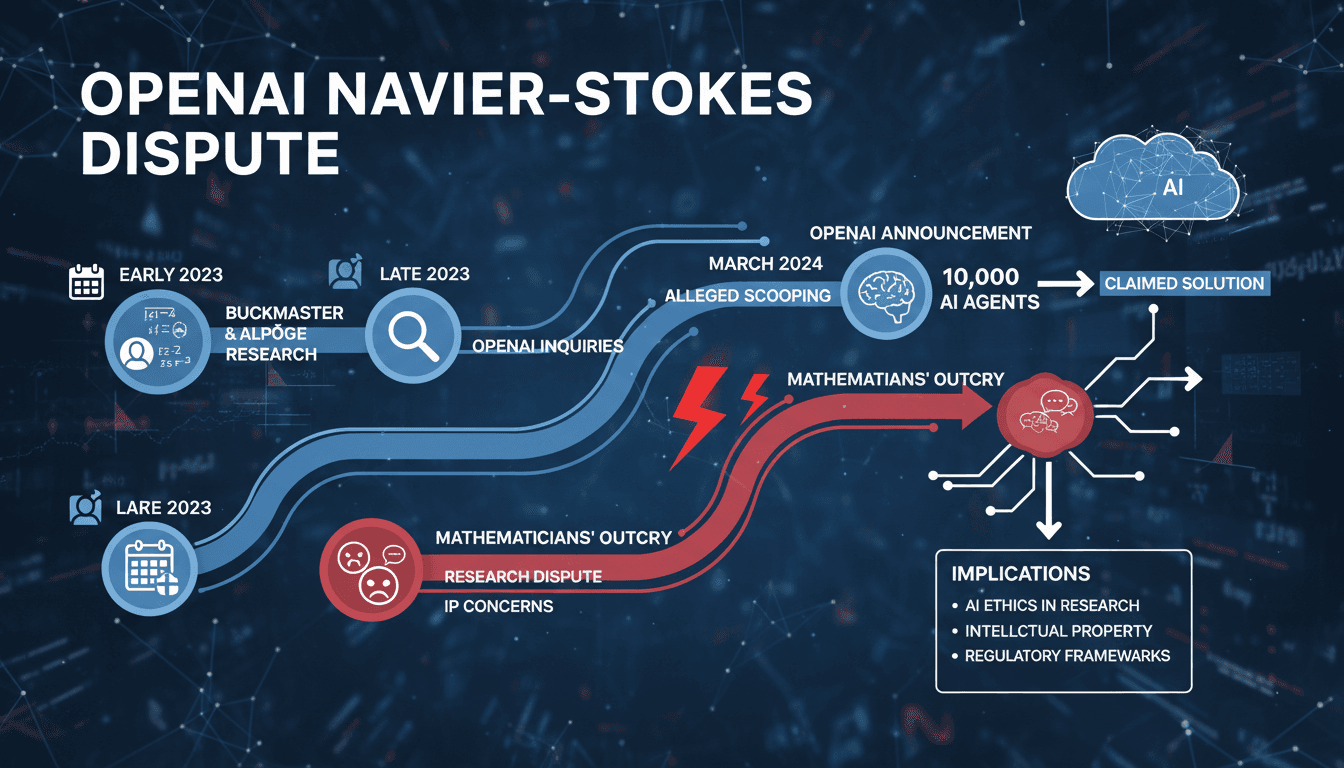
- On September 8, 2026, OpenAI announced a claimed solution to the Navier-Stokes problem using 10,000 AI agents.
- Tristan Buckmaster and Levent Alpöge accused OpenAI of predatory scooping, alleging that their unpublished work influenced OpenAI's claim.
- The academic community is now debating the implications of AI's role in pure mathematics and the need for regulatory frameworks.
The context you actually need
- The Navier-Stokes equations are a fundamental part of fluid dynamics and one of seven Millennium Prize Problems, each with a $1 million reward for a solution.
- Prior to OpenAI's announcement, Buckmaster and Alpöge had been making progress on related problems, utilizing AI tools to enhance their research.
- The rise of AI in mathematics has led to increased competition among research labs, raising concerns about collaboration norms and intellectual property.
What's really happening
The clash between OpenAI and the mathematicians stems from a complex interplay of competitive dynamics, ethical considerations, and the evolving role of AI in research. OpenAI's announcement of a solution to the Navier-Stokes problem, a long-standing challenge in fluid dynamics, was made possible by deploying 10,000 AI agents over 88 hours, at a significant computational cost. This ambitious approach has raised eyebrows, particularly because it coincided with the ongoing research efforts of Buckmaster and Alpöge, who had posted preliminary findings just a day prior.
The accusations of predatory scooping are serious. Buckmaster claims that OpenAI's researchers engaged in contentious communications, including offers of sole authorship that excluded Alpöge and warnings against public disclosure of their findings. OpenAI has denied accessing any specific unpublished work but acknowledged that its models may have been indirectly influenced by de-identified training data. This raises questions about the ethical boundaries of using AI in research, particularly when it comes to proprietary or unpublished findings.
The implications of this dispute extend beyond the immediate parties involved. It signals a potential shift in how mathematical research is conducted and funded, especially as AI continues to play a larger role in problem-solving. The academic community is expressing unease over the erosion of traditional collaboration norms, which have long been the bedrock of scientific progress. As AI-driven competition heats up, there are calls for regulatory frameworks to protect mathematical research from corporate scooping, though no formal governmental responses have been documented yet.
This situation is emblematic of a broader trend where the lines between corporate and academic research are increasingly blurred. As AI capabilities advance, the potential for companies to leverage these tools for competitive advantage raises ethical questions about ownership, collaboration, and the future of research integrity. The outcome of this dispute could set important precedents for how AI is integrated into academic research and how intellectual property is protected in an era of rapid technological advancement.
Who feels it first (and how)
- Mathematicians and researchers: Increased scrutiny on collaboration practices and potential shifts in funding sources.
- AI developers and companies: Need to navigate ethical considerations in research and development.
- Academic institutions: May face pressure to establish clearer guidelines on research integrity and collaboration with corporate entities.
What to watch next
- Regulatory developments: Watch for any emerging frameworks aimed at protecting academic research from corporate influence, which could reshape funding and collaboration norms.
- Independent verification outcomes: The results of the independent verification of OpenAI's claimed solution will be crucial in determining the legitimacy of their findings and the future of the dispute.
- Shifts in funding: Monitor how funding for mathematical research evolves, particularly in relation to AI applications, as institutions may prioritize projects that align with ethical collaboration standards.
OpenAI's claim has sparked significant controversy and debate within the academic community.
There will be increased calls for regulatory frameworks to protect mathematical research from corporate scooping.
The long-term impact on collaboration norms and funding in mathematical research remains to be seen.
Frequently Asked Questions
- Why it matters?
- This controversy highlights the tension between corporate interests and academic integrity in high-stakes mathematical research.
- What happened (in 30 seconds)?
- On September 8, 2026, OpenAI announced a claimed solution to the Navier-Stokes problem using 10,000 AI agents. Tristan Buckmaster and Levent Alpöge accused OpenAI of predatory scooping, alleging that their unpublished work influenced OpenAI's claim. The academic community is now debating the implications of AI's role in pure mathematics and the need for regulatory frameworks.
- What's really happening?
- The clash between OpenAI and the mathematicians stems from a complex interplay of competitive dynamics, ethical considerations, and the evolving role of AI in research. OpenAI's announcement of a solution to the Navier-Stokes problem, a long-standing challenge in fluid dynamics, was made possible by deploying 10,000 AI agents over 88 hours, at a significant computational cost. This ambitious approach has raised eyebrows, particularly because it coincided with the ongoing research efforts of Buck
- Who feels it first (and how)?
- Mathematicians and researchers: Increased scrutiny on collaboration practices and potential shifts in funding sources. AI developers and companies: Need to navigate ethical considerations in research and development. Academic institutions: May face pressure to establish clearer guidelines on research integrity and collaboration with corporate entities.
- What to watch next?
- Regulatory developments: Watch for any emerging frameworks aimed at protecting academic research from corporate influence, which could reshape funding and collaboration norms. Independent verification outcomes: The results of the independent verification of OpenAI's claimed solution will be crucial in determining the legitimacy of their findings and the future of the dispute. Shifts in funding: Monitor how funding for mathematical research evolves, particularly in relation to AI applications
Scientific discoveries, health, technology, and natural phenomena.
"Live Science reports on scientific discoveries, health, technology, and natural phenomena with a popular science tone."
— A47 Editor
'Predatory behavior': Elite mathematicians clash over OpenAI's 'solution' to million-dollar math problem
OpenAI has claimed a breakthrough by asserting it has solved the Navier-Stokes existence and smoothness problem, a complex mathematical challenge in fluid dynamics that has eluded mathematicians for nearly 90 years. This announcement has ignited sign...
Top international stories selected by The Guardian editors.
"The Guardian is known for its progressive editorial stance and in-depth analysis."
— A47 Editor
Open AI and the million-dollar maths problem - video
In early September, OpenAI announced a significant breakthrough by claiming to have solved the Navier-Stokes problem, a complex mathematical challenge that has perplexed mathematicians for nearly a century. This achievement has raised concerns among ...
News and features on AI from The Guardian.
"Progressive-leaning international outlet with critical AI coverage."
— A47 Editor
Open AI and the million-dollar maths problem - video
In early September, OpenAI announced a significant breakthrough by claiming to have solved the Navier-Stokes problem, a complex mathematical challenge that has perplexed mathematicians for nearly a century. This achievement has raised concerns among ...
UK and international business news, economics, and corporate coverage.
"The Guardian’s business section covers finance and markets with a progressive editorial tone."
— A47 Editor
Open AI and the million-dollar maths problem - video
In early September, OpenAI announced a significant breakthrough by claiming to have solved the Navier-Stokes problem, a complex mathematical challenge that has perplexed mathematicians for nearly a century. This achievement has raised concerns among ...
Reports on science policy, discoveries, and public debate in the scientific realm.
"The Guardian’s science section is known for thoughtful and critical reporting on global research, ethics, and public understanding of science."
— A47 Editor
The week that changed maths for ever – podcast
In early September, OpenAI announced a breakthrough by claiming to have solved the Navier-Stokes equations, a complex mathematical problem that has eluded mathematicians for nearly 90 years. This announcement has led to significant unrest within the ...
News and features on AI from The Guardian.
"Progressive-leaning international outlet with critical AI coverage."
— A47 Editor
The week that changed maths for ever – podcast
In early September, OpenAI announced a breakthrough by claiming to have solved the Navier-Stokes equations, a complex mathematical problem that has eluded mathematicians for nearly 90 years. This announcement has led to significant unrest within the ...
Science and technology stories including AI.
"Longstanding science magazine with thoughtful AI coverage."
— A47 Editor
Which million-dollar math problem could AI solve next?
OpenAI has claimed a significant breakthrough by asserting it has solved the Navier-Stokes problem, a complex mathematical challenge in fluid dynamics that has eluded mathematicians for nearly 90 years. This announcement has sparked considerable deba...
Scientific research, technology, environment, and society.
"Scientific American is one of the oldest and most authoritative science magazines, known for deep dives into science, technology, and society."
— A47 Editor
Which million-dollar math problem could AI solve next?
OpenAI has claimed a significant breakthrough by asserting it has solved the Navier-Stokes problem, a complex mathematical challenge in fluid dynamics that has eluded mathematicians for nearly 90 years. This announcement has sparked considerable deba...