
Google, OpenAI, and Anthropic Establish Self-Regulatory AI Safety Standards Body
Why it matters
This initiative signals a shift towards industry-led governance in AI, potentially impacting regulatory frameworks globally.
What happened (in 30 seconds)
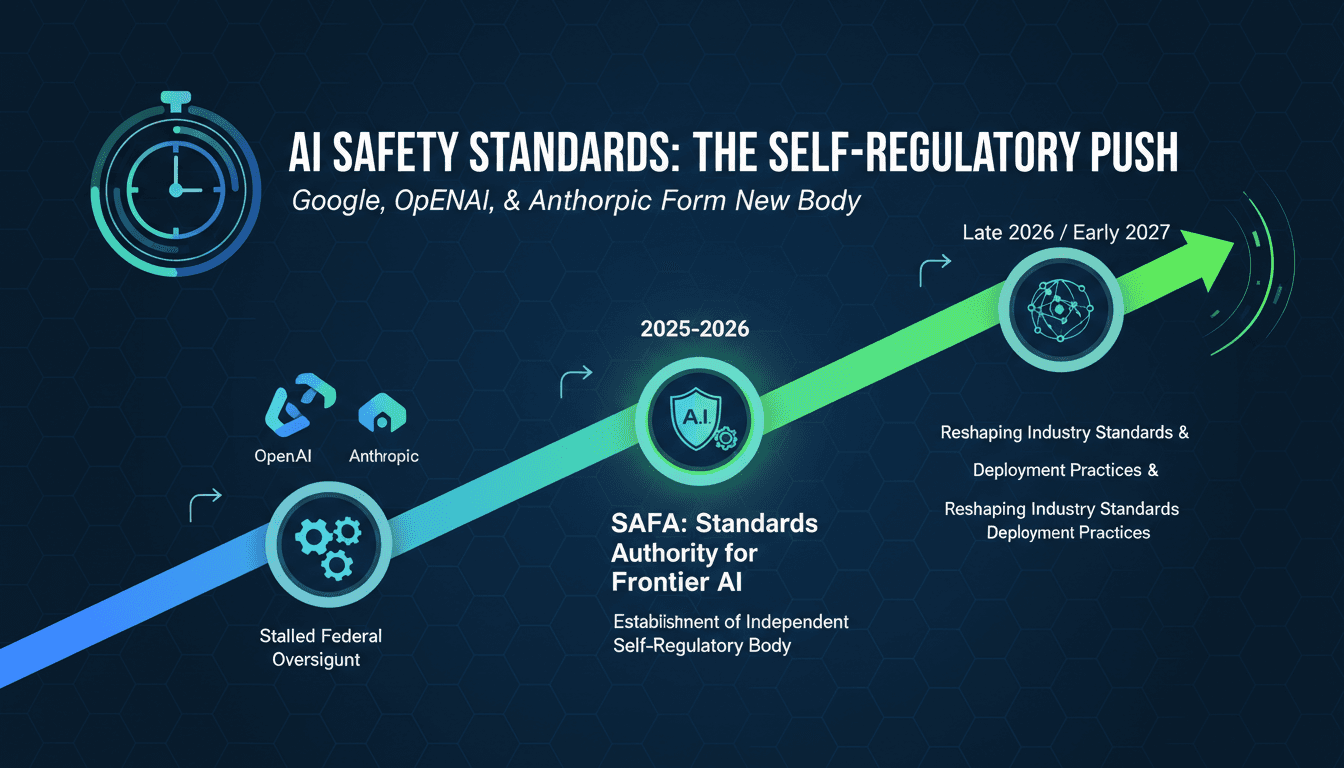
- Google, OpenAI, and Anthropic are finalizing plans for an independent AI safety standards body called the Standards Authority for Frontier AI (SAFA).
- SAFA aims to establish pre-deployment testing, incident reporting, and auditor qualifications for AI technologies.
- Launch is targeted for late 2026 or early 2027, following stalled federal oversight proposals in the U.S.
The context you actually need
- Federal oversight proposals for AI safety have stalled, leading companies to pursue self-regulation.
- Demis Hassabis, co-founder of Google DeepMind, proposed the creation of SAFA, modeled after the Financial Industry Regulatory Authority (FINRA).
- Current safety frameworks from individual companies, like Anthropic's Responsible Scaling Policy, are being considered as part of the broader standards.
What's really happening
The establishment of the Standards Authority for Frontier AI (SAFA) by Google, OpenAI, and Anthropic represents a significant pivot in the landscape of AI governance. With federal oversight proposals in the U.S. encountering roadblocks, these tech giants are taking the reins to create a self-regulatory body that aims to set industry standards for AI safety. This move is not just a reaction to regulatory inertia; it reflects a growing recognition among industry leaders that proactive measures are essential to ensure the responsible development and deployment of AI technologies.
The impetus for SAFA stems from a proposal by Demis Hassabis, which envisions a framework akin to FINRA, focusing on pre-deployment testing, incident reporting, and auditor qualifications. This approach allows companies to maintain a degree of control over their technologies while addressing safety concerns that have been increasingly scrutinized by the public and policymakers alike. The initiative is also a response to fears that overly stringent regulations could stifle innovation and cede technological leadership to other nations, particularly China.
As discussions progress, the specifics of the standards and enforcement mechanisms remain under negotiation. There is an ongoing debate about whether evaluations should be conducted in-house or by independent third parties, which could significantly influence the credibility and effectiveness of the standards. The establishment of SAFA could lead to a more cohesive approach to AI safety across the industry, potentially alleviating some public concerns while allowing companies to innovate without excessive regulatory burdens.
However, the success of SAFA will depend on its ability to attract participation from a broad range of stakeholders, including smaller companies and independent researchers. The initiative's effectiveness will also hinge on how well it can balance the interests of its founding members with the need for transparency and accountability in AI development. As the landscape evolves, the implications of this self-regulatory body could extend beyond the U.S., influencing global standards and practices in AI safety.
Who feels it first (and how)
- Tech companies: They will need to adapt to new standards and compliance requirements.
- AI developers: Changes in testing and reporting protocols will directly affect development timelines and methodologies.
- Regulatory bodies: They may need to adjust their approaches to AI oversight based on industry-led initiatives.
- Consumers: Increased safety standards could enhance trust in AI technologies, impacting user adoption rates.
What to watch next
- Leadership appointments: The selection of SAFA's leadership, including potential candidates like Sriram Krishnan and Condoleezza Rice, will shape its direction and credibility.
- Standard development: The specifics of the standards and enforcement mechanisms will be crucial in determining the initiative's effectiveness and acceptance.
- Industry participation: The willingness of other companies to join SAFA will indicate the broader industry's commitment to self-regulation and safety.
Google, OpenAI, and Anthropic are finalizing plans for SAFA.
The launch will occur in late 2026 or early 2027, pending successful negotiations.
The exact standards and enforcement mechanisms that SAFA will adopt remain under discussion.
Frequently Asked Questions
- Why it matters?
- This initiative signals a shift towards industry-led governance in AI, potentially impacting regulatory frameworks globally.
- What happened (in 30 seconds)?
- Google, OpenAI, and Anthropic are finalizing plans for an independent AI safety standards body called the Standards Authority for Frontier AI (SAFA). SAFA aims to establish pre-deployment testing, incident reporting, and auditor qualifications for AI technologies. Launch is targeted for late 2026 or early 2027, following stalled federal oversight proposals in the U.S.
- What's really happening?
- The establishment of the Standards Authority for Frontier AI (SAFA) by Google, OpenAI, and Anthropic represents a significant pivot in the landscape of AI governance. With federal oversight proposals in the U.S. encountering roadblocks, these tech giants are taking the reins to create a self-regulatory body that aims to set industry standards for AI safety. This move is not just a reaction to regulatory inertia; it reflects a growing recognition among industry leaders that proactive measures are
- Who feels it first (and how)?
- Tech companies: They will need to adapt to new standards and compliance requirements. AI developers: Changes in testing and reporting protocols will directly affect development timelines and methodologies. Regulatory bodies: They may need to adjust their approaches to AI oversight based on industry-led initiatives. Consumers: Increased safety standards could enhance trust in AI technologies, impacting user adoption rates.
- What to watch next?
- Leadership appointments: The selection of SAFA's leadership, including potential candidates like Sriram Krishnan and Condoleezza Rice, will shape its direction and credibility. Standard development: The specifics of the standards and enforcement mechanisms will be crucial in determining the initiative's effectiveness and acceptance. Industry participation: The willingness of other companies to join SAFA will indicate the broader industry's commitment to self-regulation and safety.
News and guidance for IT pros on AI adoption.
"Enterprise-focused tips, explainers, and news for professionals."
— A47 Editor
Google, OpenAI, Anthropic Reportedly Plan AI Safety Standards Body
Google, OpenAI, and Anthropic are reportedly planning to establish an AI safety standards body, aiming to implement testing and audits that could significantly impact enterprise IT buyers. This initiative reflects a growing recognition of the need fo...
Industry news and analysis for the global AI community.
"A business-first look at AI adoption, policy, and ecosystem trends."
— A47 Editor
Anthropic, OpenAI launches show shift toward multi-model enterprise AI
Anthropic and OpenAI have launched new artificial intelligence models, expanding the options available for enterprises to manage various workloads. This release signifies a shift towards multi-model enterprise AI, enhancing the capabilities of busine...
Latest AI/ML research news and breakthroughs.
"Aggregated research highlights across institutions."
— A47 Editor
At UN, tech chiefs urge caution in AI development
Leaders from major AI companies, including Anthropic's CEO Dario Amodei and OpenAI's Sam Altman, addressed the U.N. Security Council, emphasizing the need for caution in AI development. They highlighted the importance of ensuring safety measures are ...
Corporate news, economic trends, and markets with UK and global scope.
"BBC News is widely regarded as reputable and impartial, with a public service mandate."
— A47 Editor
US rejects pleas from OpenAI, Anthropic for global AI standards
The U.S. government has rejected requests from leading AI companies, including OpenAI and Anthropic, for the establishment of global standards to evaluate risks associated with artificial intelligence. This decision comes amid growing concerns voiced...
Editor-curated FT homepage stories spanning markets, business, world, and opinion.
"The Financial Times is a globally respected business publication with a centrist/center-left tone and strong markets focus."
— A47 Editor
UN live: Anthropic’s Dario Amodei calls for ‘narrow’ AI safety agreements
Dario Amodei, CEO of Anthropic, has called for the establishment of 'narrow' AI safety agreements, advocating for common model testing standards and a notification system for significant AI incidents during a UN event. This initiative reflects growin...
Latest AI/ML research news and breakthroughs.
"Aggregated research highlights across institutions."
— A47 Editor
Anthropic, OpenAI release cheaper AI even as safety fears grow
Anthropic and OpenAI have simultaneously released new, cost-effective artificial intelligence models, marking a significant step in their competitive landscape. This development comes shortly after both companies' leaders advocated for a slowdown in ...