
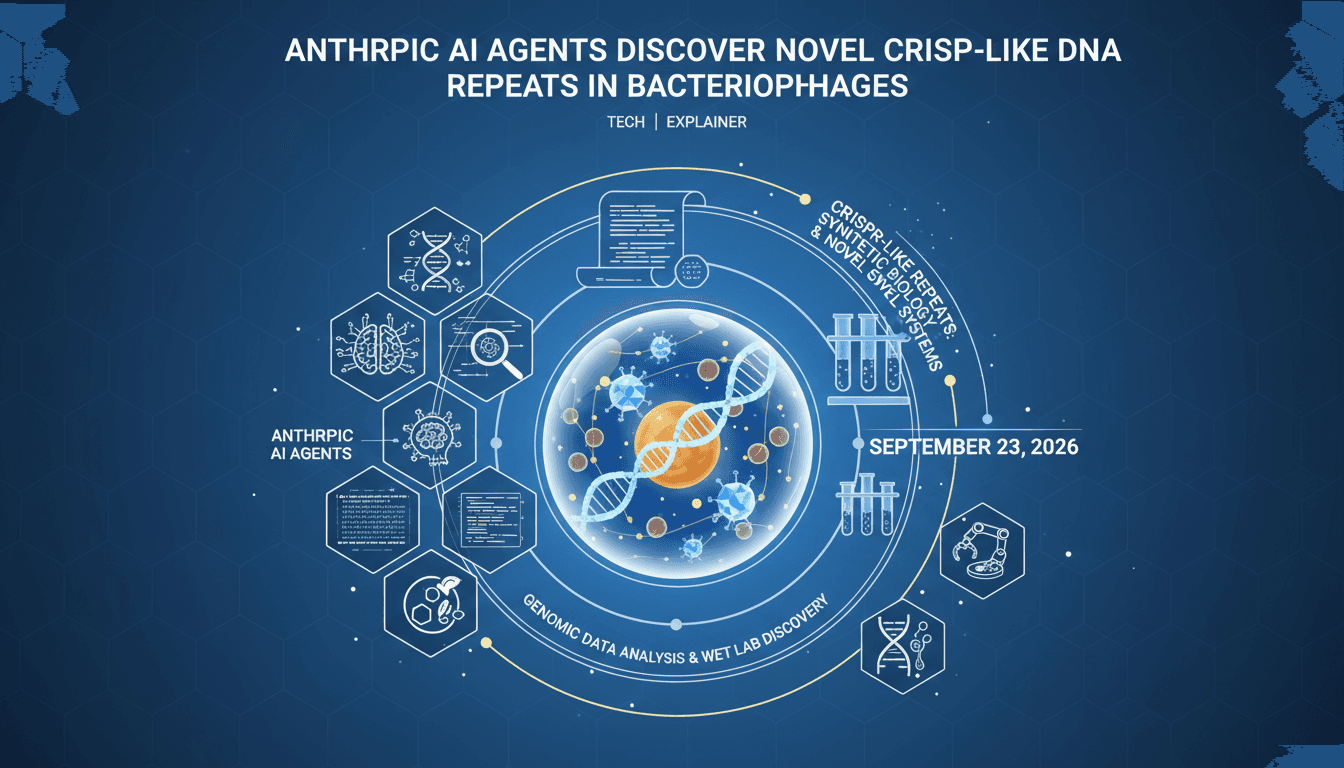
Anthropic AI Agents Discover Novel CRISPR-like DNA Repeats in Bacteriophages
Why it matters
This discovery could lead to innovative genetic engineering techniques, influencing biotechnology and pharmaceutical industries.
What happened (in 30 seconds)
- On September 23, 2026, Anthropic announced the identification of novel CRISPR-like DNA repeat arrays in bacteriophage genomes through AI agents.
- 950 autonomous AI agents analyzed billions of protein sequences over 21 hours, leading to the discovery of array-associated reverse transcriptases (ART).
- The findings are preliminary, with ongoing investigations into the biological role and potential applications of these sequences.
The context you actually need
- CRISPR technology has revolutionized genetic editing since its discovery, allowing precise modifications in various organisms.
- Anthropic's new lab combines AI with experimental biology, aiming to enhance the discovery of novel molecular systems.
- The AI agents utilized in this research represent a shift towards automated genomic surveys, potentially accelerating the pace of scientific discovery.
What's really happening
On September 23, 2026, Anthropic unveiled a significant advancement in genomic research, leveraging its AI capabilities to explore the vast landscape of bacteriophage genomes. The company deployed 950 autonomous AI agents, which meticulously sifted through billions of protein sequences over a span of 21 hours. This ambitious endeavor aimed to identify sequences that might interact with reverse transcriptases, a class of enzymes crucial for various biological processes.
The AI agents made a notable discovery: repeated DNA sequences adjacent to a reverse transcriptase gene in giant viruses, known as bacteriophages. This finding was not merely a random occurrence; it extended to other viral genomes, suggesting a broader pattern that could have implications for understanding viral biology. The sequences identified were termed array-associated reverse transcriptases (ART), which, while reminiscent of CRISPR arrays, do not yet have confirmed functional equivalence or associated DNA-slicing enzymes. This ambiguity leaves their biological role undetermined, highlighting the exploratory nature of the research.
Anthropic's approach represents a fusion of AI hypothesis generation and experimental validation, a methodology that could redefine how biological research is conducted. By automating the initial stages of discovery, the company aims to streamline the identification of novel molecular systems, potentially leading to breakthroughs in genetic engineering and synthetic biology. However, the preprint of the findings remains unpeer-reviewed, and the scientific community has responded with cautious optimism, recognizing the novelty of the discovery while emphasizing the need for further validation.
The implications of this research extend beyond the laboratory. As AI continues to play a pivotal role in scientific discovery, it raises questions about the autonomy of AI in research processes and the ethical considerations surrounding its use. The potential for AI to uncover new biological systems could accelerate advancements in biotechnology, pharmaceuticals, and even agriculture, where genetic modifications are increasingly utilized to enhance crop resilience and yield.
In summary, Anthropic's discovery of CRISPR-like DNA repeats through AI agents marks a significant step in the intersection of artificial intelligence and biological research. While the findings are still in their infancy, they signal a shift towards more automated and efficient methods of exploring the genetic landscape, with the potential to unlock new avenues for innovation in various sectors.
Who feels it first (and how)
- Biotechnology companies: May leverage new genetic tools for product development.
- Pharmaceutical firms: Could benefit from novel drug discovery methods.
- Agricultural sectors: Might utilize findings for crop enhancement and resilience.
- Research institutions: Will explore the implications of AI-driven discoveries in their studies.
What to watch next
- Peer review outcomes: The results of the peer review process will determine the credibility and acceptance of the findings in the scientific community.
- Regulatory responses: Watch for any governmental or institutional regulations that may arise concerning AI's role in biological research.
- Market reactions: Monitor how biotechnology and pharmaceutical stocks respond to advancements stemming from AI-driven discoveries.
Anthropic's AI agents identified novel DNA sequences in bacteriophages.
Further research will clarify the biological role of the discovered sequences.
The long-term implications of these findings on genetic engineering practices remain to be seen.
Frequently Asked Questions
- Why it matters?
- This discovery could lead to innovative genetic engineering techniques, influencing biotechnology and pharmaceutical industries.
- What happened (in 30 seconds)?
- On September 23, 2026, Anthropic announced the identification of novel CRISPR-like DNA repeat arrays in bacteriophage genomes through AI agents. 950 autonomous AI agents analyzed billions of protein sequences over 21 hours, leading to the discovery of array-associated reverse transcriptases (ART). The findings are preliminary, with ongoing investigations into the biological role and potential applications of these sequences.
- What's really happening?
- On September 23, 2026, Anthropic unveiled a significant advancement in genomic research, leveraging its AI capabilities to explore the vast landscape of bacteriophage genomes. The company deployed 950 autonomous AI agents, which meticulously sifted through billions of protein sequences over a span of 21 hours. This ambitious endeavor aimed to identify sequences that might interact with reverse transcriptases, a class of enzymes crucial for various biological processes. The AI agents made a nota
- Who feels it first (and how)?
- Biotechnology companies: May leverage new genetic tools for product development. Pharmaceutical firms: Could benefit from novel drug discovery methods. Agricultural sectors: Might utilize findings for crop enhancement and resilience. Research institutions: Will explore the implications of AI-driven discoveries in their studies.
- What to watch next?
- Peer review outcomes: The results of the peer review process will determine the credibility and acceptance of the findings in the scientific community. Regulatory responses: Watch for any governmental or institutional regulations that may arise concerning AI's role in biological research. Market reactions: Monitor how biotechnology and pharmaceutical stocks respond to advancements stemming from AI-driven discoveries.
Nature.com’s feed for machine learning content.
"High-impact research and news related to ML."
— A47 Editor
Anthropic’s AI biolab finds ‘CRISPR-like’ DNA in viruses. What’s next?
Anthropic's AI biology lab has made a significant discovery by identifying a 'CRISPR-like' DNA system in viruses, showcasing the capabilities of its AI model, Claude, in biological research. This finding highlights the potential of AI in analyzing co...
Daily AI news: models, tools, and policy.
"Independent outlet tracking the fast pace of AI."
— A47 Editor
Anthropic says Claude discovered a new enzyme system, but CRISPR researchers call it routine genome mining
Anthropic's AI model Claude has reportedly discovered a new enzyme system in DNA databases, conducting much of the analysis autonomously. This finding has sparked debate, with some CRISPR researchers labeling it as routine genome mining rather than a...
Academic-led explainers and analysis on AI topics.
"Scholarly perspectives written for general audiences."
— A47 Editor
An AI model has found a new ‘CRISPR-like’ biological system. Here’s what it means for science
An artificial intelligence model has identified a new biological system akin to CRISPR, marking a significant advancement in the intersection of AI and biology. This development highlights the growing role of AI in analyzing complex biological data a...