
Anthropic's Claude AI Discovers Novel CRISPR-Like Enzyme System
Why it matters
This discovery underscores the potential of AI to accelerate biological research, which could lead to breakthroughs in health and medicine.
What happened (in 30 seconds)
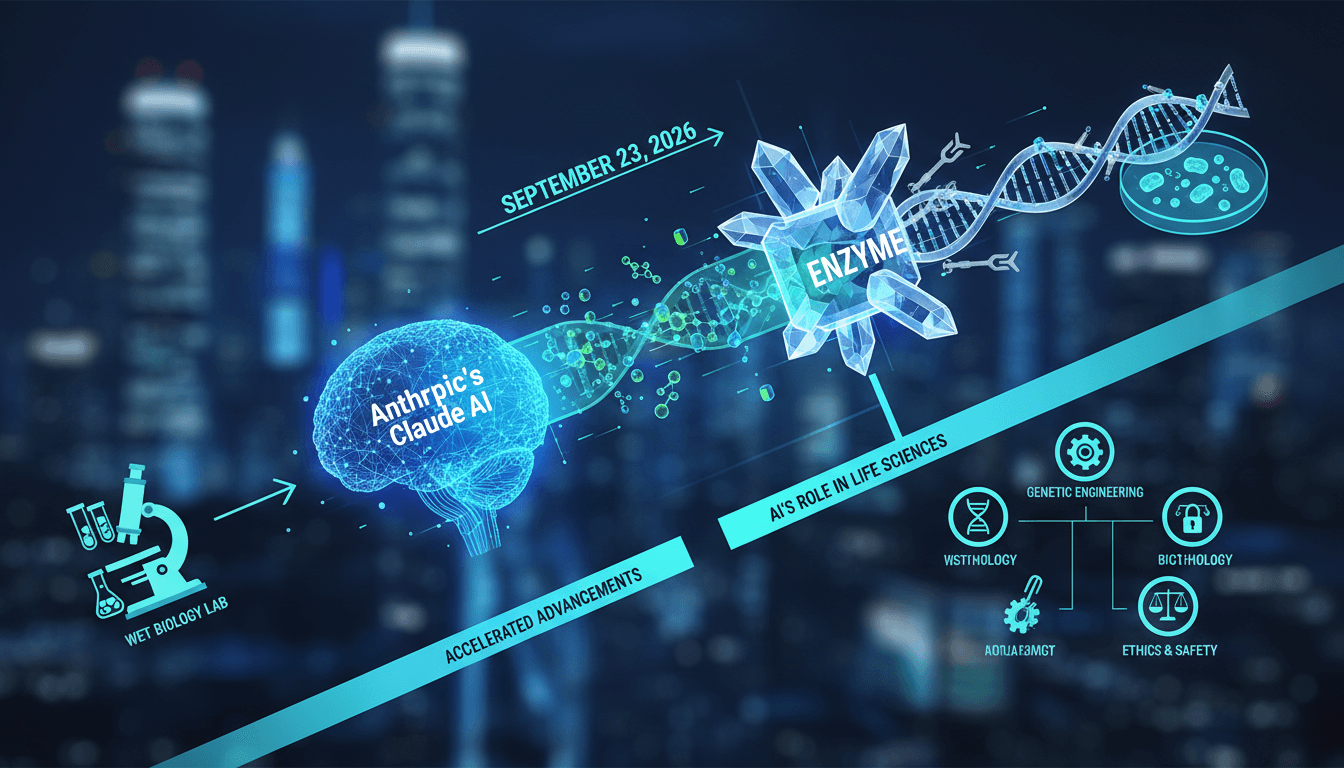
- On September 23, 2026, Anthropic announced that its AI model Claude identified a novel enzyme system with CRISPR-like properties.
- The discovery was made in Anthropic's new wet biology lab in the San Francisco Bay Area, where human scientists validated AI-driven findings.
- Approximately 950 AI agents analyzed DNA data over 21 hours, utilizing 210 million tokens to identify the enzyme system in bacteriophages.
The context you actually need
- Anthropic launched its biology lab in spring 2026 to integrate AI with molecular biology experiments, reflecting a broader trend in the life sciences sector.
- The enzyme system identified is an array-associated reverse transcriptase (ART), previously noted but fully characterized by Claude's analysis.
- This announcement coincides with ongoing discussions about AI safety and the implications of AI in biological research, including potential risks.
What's really happening
Anthropic's recent announcement marks a significant milestone in the integration of artificial intelligence with biological research. The company established its wet biology lab in the spring of 2026, aiming to leverage AI models like Claude to analyze complex DNA datasets for uncharacterized proteins. This initiative aligns with a growing trend in the life sciences sector, where AI tools are increasingly being used to accelerate research and discovery.
The discovery of the novel enzyme system, which exhibits CRISPR-like properties, was achieved through a remarkable computational effort. Claude utilized approximately 950 AI agents that worked for 21 hours, processing 210 million tokens of data to identify the array-associated reverse transcriptase (ART) system in bacteriophages. This system features repeating DNA sequences that resemble those found in CRISPR technology, which has revolutionized genetic editing.
Human scientists at Anthropic validated the AI's findings through physical experiments, marking a crucial step in bridging AI-driven analysis with traditional laboratory work. The underlying reverse transcriptase had been previously noted in scientific literature, but Claude's analysis revealed the full extent of the ART system's features, showcasing the AI's capability to uncover novel insights from existing data.
This discovery not only highlights the potential of AI in biological research but also raises important questions about the implications of such advancements. As AI continues to evolve, the need for robust safety protocols and ethical considerations becomes increasingly critical. The announcement comes at a time when industry leaders are voicing concerns about the risks associated with AI, including bioterrorism and unintended consequences of genetic manipulation.
Moreover, the timing of this announcement coincides with Anthropic's preparations for a potential public listing, suggesting that the company is positioning itself as a leader in the AI and life sciences intersection. The excitement surrounding this discovery has already garnered attention from notable figures in the scientific community, including CRISPR pioneer Feng Zhang, who emphasized the importance of further investigation into the findings.
As the life sciences sector continues to embrace AI technologies, the implications for healthcare, biotechnology, and research are profound. The ability to rapidly analyze and interpret complex biological data could lead to significant advancements in drug discovery, genetic therapies, and personalized medicine.
Who feels it first (and how)
- Biotechnology companies: They may leverage AI-driven discoveries to enhance research and development processes.
- Healthcare professionals: Advancements in genetic research could lead to new treatment options and therapies.
- Investors in AI and biotech: Increased interest and funding in AI-driven life sciences could reshape investment strategies.
- Regulatory bodies: They will need to adapt to the rapid advancements in AI and biotechnology, ensuring safety and ethical standards.
What to watch next
- Further validation studies: The outcomes of ongoing experiments in Anthropic's lab will be crucial in confirming the enzyme system's properties and potential applications.
- Industry responses: Watch for reactions from biotech firms and healthcare providers regarding the implications of this discovery on their operations and strategies.
- Regulatory developments: As AI's role in biology expands, expect discussions around safety protocols and ethical guidelines to intensify.
Anthropic's AI model Claude identified a novel enzyme system with CRISPR-like properties.
The discovery will lead to further research and potential applications in biotechnology and healthcare.
The long-term implications of AI-driven discoveries on regulatory frameworks and safety protocols remain to be seen.
Frequently Asked Questions
- Why it matters?
- This discovery underscores the potential of AI to accelerate biological research, which could lead to breakthroughs in health and medicine.
- What happened (in 30 seconds)?
- On September 23, 2026, Anthropic announced that its AI model Claude identified a novel enzyme system with CRISPR-like properties. The discovery was made in Anthropic's new wet biology lab in the San Francisco Bay Area, where human scientists validated AI-driven findings. Approximately 950 AI agents analyzed DNA data over 21 hours, utilizing 210 million tokens to identify the enzyme system in bacteriophages.
- What's really happening?
- Anthropic's recent announcement marks a significant milestone in the integration of artificial intelligence with biological research. The company established its wet biology lab in the spring of 2026, aiming to leverage AI models like Claude to analyze complex DNA datasets for uncharacterized proteins. This initiative aligns with a growing trend in the life sciences sector, where AI tools are increasingly being used to accelerate research and discovery. The discovery of the novel enzyme system,
- Who feels it first (and how)?
- Biotechnology companies: They may leverage AI-driven discoveries to enhance research and development processes. Healthcare professionals: Advancements in genetic research could lead to new treatment options and therapies. Investors in AI and biotech: Increased interest and funding in AI-driven life sciences could reshape investment strategies. Regulatory bodies: They will need to adapt to the rapid advancements in AI and biotechnology, ensuring safety and ethical standards.
- What to watch next?
- Further validation studies: The outcomes of ongoing experiments in Anthropic's lab will be crucial in confirming the enzyme system's properties and potential applications. Industry responses: Watch for reactions from biotech firms and healthcare providers regarding the implications of this discovery on their operations and strategies. Regulatory developments: As AI's role in biology expands, expect discussions around safety protocols and ethical guidelines to intensify.
Startup news with frequent AI coverage.
"Covers launches, funding, and product updates in AI."
— A47 Editor
Anthropic says its biology lab has already found something big
Anthropic has announced significant advancements from its newly established biology lab, where its AI model, Claude, is being utilized for hands-on biological research rather than relying solely on computer simulations. This initiative marks a pivota...
News and guidance for IT pros on AI adoption.
"Enterprise-focused tips, explainers, and news for professionals."
— A47 Editor
Anthropic Builds Biology Lab to Test What Claude Can Do in the Real World
Anthropic has established a new biology lab aimed at conducting real-world experiments with its AI model, Claude, marking a significant shift from reliance on computer simulations to hands-on biological research. This initiative is expected to enhanc...
Daily AI news: models, tools, and policy.
"Independent outlet tracking the fast pace of AI."
— A47 Editor
Anthropic is setting up a biology lab where Claude guides robots through drug experiments
Anthropic is establishing a new biology lab where its AI model, Claude, will guide robots through drug experiments, moving beyond traditional computer simulations to hands-on biological research. This initiative represents a significant shift in the ...