
Microsoft AI Launches Advanced Voice Models for Real-Time Transcription and Multilingual Speech
Why it matters
The release of these models signals a significant leap in the capabilities of conversational AI, impacting industries reliant on real-time communication.
What happened (in 30 seconds)
- Microsoft AI launched MAI-Transcribe-2-Streaming and MAI-Voice-2.1 models on October 1, 2026.
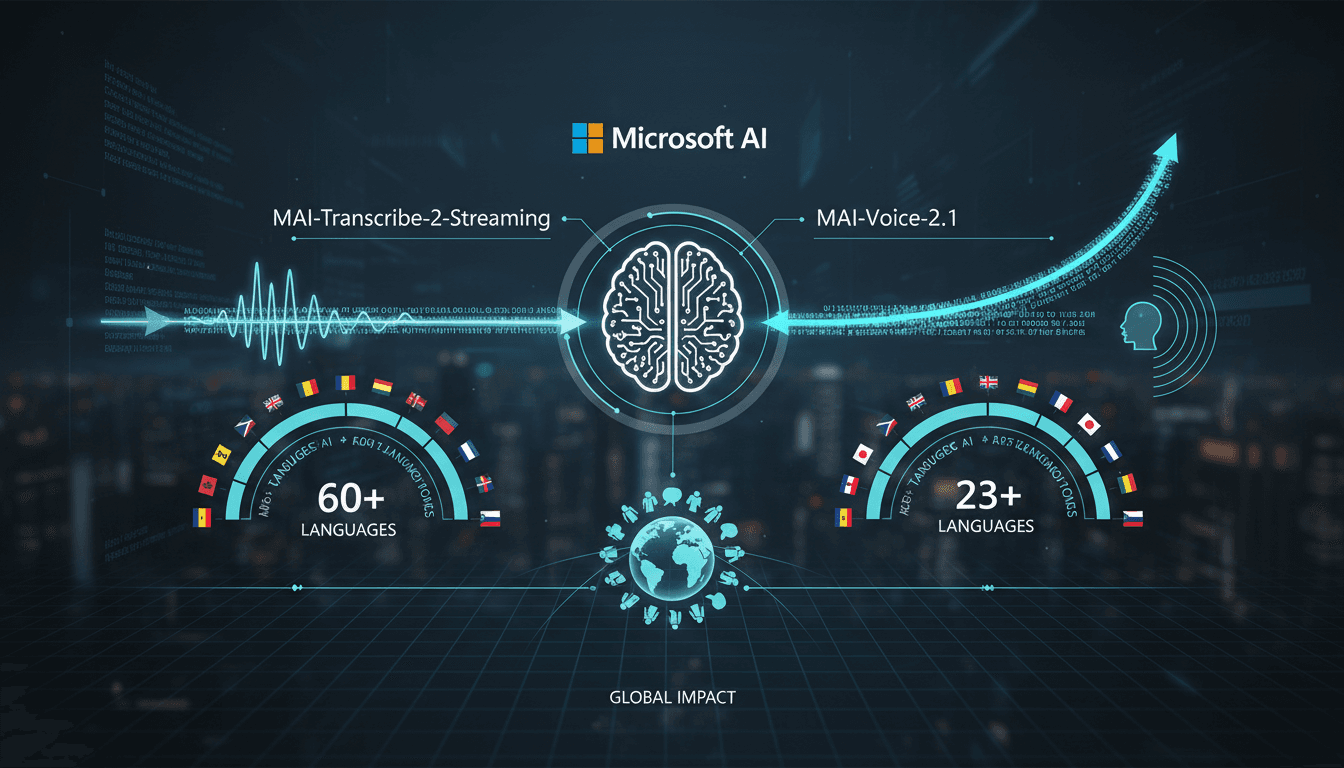
- Real-time transcription now supports 60 languages with initial results in just over 100 milliseconds.
- Multilingual TTS models maintain consistent voice identity across 23 languages, enhancing user experience.
The context you actually need
- Prior advancements: These releases build on the MAI-Voice-2 model from June 2026, which expanded multilingual support.
- Market demand: There is a growing need for integrated, low-latency audio pipelines in voice applications as conversational AI evolves.
- Developer focus: Microsoft emphasizes accuracy and cost efficiency, targeting developers building conversational voice agents.
What's really happening
On October 1, 2026, Microsoft AI unveiled its MAI-Transcribe-2-Streaming model, marking a pivotal moment in voice technology. This model is designed to deliver real-time transcription across 60 languages, with the ability to provide initial partial results in just over 100 milliseconds. This rapid response time allows voice agents to engage users more naturally, initiating responses or tool calls before speakers finish their sentences. Such capabilities are crucial for enhancing user experience in applications ranging from customer service to virtual assistants.
The MAI-Voice-2.1 model, along with its Flash variant, supports 23 languages and 26 locales, ensuring that a single voice can maintain its native accent and identity across different languages. This consistency is vital for businesses operating in multilingual environments, as it fosters a sense of familiarity and trust with users. The Flash model achieves an impressive 150 milliseconds end-to-end latency for audio up to 45 seconds, making it a cost-effective solution for developers.
These advancements are not just technical feats; they reflect a broader trend in the AI landscape where low-latency interactions are becoming the norm. As conversational AI systems advance, the demand for integrated audio pipelines that can handle real-time processing is surging. Microsoft’s focus on sub-second latency and accuracy positions it well in a competitive market, appealing to developers who prioritize seamless user interactions.
Moreover, the inclusion of voice cloning capabilities and misuse safeguards in these models indicates a commitment to ethical AI development. By allowing developers to create voice agents that can mimic human speech patterns while ensuring safety measures are in place, Microsoft is addressing potential concerns about misuse in voice technology.
The implications of these releases extend beyond just technological improvements. They represent a shift in how businesses will approach customer interactions, with an emphasis on speed and personalization. As more companies adopt these tools, the landscape of customer service and virtual assistance will likely evolve, prioritizing real-time engagement and multilingual support.
Who feels it first (and how)
- Developers: They will leverage these models to create more responsive and engaging voice applications.
- Customer service teams: Enhanced multilingual capabilities will improve interactions with diverse clientele.
- Businesses in global markets: Companies operating in multiple languages will benefit from consistent voice identity and faster response times.
What to watch next
- Adoption rates: Monitor how quickly developers integrate these models into their applications, as this will indicate market acceptance.
- User feedback: Pay attention to how end-users respond to the improvements in voice interactions, particularly in customer service settings.
- Competitive landscape: Watch for responses from other tech companies as they seek to match or exceed Microsoft’s advancements in voice technology.
Microsoft AI's MAI-Transcribe-2-Streaming and MAI-Voice-2.1 models are now available for developers.
Increased adoption of these models will lead to enhanced customer service experiences across industries.
The long-term impact on the competitive landscape of voice technology remains to be seen.
Frequently Asked Questions
- Why it matters?
- The release of these models signals a significant leap in the capabilities of conversational AI, impacting industries reliant on real-time communication.
- What happened (in 30 seconds)?
- Microsoft AI launched MAI-Transcribe-2-Streaming and MAI-Voice-2.1 models on October 1, 2026. Real-time transcription now supports 60 languages with initial results in just over 100 milliseconds. Multilingual TTS models maintain consistent voice identity across 23 languages, enhancing user experience.
- What's really happening?
- On October 1, 2026, Microsoft AI unveiled its MAI-Transcribe-2-Streaming model, marking a pivotal moment in voice technology. This model is designed to deliver real-time transcription across 60 languages, with the ability to provide initial partial results in just over 100 milliseconds. This rapid response time allows voice agents to engage users more naturally, initiating responses or tool calls before speakers finish their sentences. Such capabilities are crucial for enhancing user experience
- Who feels it first (and how)?
- Developers: They will leverage these models to create more responsive and engaging voice applications. Customer service teams: Enhanced multilingual capabilities will improve interactions with diverse clientele. Businesses in global markets: Companies operating in multiple languages will benefit from consistent voice identity and faster response times.
- What to watch next?
- Adoption rates: Monitor how quickly developers integrate these models into their applications, as this will indicate market acceptance. User feedback: Pay attention to how end-users respond to the improvements in voice interactions, particularly in customer service settings. Competitive landscape: Watch for responses from other tech companies as they seek to match or exceed Microsoft’s advancements in voice technology.
Daily AI news: models, tools, and policy.
"Independent outlet tracking the fast pace of AI."
— A47 Editor
Microsoft AI releases new transcription and text-to-speech models for voice agents
Microsoft AI has introduced MAI-Transcribe-2-Streaming, a new model designed for real-time transcription, enhancing the capabilities of voice agents. This model aims to provide low-latency transcription, improving the efficiency of audio processing i...
AI news with an enterprise and cloud focus.
"Covers AI in the context of data infrastructure, cloud, and enterprise stacks."
— A47 Editor
Microsoft targets ultra-realistic voice agents with its first streaming transcription model
Microsoft Corp. has introduced its first streaming transcription model as part of its MAI artificial intelligence model family, aimed at enabling developers to create ultra-realistic voice agents that can engage in real-time conversations. This model...
Curated tech headlines including AI stories.
"Influential aggregator surfacing the day’s top tech/AI links."
— A47 Editor
Microsoft launches MAI-Transcribe-2-Streaming, a model for low-latency, real-time transcripts, and two new voice models, MAI-Voice-2.1 and MAI-Voice-2.1-Flash (Microsoft AI)
Microsoft has launched MAI-Transcribe-2-Streaming, a new model designed for low-latency, real-time transcription, alongside two new voice models, MAI-Voice-2.1 and MAI-Voice-2.1-Flash. These advancements aim to enhance audio understanding and generat...