
Google Tests Satellite for AI Data Centers in Low-Earth Orbit
Why it matters
The exploration of orbital data centers could alleviate terrestrial energy constraints and redefine the future of AI computing.
What happened (in 30 seconds)
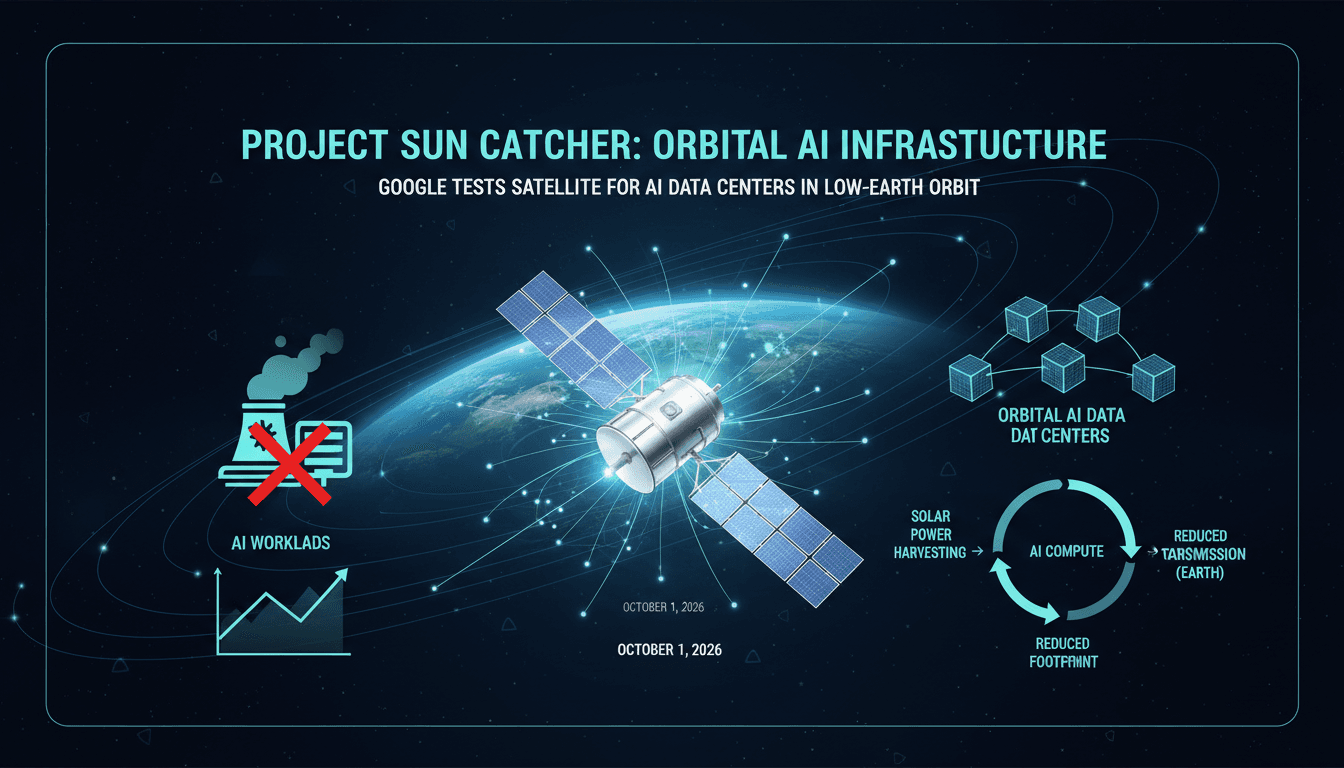
- Google launched an experimental satellite on October 1, 2026, to test AI processing in low-Earth orbit.
- The satellite carries four Tensor Processing Units (TPUs) and aims to assess solar-powered AI compute infrastructure.
- Initial operations are underway, with the satellite designed for one year of active operation and a potential six-year lifespan.
The context you actually need
- AI workloads are surging, leading to increased demand for data center power and cooling solutions on Earth.
- Project Suncatcher, announced in late 2025, aims to leverage continuous solar exposure in orbit to support AI accelerators.
- Ground tests have already been conducted to simulate radiation exposure, indicating a serious commitment to this research initiative.
What's really happening
Google's launch of its experimental satellite as part of Project Suncatcher marks a significant step in the tech giant's quest to explore alternative environments for data processing. The satellite, developed in collaboration with Planet Labs, is equipped with four Tensor Processing Units (TPUs) and is designed to operate in low-Earth orbit, where it can harness solar energy continuously. This initiative is a direct response to the escalating demand for AI processing power, which has strained existing data center infrastructures on Earth.
The satellite is powered by solar panels that supply approximately 1 kW to the TPUs, enabling short inference sessions on AI models. These sessions are limited to 15 minutes, followed by cooling periods to manage thermal output. This operational model reflects the challenges of maintaining optimal performance in the harsh conditions of space, where radiation and temperature fluctuations can impact hardware reliability.
The implications of this project extend beyond mere technological experimentation. By moving data processing to orbit, Google aims to reduce its reliance on terrestrial energy grids, which are increasingly under pressure from the growing energy demands of AI workloads. This shift could lead to a more sustainable model for data centers, potentially lowering energy costs and minimizing environmental impact.
Moreover, the success of this satellite could pave the way for future prototypes and the development of inter-satellite laser communications, enhancing the efficiency of data transfer in space. As other companies and organizations observe Google's progress, there may be a surge of interest in similar orbital compute concepts, further accelerating innovation in this field.
However, the initiative is not without its challenges. Concerns have been raised by astronomers regarding potential increases in orbital light pollution from future satellite constellations, which could affect astronomical observations. Additionally, the regulatory landscape surrounding space operations remains complex, and any significant market movements or governmental actions in response to this launch have yet to materialize.
In summary, Google's Project Suncatcher represents a bold exploration of the future of data processing, with the potential to reshape the landscape of AI computing and energy consumption.
Who feels it first (and how)
- Tech companies: Increased competition in AI processing capabilities and infrastructure.
- Energy providers: Potential shifts in energy demand as companies explore orbital solutions.
- Astronomers: Concerns over light pollution and its impact on observational astronomy.
- Investors: Opportunities in emerging technologies related to space-based data centers.
What to watch next
- Future satellite launches: Monitor additional prototypes planned for 2027 to assess advancements in inter-satellite communications.
- Regulatory developments: Watch for any governmental actions regarding orbital operations and their implications for the industry.
- Market interest: Keep an eye on how other tech companies respond to Google's initiative and whether they pursue similar projects.
Google has successfully launched its experimental satellite and initial operations are underway.
Other companies will explore similar orbital data center concepts in response to Google's initiative.
The long-term regulatory and environmental impacts of increased satellite operations in low-Earth orbit.
Frequently Asked Questions
- Why it matters?
- The exploration of orbital data centers could alleviate terrestrial energy constraints and redefine the future of AI computing.
- What happened (in 30 seconds)?
- Google launched an experimental satellite on October 1, 2026, to test AI processing in low-Earth orbit. The satellite carries four Tensor Processing Units (TPUs) and aims to assess solar-powered AI compute infrastructure. Initial operations are underway, with the satellite designed for one year of active operation and a potential six-year lifespan.
- What's really happening?
- Google's launch of its experimental satellite as part of Project Suncatcher marks a significant step in the tech giant's quest to explore alternative environments for data processing. The satellite, developed in collaboration with Planet Labs, is equipped with four Tensor Processing Units (TPUs) and is designed to operate in low-Earth orbit, where it can harness solar energy continuously. This initiative is a direct response to the escalating demand for AI processing power, which has strained ex
- Who feels it first (and how)?
- Tech companies: Increased competition in AI processing capabilities and infrastructure. Energy providers: Potential shifts in energy demand as companies explore orbital solutions. Astronomers: Concerns over light pollution and its impact on observational astronomy. Investors: Opportunities in emerging technologies related to space-based data centers.
- What to watch next?
- Future satellite launches: Monitor additional prototypes planned for 2027 to assess advancements in inter-satellite communications. Regulatory developments: Watch for any governmental actions regarding orbital operations and their implications for the industry. Market interest: Keep an eye on how other tech companies respond to Google's initiative and whether they pursue similar projects.
Science discoveries, research, and analysis.
"NPR is a nonprofit media organization offering thoughtful, in-depth journalism and storytelling, often with a liberal or progressive slant."
— A47 Editor
Google launches satellite to test feasibility of building data centers in space
Google has launched an experimental satellite as part of Project Suncatcher, aimed at testing the feasibility of establishing AI data centers in space. This fridge-sized satellite, equipped with AI chips, was sent into orbit aboard a SpaceX rocket to...
Tech business coverage, major deals, product launches, and Silicon Valley trends.
"WSJ’s tech section offers authoritative reporting on the intersection of technology and business, including exclusive industry analysis."
— A47 Editor
Can AI Run in Space? Google Is About to Find Out
Google is preparing to launch a satellite equipped with AI chips into orbit, marking a significant step in its exploration of artificial intelligence capabilities in space. This initiative, known as Project Suncatcher, aims to evaluate the performanc...
Science and technology stories including AI.
"Longstanding science magazine with thoughtful AI coverage."
— A47 Editor
Google’s Project Suncatcher AI data center test has officially launched to space onboard SpaceX rocket
Google has officially launched Project Suncatcher, an experimental AI data center, into space aboard a SpaceX rocket. This initiative aims to test the performance of Google's AI chips in the extreme conditions of outer space, marking a significant st...
Scientific research, technology, environment, and society.
"Scientific American is one of the oldest and most authoritative science magazines, known for deep dives into science, technology, and society."
— A47 Editor
Google’s Project Suncatcher AI data center test has officially launched to space onboard SpaceX rocket
Google has officially launched Project Suncatcher, an experimental AI data center, into space aboard a SpaceX rocket. This initiative aims to test the performance of Google's AI chips in the extreme conditions of outer space, marking a significant st...
Science and technology stories including AI.
"Longstanding science magazine with thoughtful AI coverage."
— A47 Editor
Google tests its plan for AI data centers in space with Project Suncatcher
Google is launching Project Suncatcher, sending four AI processors into orbit aboard a SpaceX rocket to test the viability of data centers in space. This initiative aims to evaluate how these processors perform under the extreme conditions of outer s...
Scientific research, technology, environment, and society.
"Scientific American is one of the oldest and most authoritative science magazines, known for deep dives into science, technology, and society."
— A47 Editor
Google tests its plan for AI data centers in space with Project Suncatcher
Google is launching Project Suncatcher, sending four AI processors into orbit aboard a SpaceX rocket to test the viability of data centers in space. This initiative aims to evaluate how these processors perform under the extreme conditions of outer s...