
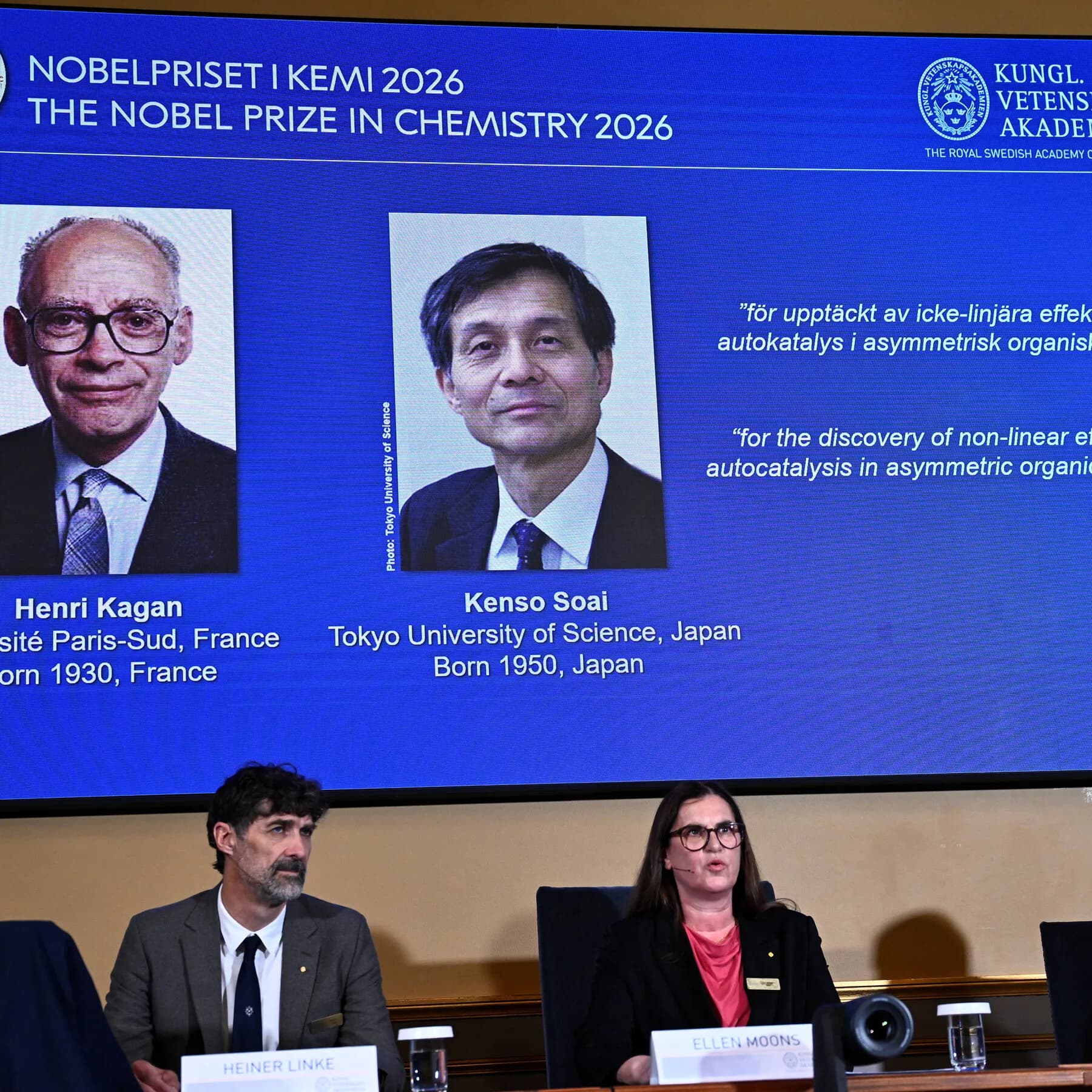
2026 Nobel Prize in Chemistry Awarded to Kagan and Soai for Asymmetric Organic Synthesis Breakthroughs
Why it matters
This award highlights critical breakthroughs in pharmaceutical chemistry that can enhance drug safety and efficacy globally.
What happened (in 30 seconds)
- The Nobel Prize in Chemistry was awarded on October 7, 2026, to Henri Kagan and Kenso Soai for their work on asymmetric organic synthesis.
- Their discoveries resolve a century-old puzzle regarding molecular chirality, crucial for pharmaceutical applications.
- The prize amount totals 12 million Swedish kronor, shared equally between the two laureates.
The context you actually need
- Chirality is fundamental: Living organisms predominantly use one enantiomer of molecules, a phenomenon known as homochirality, which is essential for biological functions.
- Historical significance: Previous Nobel recognitions in 2001 for asymmetric catalysis laid the groundwork but did not fully address the spontaneous emergence of molecular asymmetry.
- Pharmaceutical implications: The ability to control mirror-image variants of molecules can lead to more targeted drug designs, minimizing side effects associated with unwanted enantiomers.
What's really happening
The 2026 Nobel Prize in Chemistry awarded to Henri Kagan and Kenso Soai marks a significant milestone in the field of asymmetric organic synthesis, a branch of chemistry that focuses on creating molecules that are not superimposable on their mirror images. This concept, known as chirality, is crucial in the pharmaceutical industry, where the efficacy and safety of drugs can hinge on the specific enantiomer used.
Kagan's research began in the 1960s, leading to the development of catalysts that preferentially produce one enantiomer over another. This work was further advanced by Soai in the 1990s, culminating in a groundbreaking autocatalytic reaction in 2003 that allowed for the exclusive production of one enantiomer from achiral precursors. This discovery not only resolved a long-standing scientific question but also opened new avenues for drug synthesis, where controlling chirality can significantly reduce adverse side effects.
The implications of their work extend beyond academic recognition; they provide a framework for pharmaceutical companies to design drugs with greater precision. By understanding and manipulating the non-linear effects and autocatalytic processes that lead to molecular asymmetry, chemists can create enantiopure medications—drugs that contain only one enantiomer. This is particularly important in treating conditions where the wrong enantiomer can lead to harmful side effects or reduced efficacy.
As the pharmaceutical industry increasingly prioritizes personalized medicine, the ability to produce specific enantiomers will become a competitive advantage. Companies that can leverage these discoveries will likely see improved patient outcomes and reduced costs associated with side effects and ineffective treatments. The Nobel Committee's recognition of Kagan and Soai underscores the importance of continued research and collaboration in this field, as the global demand for safer and more effective medications grows.
Who feels it first (and how)
- Pharmaceutical companies: They will need to adapt their synthesis processes to incorporate these advancements, impacting production costs and drug safety.
- Healthcare providers: Improved drug formulations will enhance treatment efficacy, directly affecting patient care and outcomes.
- Patients: Individuals will benefit from safer medications with fewer side effects, leading to better health management.
- Research institutions: Increased funding and interest in asymmetric synthesis research could lead to further innovations in drug development.
What to watch next
- Research funding trends: Increased investment in asymmetric synthesis research could signal a shift in pharmaceutical development strategies.
- Regulatory changes: Watch for updates in drug approval processes that may prioritize enantiopure medications, reflecting the impact of Kagan and Soai's work.
- Market responses: Monitor how pharmaceutical companies adjust their production methods and marketing strategies in response to these advancements.
Kagan and Soai's discoveries will enhance the precision of pharmaceutical synthesis.
The pharmaceutical industry will increasingly focus on enantiopure drugs, leading to safer medications.
The long-term impact on drug pricing and accessibility remains to be seen.
Frequently Asked Questions
- Why it matters?
- This award highlights critical breakthroughs in pharmaceutical chemistry that can enhance drug safety and efficacy globally.
- What happened (in 30 seconds)?
- The Nobel Prize in Chemistry was awarded on October 7, 2026, to Henri Kagan and Kenso Soai for their work on asymmetric organic synthesis. Their discoveries resolve a century-old puzzle regarding molecular chirality, crucial for pharmaceutical applications. The prize amount totals 12 million Swedish kronor, shared equally between the two laureates.
- What's really happening?
- The 2026 Nobel Prize in Chemistry awarded to Henri Kagan and Kenso Soai marks a significant milestone in the field of asymmetric organic synthesis, a branch of chemistry that focuses on creating molecules that are not superimposable on their mirror images. This concept, known as chirality, is crucial in the pharmaceutical industry, where the efficacy and safety of drugs can hinge on the specific enantiomer used. Kagan's research began in the 1960s, leading to the development of catalysts that
- Who feels it first (and how)?
- Pharmaceutical companies: They will need to adapt their synthesis processes to incorporate these advancements, impacting production costs and drug safety. Healthcare providers: Improved drug formulations will enhance treatment efficacy, directly affecting patient care and outcomes. Patients: Individuals will benefit from safer medications with fewer side effects, leading to better health management. Research institutions: Increased funding and interest in asymmetric synthesis research coul
- What to watch next?
- Research funding trends: Increased investment in asymmetric synthesis research could signal a shift in pharmaceutical development strategies. Regulatory changes: Watch for updates in drug approval processes that may prioritize enantiopure medications, reflecting the impact of Kagan and Soai's work. Market responses: Monitor how pharmaceutical companies adjust their production methods and marketing strategies in response to these advancements.
Reports on science policy, discoveries, and public debate in the scientific realm.
"The Guardian’s science section is known for thoughtful and critical reporting on global research, ethics, and public understanding of science."
— A47 Editor
This is what the 2026 Nobel prize for chemistry is all about
The 2026 Nobel Prize in Chemistry has been awarded to Henri B Kagan from Paris-Sud University and Kensō Soai from Tokyo University of Science for their significant discoveries regarding mirror-image molecules. Their research demonstrates how chemical...
Global political, business, and cultural coverage from WSJ international desks.
"The Wall Street Journal offers extensive international reporting with a reputation for financial insight and a center-right editorial stance."
— A47 Editor
Nobel Prize for Chemistry Awarded for Breakthroughs That Advanced Modern Pharmaceuticals
Henri Kagan from France and Kenso Soai from Japan have been jointly awarded the Nobel Prize in Chemistry for their groundbreaking contributions to asymmetric organic synthesis, specifically their work on non-linear effects and autocatalysis. This pre...
Scientific research, space, environment, and health coverage.
"The New York Times is a globally recognized newspaper offering authoritative reporting with a center-left editorial stance."
— A47 Editor
Nobel Prize in Chemistry Is Awarded to Henri Kagan and Kenso Soai
The Nobel Committee awarded the 2026 Nobel Prize in Chemistry to Henri Kagan and Kenso Soai for their significant contributions in resolving a long-standing mystery regarding chiral molecules, which have mirror-image forms. This recognition took plac...
Reports on science policy, discoveries, and public debate in the scientific realm.
"The Guardian’s science section is known for thoughtful and critical reporting on global research, ethics, and public understanding of science."
— A47 Editor
Nobel prize in chemistry awarded for work on mirror-image molecules
The Nobel Prize in Chemistry 2026 has been awarded to Henri B Kagan from Paris-Sud University and Kensō Soai from Tokyo University of Science for their groundbreaking discoveries related to mirror-image molecules. Their work has significantly enhance...
International coverage of politics, security, and social issues.
"Global News is a mainstream Canadian outlet with a centrist editorial stance, focusing on factual reporting."
— A47 Editor
Nobel Prize in chemistry goes to Kagan and Saoi for solving molecular mystery
The Nobel Prize in Chemistry has been awarded to Henri B. Kagan and Kenso Soai for their innovative research in asymmetric organic synthesis, specifically their work on non-linear effects and autocatalysis. This achievement has been recognized by the...
International stories from NPR’s global desk.
"NPR is an American public media organization known for thoughtful reporting and a slightly left-leaning editorial tone."
— A47 Editor
Henri B. Kagan and Kenso Soai win Nobel Prize in chemistry
Henri B. Kagan and Kenso Soai have been awarded the Nobel Prize in chemistry for their groundbreaking work on non-linear effects and autocatalysis in asymmetric organic synthesis, a significant advancement in the field. This recognition highlights th...
International news coverage curated for readers in the UAE and Gulf region.
"Emirates 24|7 world coverage presents global developments through a UAE-facing and Gulf-relevant editorial lens."
— A47 Editor
Henri Kagan and Kenso Soai win 2026 Nobel chemistry prize
Henri Kagan and Kenso Soai have been awarded the 2026 Nobel Prize in Chemistry for their groundbreaking work in creating a method to form a single molecular mirror image, a significant advancement for pharmaceutical manufacturing. This announcement w...
European current affairs, EU politics, and regional developments.
"France 24 is viewed as a globally focused outlet with balanced coverage and a European perspective."
— A47 Editor
Nobel Prize in Chemistry awarded to France's Henri Kagan, Japan's Kenso Soai
Henri Kagan from France and Kenso Soai from Japan have been jointly awarded the Nobel Prize in Chemistry for their significant contributions in solving a century-old chemical mystery, as announced by the Royal Swedish Academy of Sciences. This presti...
Science and technology stories including AI.
"Longstanding science magazine with thoughtful AI coverage."
— A47 Editor
2026 Nobel Prize in Chemistry is awarded to Henri Kagan and Kenso Soai for their work in ‘mirror’ chemistry
The 2026 Nobel Prize in Chemistry has been awarded to Henri Kagan and Kenso Soai for their groundbreaking work in ‘mirror’ chemistry, specifically their discoveries related to nonlinear effects and autocatalysis in asymmetric organic synthesis. This ...
Scientific research, technology, environment, and society.
"Scientific American is one of the oldest and most authoritative science magazines, known for deep dives into science, technology, and society."
— A47 Editor
2026 Nobel Prize in Chemistry is awarded to Henri Kagan and Kenso Soai for their work in ‘mirror’ chemistry
The 2026 Nobel Prize in Chemistry has been awarded to Henri Kagan and Kenso Soai for their groundbreaking work in ‘mirror’ chemistry, specifically their discoveries related to nonlinear effects and autocatalysis in asymmetric organic synthesis. This ...