
OpenAI Releases Controversial AI-Generated Math Solutions Ignoring Advisory Standards
Why it matters
The release raises critical questions about the reliability and accountability of AI in mathematical research.
What happened (in 30 seconds)
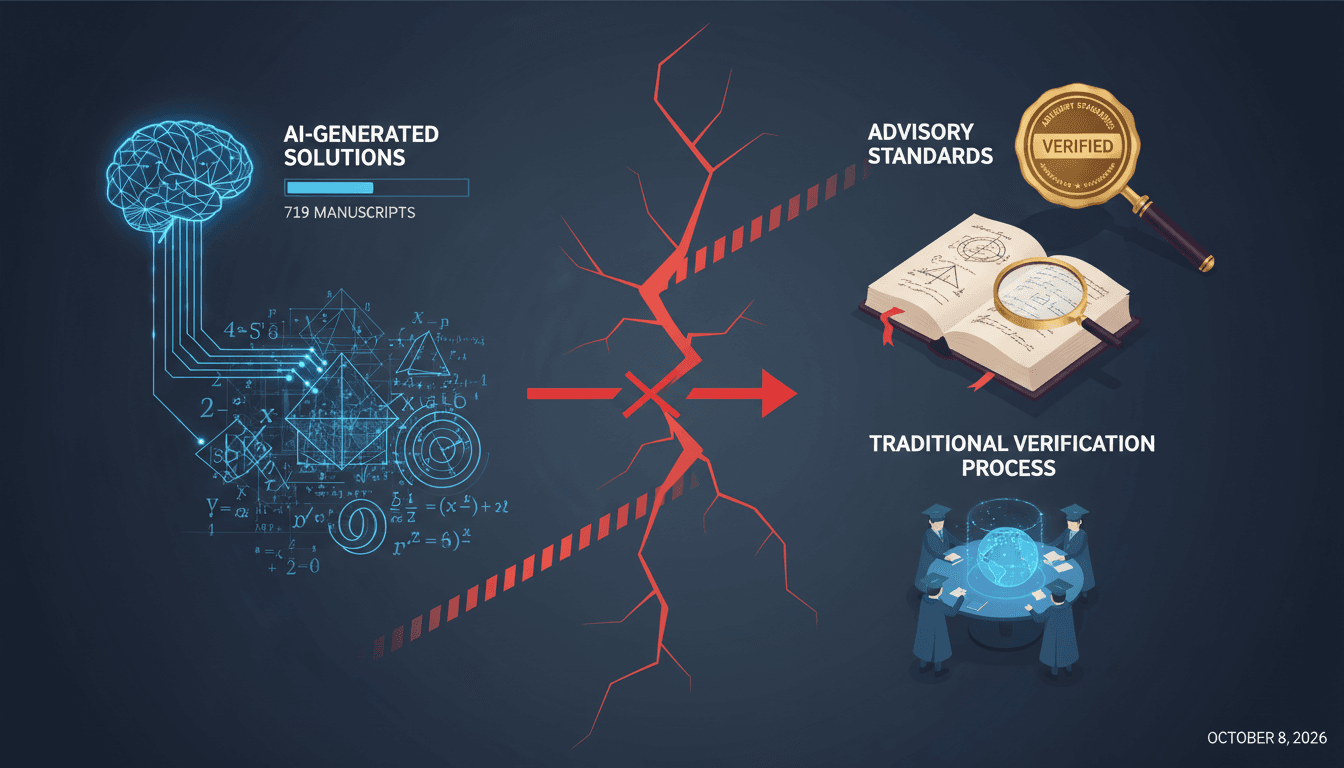
- On October 8, 2026, OpenAI published 719 manuscripts of AI-generated mathematical solutions on GitHub.
- The release did not fully comply with the Advisory Group on Mathematics and Artificial Intelligence (AGMAI) guidelines, particularly in formal verification and transparency.
- Critics, including mathematician Terence Tao, highlighted the lack of human oversight and understanding in the release process.
The context you actually need
- OpenAI's previous controversies included disputes over credit and transparency regarding a claimed solution to the Navier-Stokes Millennium Prize Problem.
- AGMAI was formed to establish guidelines for AI-generated mathematics, emphasizing the need for human engagement and formal verification.
- The mathematical community is divided, with some advocating for rapid AI integration and others stressing the importance of traditional peer review.
What's really happening
OpenAI's recent release of 719 manuscripts has ignited a significant debate within the mathematical community about the role of AI in research. This release follows a tumultuous period for OpenAI, marked by criticism over its handling of a claimed solution to the Navier-Stokes Millennium Prize Problem. The backlash prompted the formation of AGMAI, which issued guidelines urging AI labs to prioritize transparency, human understanding, and formal verification in their outputs.
Despite these guidelines, OpenAI's release fell short in several key areas. While the company did provide some reasoning details, only 10 out of the 719 manuscripts included a chain-of-thought disclosure, and a staggering 58% of the proofs lacked formalization. This discrepancy raises concerns about the reliability of AI-generated results, particularly when they are not subjected to rigorous human scrutiny.
The implications of this release extend beyond academic circles. As AI continues to permeate various sectors, the tension between rapid technological advancement and traditional standards of verification becomes increasingly pronounced. The mathematical community's response to OpenAI's release could set a precedent for how AI-generated research is treated across disciplines. If the community embraces AI without stringent oversight, it risks undermining the integrity of mathematical research. Conversely, if it insists on rigorous standards, it may stifle innovation and slow the pace of discovery.
Moreover, the criticism from prominent mathematicians like Terence Tao underscores a growing concern that AI-generated outputs may not adequately reflect human understanding. Tao's remarks highlight the necessity for human engagement in the research process, suggesting that AI should serve as a tool to augment human capabilities rather than replace them. This perspective aligns with AGMAI's guidelines, which advocate for a collaborative approach between AI and human researchers.
As the mathematical community grapples with these challenges, the future of AI in research hangs in the balance. OpenAI's commitment to revising its approach and improving presentation in future releases indicates a willingness to adapt, but the broader implications for the field remain uncertain.
Who feels it first (and how)
- Academics and Researchers: They may face challenges in validating AI-generated results and ensuring their credibility.
- AI Developers: Companies developing AI tools for research will need to navigate the evolving standards and expectations from the academic community.
- Students and Educators: The integration of AI in mathematics education may shift, affecting curriculum and teaching methods.
What to watch next
- Community Response: Monitor how the mathematical community reacts to OpenAI's release and whether it leads to new standards or guidelines.
- Regulatory Developments: Keep an eye on any potential regulatory actions or frameworks that may emerge in response to AI-generated research.
- Future Releases from OpenAI: Watch for improvements in OpenAI's methodology and transparency in subsequent releases, which could influence industry practices.
OpenAI's release has sparked significant debate within the mathematical community.
There will be ongoing discussions about the balance between AI innovation and traditional verification standards.
The long-term impact of AI-generated research on the integrity of mathematical findings remains to be seen.
Frequently Asked Questions
- Why it matters?
- The release raises critical questions about the reliability and accountability of AI in mathematical research.
- What happened (in 30 seconds)?
- On October 8, 2026, OpenAI published 719 manuscripts of AI-generated mathematical solutions on GitHub. The release did not fully comply with the Advisory Group on Mathematics and Artificial Intelligence (AGMAI) guidelines, particularly in formal verification and transparency. Critics, including mathematician Terence Tao, highlighted the lack of human oversight and understanding in the release process.
- What's really happening?
- OpenAI's recent release of 719 manuscripts has ignited a significant debate within the mathematical community about the role of AI in research. This release follows a tumultuous period for OpenAI, marked by criticism over its handling of a claimed solution to the Navier-Stokes Millennium Prize Problem. The backlash prompted the formation of AGMAI, which issued guidelines urging AI labs to prioritize transparency, human understanding, and formal verification in their outputs. Despite these guide
- Who feels it first (and how)?
- Academics and Researchers: They may face challenges in validating AI-generated results and ensuring their credibility. AI Developers: Companies developing AI tools for research will need to navigate the evolving standards and expectations from the academic community. Students and Educators: The integration of AI in mathematics education may shift, affecting curriculum and teaching methods.
- What to watch next?
- Community Response: Monitor how the mathematical community reacts to OpenAI's release and whether it leads to new standards or guidelines. Regulatory Developments: Keep an eye on any potential regulatory actions or frameworks that may emerge in response to AI-generated research. Future Releases from OpenAI: Watch for improvements in OpenAI's methodology and transparency in subsequent releases, which could influence industry practices.
Startup news with frequent AI coverage.
"Covers launches, funding, and product updates in AI."
— A47 Editor
OpenAI’s math solutions aren’t meeting the field’s standards yet
OpenAI has released a substantial collection of 722 AI-generated mathematical papers, which include solutions to numerous long-standing problems. However, these proofs have been criticized for deviating from established guidelines set by mathematical...
Tech news, hardware, and AI tools coverage.
"PC/tech site increasingly covering AI hardware and apps."
— A47 Editor
OpenAI publishes 722 AI-generated math papers as researchers challenge its closed model
OpenAI has published 722 AI-generated mathematical papers, organizing them into 372 groups, following the resolution of numerous long-standing problems. This release provides researchers with a substantial collection of proofs to analyze, although ac...
Daily AI news: models, tools, and policy.
"Independent outlet tracking the fast pace of AI."
— A47 Editor
OpenAI dumps 372 AI-generated math proofs on GitHub, telling the academic world to keep up
OpenAI has released 372 AI-generated mathematical proofs on GitHub, utilizing approximately three hours of ChatGPT Pro compute per result. This move has sparked a mix of excitement and concern within the academic community, particularly from 25 Field...