
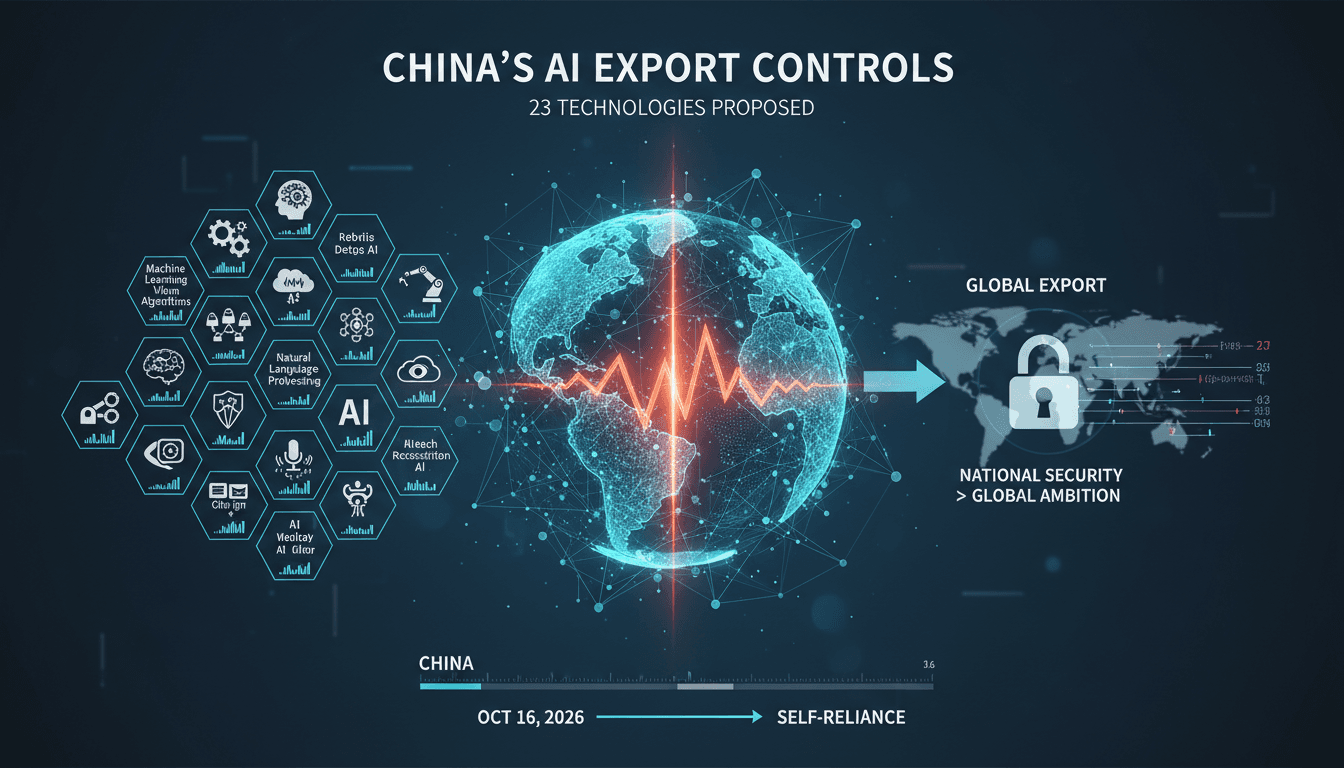
China Proposes New Export Controls on 23 AI Technologies
Why it matters
This proposal reflects China's strategic pivot in the global tech landscape amid rising geopolitical tensions.
What happened (in 30 seconds)
- On October 16, 2026, China proposed adding 23 AI technologies to its export control catalogue.
- The draft targets large models, AI agents, and computing clusters, with specific thresholds for regulation.
- Public consultation is open until November 15, 2026, with immediate registration required for affected exports.
The context you actually need
- Geopolitical competition: This move comes as the U.S. imposes restrictions on advanced AI technologies, prompting China to bolster its domestic capabilities.
- National security focus: The proposal aims to prevent misuse of AI technologies and ensure human oversight amid rapid advancements.
- Market implications: Companies may pivot towards domestic alternatives or accelerate open-source strategies in response to these controls.
What's really happening
On October 16, 2026, China's Ministry of Commerce and Ministry of Science and Technology released a draft proposal to expand the Catalogue of Technologies Prohibited and Restricted from Export. This catalogue now includes 23 AI technologies, bringing the total to 40. The targeted technologies encompass large AI models, AI agents, and computing clusters, with specific controls triggered by training on sensitive national data or exceeding defined thresholds—such as 2 trillion parameters or 10^26 FLOPs of compute power.
The proposal distinguishes between prohibited items, like autonomous malware tools, and restricted items, such as large model weights that surpass specified limits. Notably, the draft includes a fast-track automatic licensing process for open-source releases and certain overseas activities by Chinese firms, which could facilitate international collaboration while maintaining regulatory oversight.
This regulatory shift is part of China's broader strategy to enhance national security and prevent the misuse of advanced technologies. The Chinese government is keenly aware of the implications of AI on national defense and public safety, especially in the context of ongoing U.S.-China technology competition. By tightening export controls, China aims to ensure that sensitive technologies do not fall into the hands of adversaries, while also fostering a domestic ecosystem capable of innovation.
International observers have drawn parallels between these proposed controls and existing U.S. regulations on model weights, suggesting a tit-for-tat dynamic in global tech governance. As companies navigate these new restrictions, they may increasingly turn to domestic alternatives or accelerate their open-source initiatives to mitigate the impact of export controls.
The public consultation period, which runs until November 15, 2026, allows stakeholders to voice their opinions on the proposed measures. However, the immediate registration requirement for affected exports indicates that the Chinese government is moving quickly to implement these controls, reflecting a sense of urgency in addressing national security concerns.
Who feels it first (and how)
- Tech companies: Firms relying on Chinese AI technologies may face immediate licensing challenges.
- Developers: Those working with large AI models could see restrictions on their projects.
- Businesses in Dubai: Local enterprises may experience indirect effects through altered availability of certain AI models.
What to watch next
- Public feedback: Monitor the outcomes of the public consultation period and any adjustments to the proposal based on stakeholder input.
- International responses: Watch for reactions from other nations, particularly the U.S., which may influence global tech policies.
- Market shifts: Keep an eye on how companies adapt, particularly in terms of sourcing AI technologies and pivoting to domestic alternatives.
The proposal includes 23 AI technologies for export control.
Companies will shift towards domestic alternatives or open-source strategies.
The long-term impact on international collaboration in AI development.
Frequently Asked Questions
- Why it matters?
- This proposal reflects China's strategic pivot in the global tech landscape amid rising geopolitical tensions.
- What happened (in 30 seconds)?
- On October 16, 2026, China proposed adding 23 AI technologies to its export control catalogue. The draft targets large models, AI agents, and computing clusters, with specific thresholds for regulation. Public consultation is open until November 15, 2026, with immediate registration required for affected exports.
- What's really happening?
- On October 16, 2026, China's Ministry of Commerce and Ministry of Science and Technology released a draft proposal to expand the Catalogue of Technologies Prohibited and Restricted from Export. This catalogue now includes 23 AI technologies, bringing the total to 40. The targeted technologies encompass large AI models, AI agents, and computing clusters, with specific controls triggered by training on sensitive national data or exceeding defined thresholds—such as 2 trillion parameters or 10^26 F
- Who feels it first (and how)?
- Tech companies: Firms relying on Chinese AI technologies may face immediate licensing challenges. Developers: Those working with large AI models could see restrictions on their projects. Businesses in Dubai: Local enterprises may experience indirect effects through altered availability of certain AI models.
- What to watch next?
- Public feedback: Monitor the outcomes of the public consultation period and any adjustments to the proposal based on stakeholder input. International responses: Watch for reactions from other nations, particularly the U.S., which may influence global tech policies. Market shifts: Keep an eye on how companies adapt, particularly in terms of sourcing AI technologies and pivoting to domestic alternatives.
Daily AI news: models, tools, and policy.
"Independent outlet tracking the fast pace of AI."
— A47 Editor
China plans to tighten export controls on open-weight models and 23 key AI technologies
China has announced plans to tighten export controls on 23 key artificial intelligence technologies, including model weights and source code, particularly for systems with significant computational capabilities. This move aims to restrict overseas tr...
Curated insights and thought leadership in enterprise technology.
"Ciente.io delivers curated insights, thought leadership, and trends in B2B tech and innovation."
— A47 Editor
China Clamps Down on AI Exports
China has proposed extensive export controls on 23 critical artificial intelligence technologies, including AI models and chips, as part of a draft regulation released by the Ministry of Commerce and the Ministry of Science and Technology. This move ...
Tech business coverage, major deals, product launches, and Silicon Valley trends.
"WSJ’s tech section offers authoritative reporting on the intersection of technology and business, including exclusive industry analysis."
— A47 Editor
China Proposes Export Controls on AI Technologies
China is considering implementing new export controls on artificial intelligence (AI) technologies, including AI models and chips, to protect its strategic interests amid increasing global competition. This proposal aims to restrict overseas transfer...
Global political, business, and cultural coverage from WSJ international desks.
"The Wall Street Journal offers extensive international reporting with a reputation for financial insight and a center-right editorial stance."
— A47 Editor
China Proposes Export Controls on AI Technologies
China is contemplating new export controls on artificial intelligence (AI) technologies to protect its strategically important industry amid escalating global competition. This move reflects the country's intent to maintain its technological edge and...
Technology business and AI-related headlines.
"Data-driven tech newsroom with global scope."
— A47 Editor
China Plans AI Tech Export Curbs to Manage Security Risks
China has proposed adding advanced artificial intelligence technologies, including AI models and chips, to its export-control list, aiming to restrict overseas transfers and maintain tighter control over its domestic advancements in this strategic se...
Technology business news, market impacts, and innovation trends.
"Bloomberg is a premier financial and tech news provider, respected for its in-depth reporting and analytical rigor."
— A47 Editor
China Proposes Export Controls on AI Models, Chips and Agents
China has proposed adding advanced artificial intelligence technologies, including AI models and chips, to its export-control list, aiming to restrict overseas transfers and maintain tighter control over its domestic advancements in this strategic se...