
Anthropic Report Reveals AI's Impact on Hiring and Productivity Trends
Why it matters
The report signals a significant shift in hiring practices across the tech sector, potentially impacting entry-level job availability and skill requirements.
What happened (in 30 seconds)
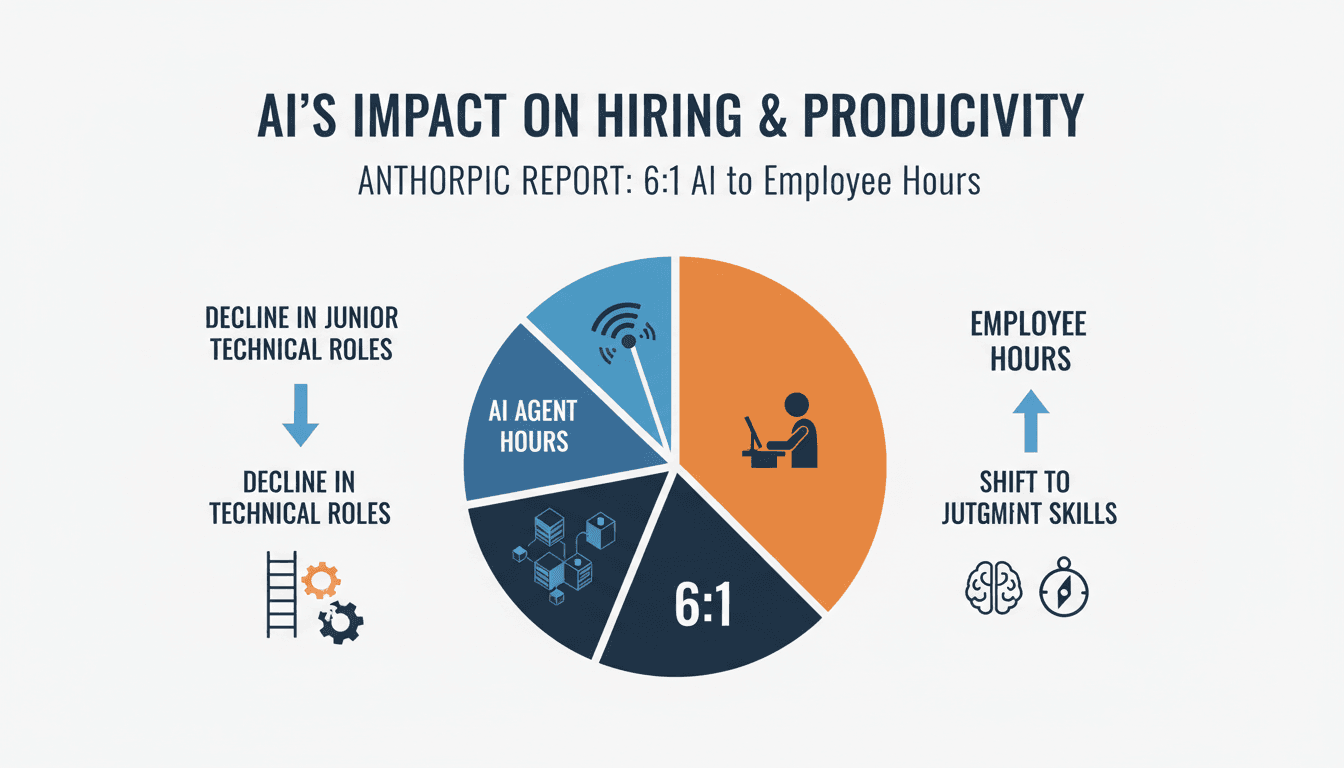
- Anthropic's report reveals a 6:1 ratio of AI agent hours to employee hours by August 2026, indicating a heavy reliance on AI for routine tasks.
- Junior technical roles have seen a decline, with their share in technical departments dropping from 21% to 14% since early 2025.
- Productivity metrics have surged, with engineers experiencing fivefold increases in code commits and non-technical employees dramatically increasing their use of coding agents.
The context you actually need
- AI adoption in the workplace has been accelerating, with companies increasingly relying on AI for tasks traditionally handled by entry-level employees.
- Anthropic's findings reflect broader industry trends, where firms are adjusting hiring practices and shifting focus toward candidates with higher autonomy and judgment.
- The labor market is evolving, with potential implications for job seekers and educational institutions as the demand for traditional entry-level roles diminishes.
What's really happening
Anthropic's internal report, published on October 16, 2026, provides a detailed analysis of how the integration of AI tools, particularly its Claude models, has transformed employment dynamics within the company. The report highlights a marked increase in the use of AI agents, which began to outpace human employee hours by March 2026. By August 2026, the ratio of interactive AI agent hours to employee hours reached an astonishing 6:1. This shift has led to a significant reduction in the hiring of junior technical roles, with the proportion of these positions in technical departments falling from 21% to 14%.
The decline in junior roles is not merely a statistical anomaly; it reflects a strategic pivot within Anthropic and potentially across the tech industry. As AI agents take over routine tasks such as coding and debugging, the demand for entry-level positions has diminished. The report notes that the share of junior technical hires plummeted from 27% to 9%, with job postings for these roles sharply declining after December 2025.
Managers at Anthropic have begun to prioritize candidates who demonstrate autonomy and judgment over those with narrow technical skills. This shift in hiring criteria suggests a broader trend where companies are looking for employees who can leverage AI tools effectively rather than simply perform basic tasks. The productivity gains reported are substantial, with engineers experiencing a fivefold increase in code commits and non-technical employees increasing their coding-agent sessions from 2 per month in August 2025 to 90 in May 2026.
The overall employment share of technical departments within Anthropic has also seen a modest decline, from 61% to 56%. This indicates a potential reallocation of resources and a shift in the types of roles that are becoming more critical as AI continues to evolve. The implications of these changes extend beyond Anthropic, serving as a bellwether for the tech industry at large, where similar patterns may emerge as AI tools become more integrated into everyday workflows.
Who feels it first (and how)
- Entry-level job seekers in tech may find fewer opportunities as companies automate routine tasks.
- Hiring managers will need to adjust their criteria, focusing on candidates with higher-level skills and adaptability.
- Educational institutions may need to rethink curricula to prepare students for a workforce increasingly dominated by AI tools.
What to watch next
- Hiring trends in tech: Monitor shifts in job postings and hiring practices across the industry to gauge the long-term impact of AI on entry-level roles.
- Productivity metrics: Keep an eye on how productivity gains from AI tools influence company performance and employee expectations.
- Skill development programs: Watch for the emergence of new training initiatives aimed at equipping workers with the skills needed to thrive in an AI-enhanced environment.
AI tools are increasingly being adopted for routine tasks, leading to reduced demand for entry-level roles.
Companies will continue to prioritize candidates with higher autonomy and judgment in their hiring processes.
The long-term effects on job security and career paths for current and future tech workers remain to be seen.
Frequently Asked Questions
- Why it matters?
- The report signals a significant shift in hiring practices across the tech sector, potentially impacting entry-level job availability and skill requirements.
- What happened (in 30 seconds)?
- Anthropic's report reveals a 6:1 ratio of AI agent hours to employee hours by August 2026, indicating a heavy reliance on AI for routine tasks. Junior technical roles have seen a decline, with their share in technical departments dropping from 21% to 14% since early 2025. Productivity metrics have surged, with engineers experiencing fivefold increases in code commits and non-technical employees dramatically increasing their use of coding agents.
- What's really happening?
- Anthropic's internal report, published on October 16, 2026, provides a detailed analysis of how the integration of AI tools, particularly its Claude models, has transformed employment dynamics within the company. The report highlights a marked increase in the use of AI agents, which began to outpace human employee hours by March 2026. By August 2026, the ratio of interactive AI agent hours to employee hours reached an astonishing 6:1. This shift has led to a significant reduction in the hiring o
- Who feels it first (and how)?
- Entry-level job seekers in tech may find fewer opportunities as companies automate routine tasks. Hiring managers will need to adjust their criteria, focusing on candidates with higher-level skills and adaptability. Educational institutions may need to rethink curricula to prepare students for a workforce increasingly dominated by AI tools.
- What to watch next?
- Hiring trends in tech: Monitor shifts in job postings and hiring practices across the industry to gauge the long-term impact of AI on entry-level roles. Productivity metrics: Keep an eye on how productivity gains from AI tools influence company performance and employee expectations. Skill development programs: Watch for the emergence of new training initiatives aimed at equipping workers with the skills needed to thrive in an AI-enhanced environment.
Curated tech headlines including AI stories.
"Influential aggregator surfacing the day’s top tech/AI links."
— A47 Editor
Anthropic report on how AI is changing employment at the startup: decline of entry-level technical hiring, productivity boom across departments, and more (Anthropic)
<A HREF="https://www.anthropic.com/research/employment-at-anthropic"><IMG VSPACE="4" HSPACE="4" BORDER="0" ALIGN="RIGHT" SRC="http://www.techmeme.com/261016/i30.jpg"></A> <P><A HREF="https://www.techmeme.com/261016/p30#a261016p30" TITLE="Techmeme per...
Curated tech headlines including AI stories.
"Influential aggregator surfacing the day’s top tech/AI links."
— A47 Editor
Survey of Anthropic staffers and US adults: 39% of US adults vs. 91% of staffers expect AI will be able to make a Nobel-level discovery by 2030, and more (Anthropic)
A recent survey conducted by Anthropic revealed that 39% of US adults and 91% of Anthropic staffers believe that artificial intelligence (AI) will achieve Nobel-level discoveries by 2030. This disparity highlights differing expectations regarding the...
Business and tech news excluding paywalled content.
"High-volume business/tech outlet with frequent AI coverage."
— A47 Editor
Anthropic polled 1,334 of its employees. They're more sure than most of us that AI will take over jobs.
A recent poll conducted by Anthropic revealed that 1,334 employees anticipate that artificial intelligence (AI) will take over 80% of their job functions by 2030, a stark contrast to the more conservative expectations of the general US workforce rega...