
Microsoft AI Diagnostic Orchestrator Outperforms Physicians on Complex Medical Cases in Science Study
Why it matters
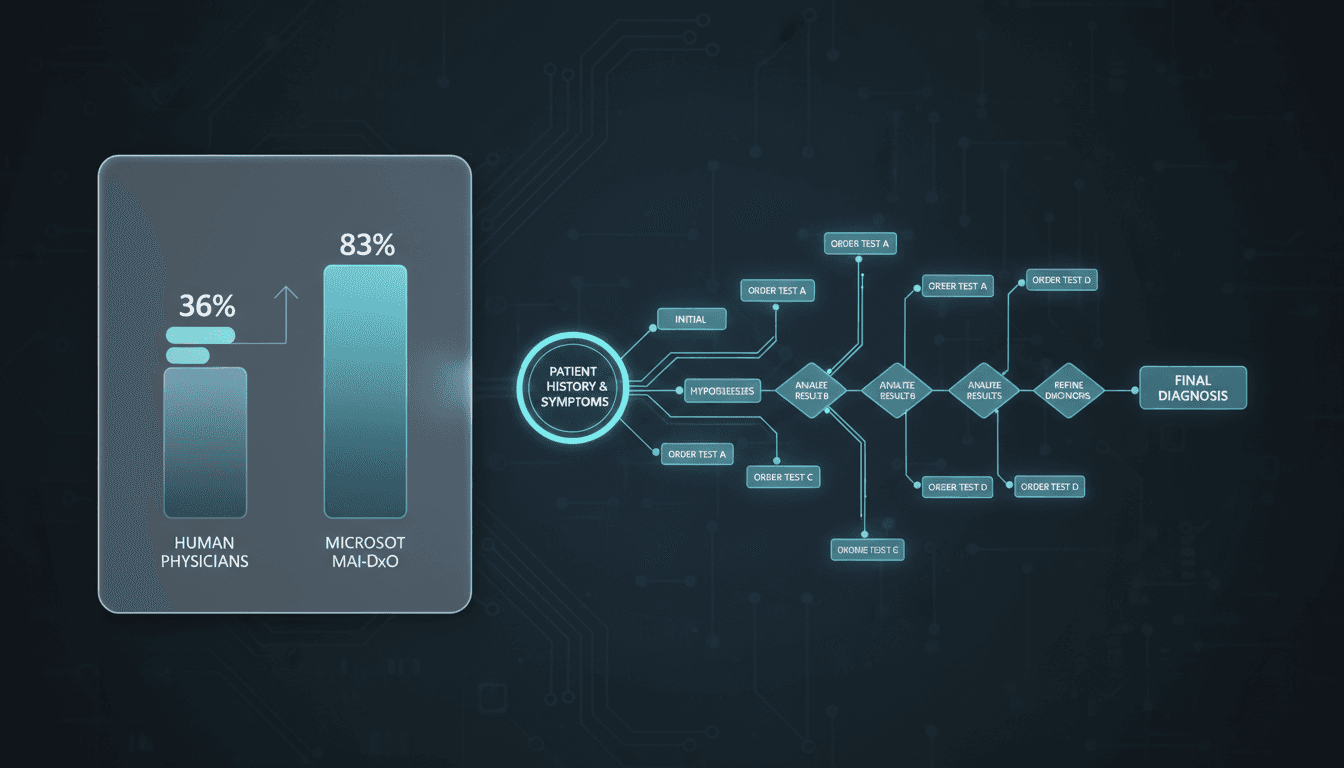
A peer-reviewed validation demonstrating that multi-agent AI systems outdiagnose practicing clinicians by a margin of 83% to 36% signals a structural transition in clinical decision support and health-system cost controls.
What happened (in 30 seconds)
* Microsoft published new clinical benchmark data in *Science*: Researchers, including Dr. Dominic King, unveiled the Diagnostic Orchestrator (MAI-DxO), a multi-agent framework that replicates an expert medical panel to sequentially gather patient history, order tests, and refine differential diagnoses. * The system outperformed human physicians across complex datasets: Tested on 304 complex cases from the *New England Journal of Medicine*, MAI-DxO scored approximately 83% accuracy versus 36% for generalist physicians working with open reference tools, and 80% versus 47% on emergency admissions from the MIMIC-IV-ED dataset. * The model optimized diagnostic pathways for cost efficiency: Rather than processing static data dumps, the orchestrator ordered tests sequentially, proving it could reach diagnostic resolution with lower estimated procedural expenses.
The context you actually need
* Legacy medical AI relied on static multiple-choice tests: Prior algorithmic evaluations presented models with complete patient charts upfront, bypassing the real-world complexity of choosing which diagnostic test to run next. * Multi-agent orchestration mirrors real hospital workflows: The Diagnostic Orchestrator coordinates specialized AI agents that debate hypotheses, interpret incoming labs, and request targeted patient history sequentially. * Generalist physicians were tested under realistic working conditions: The human control group was not restricted to memory; doctors had access to medical reference libraries and internet searches, yet still lagged the system by 47 percentage points on complex cases.
What's really happening
The primary limitation of clinical AI has never been its capacity to memorize medical textbooks; it has been its inability to mimic the iterative, sequential reasoning required in differential diagnosis. Human physicians do not receive a comprehensive dossier containing every lab result and imaging study at admission. Instead, clinical practice demands a series of high-stakes resource-allocation decisions: determining which question to ask first, which test carries sufficient diagnostic yield to justify its cost, and when to halt investigation because the probability distribution favors a specific disease.
Microsoft’s Diagnostic Orchestrator addresses this structural challenge by structuring diagnosis as a dynamic multi-agent negotiation. Rather than deploying a monolithic large language model to guess an endpoint, the system configures distinct agents into a synthetic clinical panel. One agent formulates hypotheses, another assesses test utility, and an orchestrator decides which diagnostic step to execute next.
In testing against 304 *New England Journal of Medicine* clinical case records, the orchestrator delivered an 83% diagnostic accuracy rate, compared to 36% for human generalists. In emergency care scenarios using the MIMIC-IV-ED database, it maintained an 80% accuracy rate against 47% for physicians. Because human physicians had unconstrained access to reference manuals and digital search tools during testing, this gap reflects an advantage in systematic reasoning and probabilistic tracking rather than an information retrieval deficit.
Beyond diagnostic accuracy, the economic mechanism centers on test selection. Diagnostic pathways in modern hospitals frequently generate high operational costs due to defensive medicine, redundant lab panels, and unstructured imaging orders. By evaluating the marginal information gain of each test before ordering it, the orchestrator demonstrated that diagnostic resolution can be achieved while minimizing cumulative test volume.
The immediate incentive for healthcare networks is margin preservation and diagnostic risk mitigation. Misdiagnosis remains a primary driver of malpractice liability and prolonged inpatient length of stay. By introducing an orchestrator that evaluates clinical pathways sequentially, health systems gain an operational framework that simultaneously reduces diagnostic error rates and curtails unnecessary investigative spending.
Who feels it first (and how)
* Hospital chief medical and financial officers: Executive leadership evaluating diagnostic overhead and clinical variation across complex emergency admissions. * Generalist and emergency department physicians: Clinicians managing high-volume triage who face the immediate prospect of AI-driven secondary review for complex differential diagnoses. * Health insurance payors: Actuarial teams reviewing medical necessity and diagnostic testing approvals based on AI-modeled optimal testing sequences. * Health-tech infrastructure providers: Enterprise vendors positioning clinical decision support platforms within emerging digital hospital initiatives, including long-term modernization efforts across the UAE.
What to watch next
* Clinical trial progression beyond retrospective datasets: Watch whether Microsoft moves the Diagnostic Orchestrator from historical cohorts (NEJM and MIMIC-IV-ED) into prospective, live clinical trials. * Health regulatory clearance frameworks: Monitor whether medical software regulators evaluate multi-agent orchestration tools as clinical decision support software or as autonomous diagnostic systems. * Integration into electronic health record workflows: Observe how health IT platforms attempt to embed sequential diagnostic ordering natively into physician order-entry systems.
The study was published in *Science* on October 25, 2026; MAI-DxO scored 83% accuracy versus 36% for generalists on 304 complex cases, and 80% versus 47% on emergency department data.
Enterprise health systems will prioritize adopting multi-agent diagnostic tools to curb escalating diagnostic workup expenses and shorten time-to-diagnosis.
The timeline for regulatory clearance remains undocumented, as no formal government approvals or live clinical deployments were recorded at publication.
Frequently Asked Questions
- Why it matters?
- A peer-reviewed validation demonstrating that multi-agent AI systems outdiagnose practicing clinicians by a margin of 83% to 36% signals a structural transition in clinical decision support and health-system cost controls.
- What happened (in 30 seconds)?
- Microsoft published new clinical benchmark data in *Science*: Researchers, including Dr. Dominic King, unveiled the Diagnostic Orchestrator (MAI-DxO), a multi-agent framework that replicates an expert medical panel to sequentially gather patient history, order tests, and refine differential diagnoses. The system outperformed human physicians across complex datasets: Tested on 304 complex cases from the *New England Journal of Medicine*, MAI-DxO scored approximately 83% accuracy versus 36% for ge
- What's really happening?
- The primary limitation of clinical AI has never been its capacity to memorize medical textbooks; it has been its inability to mimic the iterative, sequential reasoning required in differential diagnosis. Human physicians do not receive a comprehensive dossier containing every lab result and imaging study at admission. Instead, clinical practice demands a series of high-stakes resource-allocation decisions: determining which question to ask first, which test carries sufficient diagnostic yield to
- Who feels it first (and how)?
- Hospital chief medical and financial officers: Executive leadership evaluating diagnostic overhead and clinical variation across complex emergency admissions. Generalist and emergency department physicians: Clinicians managing high-volume triage who face the immediate prospect of AI-driven secondary review for complex differential diagnoses. Health insurance payors: Actuarial teams reviewing medical necessity and diagnostic testing approvals based on AI-modeled optimal testing sequences. Health-
- What to watch next?
- Clinical trial progression beyond retrospective datasets: Watch whether Microsoft moves the Diagnostic Orchestrator from historical cohorts (NEJM and MIMIC-IV-ED) into prospective, live clinical trials. Health regulatory clearance frameworks: Monitor whether medical software regulators evaluate multi-agent orchestration tools as clinical decision support software or as autonomous diagnostic systems. Integration into electronic health record workflows: Observe how health IT platforms attempt to e
Arabic-language sports reporting covering UAE competitions and major international events.
"Emarat Al Youm sports coverage is mainstream and accessible, with strong emphasis on UAE and regional sport."
— A47 Editor
أداة ذكاء اصطناعي تتفوّق على الأطباء في تشخيص الحالات المعقدة أداة ذكاء اصطناعي تتفوّق على الأطباء في تشخيص الحالات المعقدة
Researchers at Microsoft have developed an AI-powered tool for progressive medical diagnosis, which has demonstrated superior accuracy in tests involving complex cases. This advancement highlights the potential of artificial intelligence in enhancing...
Health, medicine, wellness, and public health coverage with a UAE angle.
"Emirates 24|7 health coverage leans toward accessible reporting on healthcare updates, medical milestones, and wellness topics."
— A47 Editor
Microsoft develops AI tool that can diagnose 'sequentially' like doctor
Microsoft researchers have developed an AI tool capable of diagnosing patients step by step, achieving over twice the accuracy of general physicians in complex medical cases, as reported in a study published in Science. This model utilizes an orchest...
Arabic-language sports reporting covering UAE competitions and major international events.
"Emarat Al Youm sports coverage is mainstream and accessible, with strong emphasis on UAE and regional sport."
— A47 Editor
تتفوق على الأطباء.. مايكروسوفت تطور أداة ذكاء اصطناعي لتشخيص الحالات المعقدة تتفوق على الأطباء.. مايكروسوفت تطور أداة ذكاء اصطناعي لتشخيص الحالات المعقدة
Researchers at Microsoft have developed an AI-powered tool for progressive medical diagnosis, which has demonstrated superior accuracy in tests involving complex cases. This advancement highlights the potential of artificial intelligence in enhancing...
Global business headlines with AI angles.
"General business outlet that frequently covers AI."
— A47 Editor
A New Microsoft AI Diagnosed 83% Of Complex Medical Cases. Doctors Using References Got 36% Right.
Microsoft has developed an AI diagnostic system that successfully diagnosed 83% of complex medical cases, significantly outperforming doctors who achieved a 36% accuracy rate using traditional references. This technology is set to be evaluated in a h...
Pan-Arab political news and analysis.
"Al-Quds Al-Arabi is a London-based Arabic newspaper known for political coverage."
— A47 Editor
مايكروسوفت تطور أداة ذكاء اصطناعي للتشخيص خطوة بخطوة كالطبيب
Microsoft researchers have developed an artificial intelligence tool that diagnoses patients step-by-step, similar to how doctors operate. The tool has demonstrated accuracy exceeding that of doctors by more than double when handling complex medical ...