
OpenAI and Partners Deploy AI Agents to Accelerate Neurological Research
Why it matters
This collaboration exemplifies how AI can significantly reduce the time required for complex biological data analysis, potentially transforming research methodologies.
What happened (in 30 seconds)
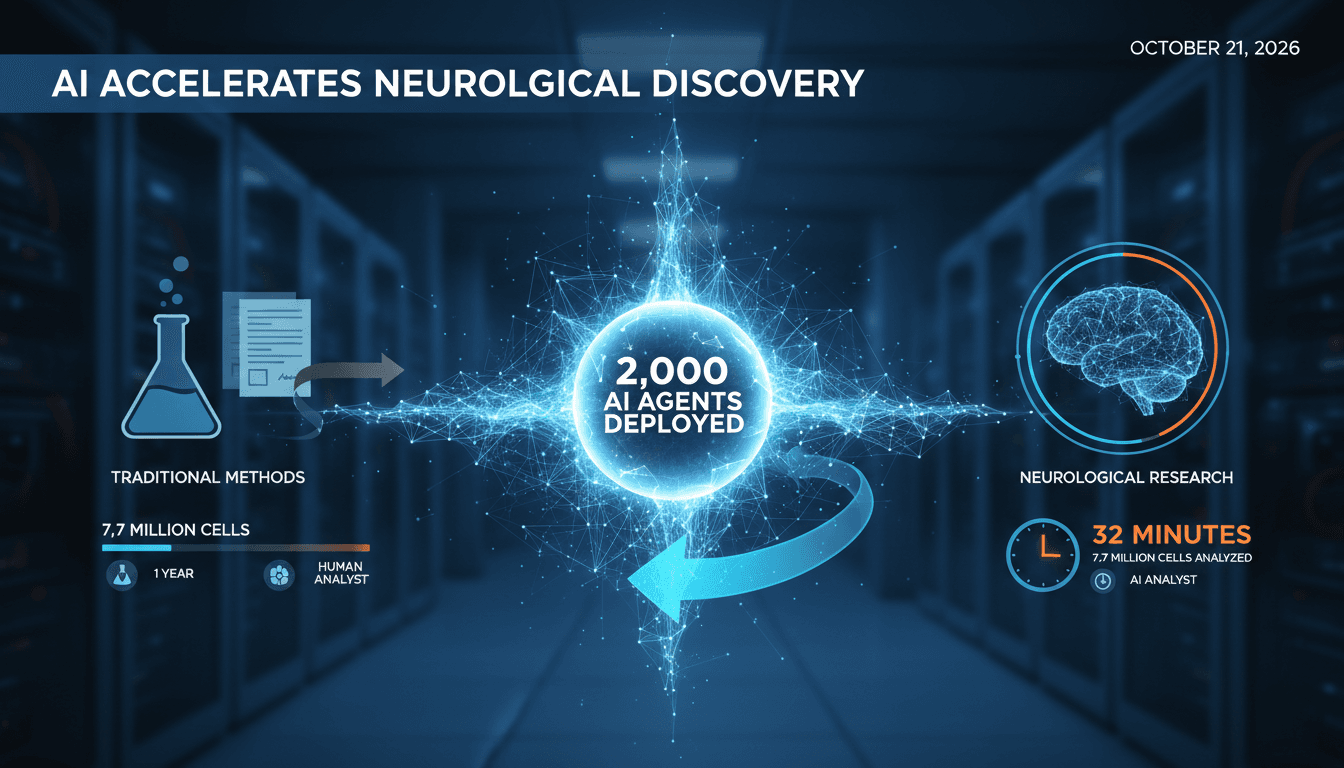
- On October 21, 2026, OpenAI, PerturbAI, and Scripps Research deployed nearly 2,000 AI agents to analyze 7.7 million mouse brain-cell nuclei in just 32 minutes.
- The AI agents examined genetic disruptions across 1,947 disease-associated genes and produced a reasoning atlas linking these to neurological conditions.
- The results highlighted specific gene disruptions relevant to diseases like Perry syndrome and tuberous sclerosis, emphasizing the need for laboratory validation of AI-generated hypotheses.
The context you actually need
- Prior advancements in AI models like GPT-Rosalind and CRISPR atlases have made it feasible to analyze high-dimensional biological datasets.
- Traditional methods of analyzing such data typically require extensive manual literature reviews, taking months or even years.
- The collaboration showcased the potential of distributed biological reasoning, where multiple AI agents work in parallel to expedite hypothesis generation.
What's really happening
The deployment of nearly 2,000 AI agents marks a significant leap in the intersection of artificial intelligence and biological research. This initiative, led by OpenAI, PerturbAI, and Scripps Research, utilized a specialized AI model, GPT-Rosalind, designed specifically for life sciences. The agents were tasked with analyzing a comprehensive CRISPR atlas containing data on 7.7 million mouse brain-cell nuclei, focusing on 1,947 genes associated with various neurological diseases.
The core of this effort lies in the ability of these AI agents to process vast amounts of data in parallel, completing the analysis in just 32 minutes. This is a stark contrast to the traditional human-led approach, which could take months to years. The agents not only analyzed cellular activity changes but also cross-referenced their findings with existing scientific literature, generating a reasoning atlas that proposed links to conditions such as Perry syndrome and tuberous sclerosis.
The implications of this research are profound. By significantly reducing the time required for hypothesis generation, researchers can pivot more quickly to experimental validation, potentially leading to faster breakthroughs in understanding and treating neurological diseases. The findings from this analysis, including specific gene disruptions linked to cholesterol production and differential effects in cerebellar neurons, provide a roadmap for future laboratory experiments.
However, it's crucial to note that while the AI-generated hypotheses are promising, they require rigorous laboratory validation before any clinical applications can be considered. The scientific community has shown considerable interest in these developments, as evidenced by the preprint publication and the availability of code and materials on GitHub. This transparency encourages further exploration and validation of AI-accelerated hypothesis generation in genomics and neuroscience.
The collaboration also highlights a shift in how biological research can be conducted, moving towards a model where AI plays a central role in data analysis and hypothesis generation. This could lead to a new era of research efficiency, where the bottlenecks of manual analysis are alleviated, allowing scientists to focus on experimental validation and application.
Who feels it first (and how)
- Researchers in genomics and neuroscience will benefit from accelerated hypothesis generation and data analysis.
- Healthcare professionals may see faster advancements in understanding and treating neurological diseases.
- AI developers and data scientists will find new opportunities in creating and refining tools for biological research.
What to watch next
- Laboratory validation outcomes: The success of AI-generated hypotheses in experimental settings will determine the practical applications of this research.
- Regulatory responses: Watch for any emerging guidelines or regulations regarding the use of AI in biological research and healthcare.
- Adoption of AI tools: Increased interest in AI-assisted research methodologies could lead to broader adoption across various scientific disciplines.
The collaboration successfully analyzed 7.7 million mouse brain-cell nuclei in 32 minutes.
AI will play an increasingly central role in biological research, leading to faster hypothesis generation.
The long-term impact of AI-generated hypotheses on clinical practices and regulatory frameworks remains to be seen.
Frequently Asked Questions
- Why it matters?
- This collaboration exemplifies how AI can significantly reduce the time required for complex biological data analysis, potentially transforming research methodologies.
- What happened (in 30 seconds)?
- On October 21, 2026, OpenAI, PerturbAI, and Scripps Research deployed nearly 2,000 AI agents to analyze 7.7 million mouse brain-cell nuclei in just 32 minutes. The AI agents examined genetic disruptions across 1,947 disease-associated genes and produced a reasoning atlas linking these to neurological conditions. The results highlighted specific gene disruptions relevant to diseases like Perry syndrome and tuberous sclerosis, emphasizing the need for laboratory validation of AI-generated hypo
- What's really happening?
- The deployment of nearly 2,000 AI agents marks a significant leap in the intersection of artificial intelligence and biological research. This initiative, led by OpenAI, PerturbAI, and Scripps Research, utilized a specialized AI model, GPT-Rosalind, designed specifically for life sciences. The agents were tasked with analyzing a comprehensive CRISPR atlas containing data on 7.7 million mouse brain-cell nuclei, focusing on 1,947 genes associated with various neurological diseases. The core of th
- Who feels it first (and how)?
- Researchers in genomics and neuroscience will benefit from accelerated hypothesis generation and data analysis. Healthcare professionals may see faster advancements in understanding and treating neurological diseases. AI developers and data scientists will find new opportunities in creating and refining tools for biological research.
- What to watch next?
- Laboratory validation outcomes: The success of AI-generated hypotheses in experimental settings will determine the practical applications of this research. Regulatory responses: Watch for any emerging guidelines or regulations regarding the use of AI in biological research and healthcare. Adoption of AI tools: Increased interest in AI-assisted research methodologies could lead to broader adoption across various scientific disciplines.
News and guidance for IT pros on AI adoption.
"Enterprise-focused tips, explainers, and news for professionals."
— A47 Editor
OpenAI Ran Nearly 2,000 AI Agents on Brain Data: What They Found in 32 Minutes
OpenAI successfully deployed nearly 2,000 AI agents to analyze mouse brain-cell data in just 32 minutes, revealing potential links to neurological diseases that warrant further investigation. This rapid analysis marks a significant advancement in the...
Daily AI news: models, tools, and policy.
"Independent outlet tracking the fast pace of AI."
— A47 Editor
OpenAI agents analyze mouse brain data in 32 minutes, a job that would take humans months
OpenAI, in collaboration with PerturbAI and Scripps Research, successfully deployed thousands of AI agents to analyze biological data from millions of mouse brain cells in just 32 minutes, a task that would typically take human researchers several mo...
Curated tech headlines including AI stories.
"Influential aggregator surfacing the day’s top tech/AI links."
— A47 Editor
OpenAI, PerturbAI, and Scripps say thousands of GPT-Rosalind agents analyzed data on millions of mouse brain cells in 32 minutes, a job that takes humans months (OpenAI)
OpenAI, PerturbAI, and Scripps Research have successfully utilized thousands of GPT-Rosalind agents to analyze data from millions of mouse brain cells in just 32 minutes, a task that typically requires months for human researchers. This rapid analysi...