
UK Commits £100 Million to Establish AI Biosecurity Laboratory with Frontier AI Developers
Why it matters
Frontier model developers and sovereign states are formalizing joint defensive architecture to counter biological risks while systematically ring-fencing commercial bio-design pipelines.
What happened (in 30 seconds)
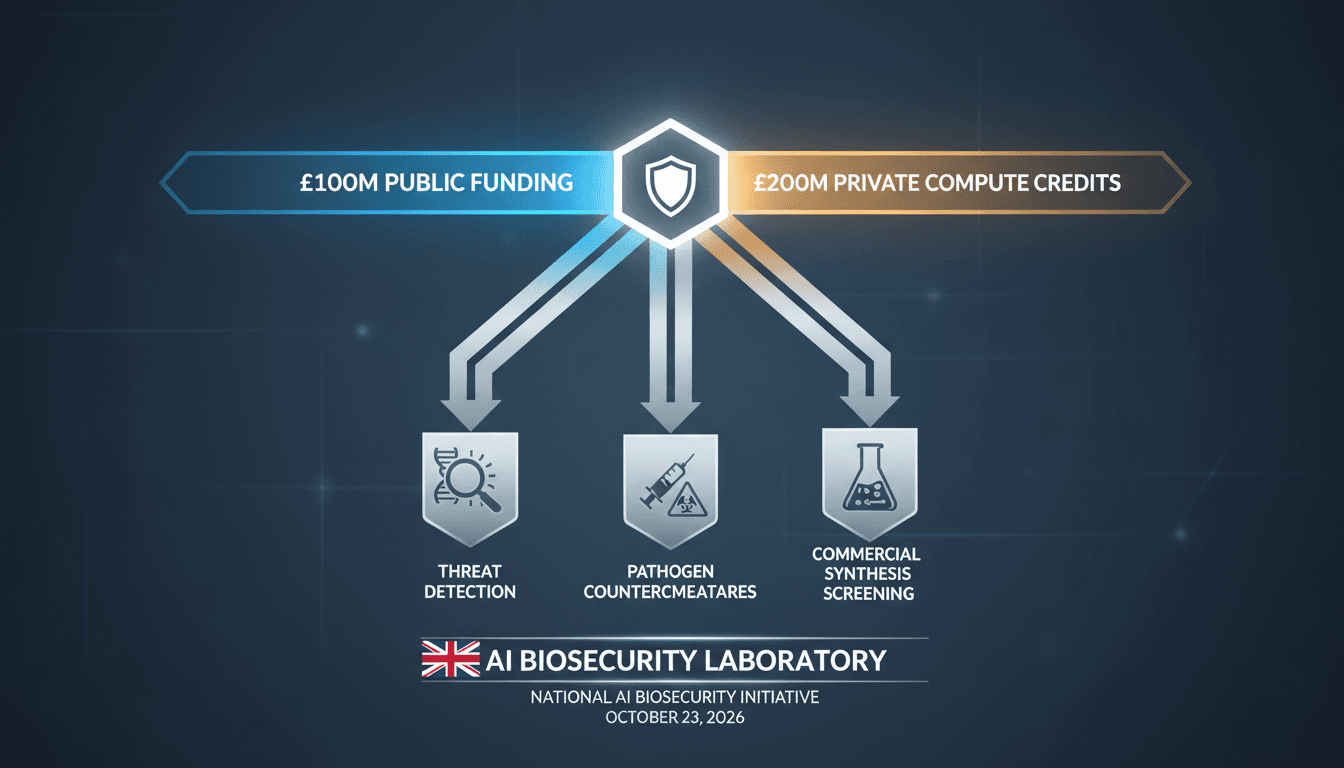
- Direct public commitment: On October 23, 2026, the United Kingdom announced £100 million ($134 million) to establish the AI Biosecurity Lab (AIBL) as an independent non-profit entity.
- Frontier tech integration: Leading AI labs OpenAI and Anthropic are backing the initiative with up to £200 million in model credits and compute support, alongside technical collaborations with Google DeepMind and Basecamp Research.
- Broader defensive spend: The lab anchors a coordinated funding package that includes £65 million for pathogen countermeasures and £120 million for the UK’s AI Security Institute.
The context you actually need
- The dual-use dilemma: The acceleration of large language models and generative biology tools has lowered barriers to designing complex biological agents, turning biosecurity into an immediate software governance problem.
- National resilience framing: The launch builds on the UK's Biological Security Strategy, catalyzed by demonstrations such as a California laboratory synthesizing an AI-designed therapeutic virus.
- The institutional model: Rather than imposing direct statutory bans on biological model training, the framework establishes a non-profit testing environment funded by the state and subsidized via private compute allocations.
What's really happening
The creation of the AI Biosecurity Lab signals a calculated pivot in how governments manage high-consequence frontier technologies. Rather than relying on static regulatory controls, the state is constructing institutional infrastructure to match the deployment velocity of commercial AI labs.
The core operational tension lies in dual-use biology. The same underlying machine learning architectures that model molecular structures to accelerate therapeutic discovery can be inverted to design novel pathogens or evade existing biosurveillance screens. By establishing the AIBL as an independent non-profit, the UK government secures direct operational visibility into biological safety research without pulling private frontier labs into traditional civil-service procurement frameworks.
For frontier labs—specifically OpenAI, Anthropic, Google DeepMind, and Basecamp Research—the commercial incentives are aligned. Offering up to £200 million in compute credits and technical bandwidth functions as a structural hedge against punitive regulation. By contributing foundational infrastructure and domain expertise to a sovereign-endorsed defensive entity, model developers establish baseline testing standards on their own terms. This setup creates high barrier-to-entry compliance protocols that smaller, open-weight model developers may struggle to replicate.
Financially, the £100 million allocation represents a targeted capital deployment within a wider defensive allocation. Paired with £65 million earmarked for pathogen countermeasures and £120 million routed to the AI Security Institute, the UK is attempting to corner the institutional market on frontier AI governance. The government positions public capital as the foundational anchor, while leveraging private compute credits to absorb the significant capital expenditures required for large-scale biological model training and red-teaming.
Ultimately, the initiative formalizes a defensive moat: using cutting-edge models to predict, flag, and synthesize countermeasures against computational bio-threats before unauthorized actors can exploit open-source or commercial toolsets.
Who feels it first (and how)
- Biotech and synthetic biology founders: Will see early technical standards set by AIBL partners, altering how therapeutic design tools screen DNA synthesis orders.
- Frontier AI safety teams: Engineers at participating labs gain structured, government-cleared environments to red-team dual-use capabilities against real-world pathogen datasets.
- Venture capital allocators: Investors in life sciences and computational biology must now account for state-backed biosecurity frameworks when evaluating cross-border data transfer and synthesis compliance.
- UK public health authorities: Gain automated early-threat detection frameworks, connecting frontier compute directly to national pathogen response systems.
What to watch next
- Compute allocation mechanics: Monitor how the £200 million in private model credits from OpenAI and Anthropic is deployed across academic and public researchers.
- Screening protocol standardization: Track whether AIBL-developed verification standards become legally binding requirements for commercial gene synthesis providers.
- International institutional replication: Watch if sovereign partners like the US or EU launch interoperable equivalents to harmonize dual-use frontier testing.
The UK government has committed £100 million in public capital, matched with up to £200 million in model credits from OpenAI and Anthropic, to launch an independent biosecurity entity.
Standardized safety evaluations designed inside AIBL will evolve into the de facto baseline for licensing commercial biological foundation models in Europe.
Whether the lab’s defensive screening capabilities can outpace open-weight, locally hosted models operating outside private compute platforms.
Frequently Asked Questions
- Why it matters?
- Frontier model developers and sovereign states are formalizing joint defensive architecture to counter biological risks while systematically ring-fencing commercial bio-design pipelines.
- What happened (in 30 seconds)?
- Direct public commitment: On October 23, 2026, the United Kingdom announced £100 million ($134 million) to establish the AI Biosecurity Lab (AIBL) as an independent non-profit entity. Frontier tech integration: Leading AI labs OpenAI and Anthropic are backing the initiative with up to £200 million in model credits and compute support, alongside technical collaborations with Google DeepMind and Basecamp Research. Broader defensive spend: The lab anchors a coordinated funding package that includes
- What's really happening?
- The creation of the AI Biosecurity Lab signals a calculated pivot in how governments manage high-consequence frontier technologies. Rather than relying on static regulatory controls, the state is constructing institutional infrastructure to match the deployment velocity of commercial AI labs. The core operational tension lies in dual-use biology. The same underlying machine learning architectures that model molecular structures to accelerate therapeutic discovery can be inverted to design novel
- Who feels it first (and how)?
- Biotech and synthetic biology founders: Will see early technical standards set by AIBL partners, altering how therapeutic design tools screen DNA synthesis orders. Frontier AI safety teams: Engineers at participating labs gain structured, government-cleared environments to red-team dual-use capabilities against real-world pathogen datasets. Venture capital allocators: Investors in life sciences and computational biology must now account for state-backed biosecurity frameworks when evaluating cro
- What to watch next?
- Compute allocation mechanics: Monitor how the £200 million in private model credits from OpenAI and Anthropic is deployed across academic and public researchers. Screening protocol standardization: Track whether AIBL-developed verification standards become legally binding requirements for commercial gene synthesis providers. International institutional replication: Watch if sovereign partners like the US or EU launch interoperable equivalents to harmonize dual-use frontier testing.
Consumer technology news with AI coverage.
"Gadget and tech site reporting on AI in products."
— A47 Editor
The UK is investing $134 million into an AI Biosecurity Lab
The UK government has announced a significant investment of $134 million to establish the AI Biosecurity Lab, aimed at enhancing the detection of biological threats and the development of vaccines through artificial intelligence. This initiative is p...
Covers consumer technology, electronics, gadgets, and product reviews.
"Engadget is a trusted source for gadget reviews and consumer tech news, known for its hands-on analysis and industry coverage."
— A47 Editor
The UK is investing $134 million into an AI Biosecurity Lab
The UK government has announced a significant investment of $134 million to establish the AI Biosecurity Lab, aimed at enhancing the detection of biological threats and the development of vaccines through artificial intelligence. This initiative is p...
English-language digital publication covering business, politics, technology, and current affairs.
"The Arabian Post mixes original and syndicated-style coverage with a broad regional and global business-news orientation."
— A47 Editor
Britain allocates £100 million to new AI biosecurity laboratory
Britain has announced a £100 million investment to establish a new artificial intelligence biosecurity laboratory, with support from OpenAI, Anthropic, and Google DeepMind. This initiative aims to enhance the country's defenses against biological thr...
Latest AI/ML research news and breakthroughs.
"Aggregated research highlights across institutions."
— A47 Editor
UK pledges more funding to guard against AI risks
The U.K. government has announced plans to increase funding for artificial intelligence safety, addressing rising concerns over the cyber risks associated with advanced AI technologies. This initiative reflects a proactive approach to mitigate potent...
Macro commentary, policy analysis, growth/inflation themes, and global outlooks.
"Contextual macro coverage that complements day-to-day market headlines."
— A47 Editor
UK unveils $800 million AI security funding plan
The UK government has announced an $800 million funding plan aimed at enhancing artificial intelligence (AI) security, reflecting a significant commitment to bolster the nation's cybersecurity infrastructure. This initiative is part of a broader stra...
Tech industry news, innovation, gadgets, and startups from a UK broadcaster.
"Sky News is often seen as a center-right outlet in the UK, known for its rolling coverage and breaking stories."
— A47 Editor
UK pledges £600m to defend against AI health and security threats
The UK government has announced a significant investment of £600 million aimed at protecting the public from health and security threats posed by artificial intelligence (AI). This funding is part of a broader strategy to enhance national security in...
UK politics, business, and social stories.
"Sky News is a UK-based 24-hour channel known for fast-breaking news and political coverage."
— A47 Editor
UK pledges £600m to defend against AI health and security threats
The UK government has announced a significant investment of £600 million aimed at protecting the public from health and security threats posed by artificial intelligence (AI). This funding is part of a broader strategy to enhance national security in...
Curated tech headlines including AI stories.
"Influential aggregator surfacing the day’s top tech/AI links."
— A47 Editor
The UK plans to invest £100M to create the AI Biosecurity Lab to boost defenses against biological threats, supported by OpenAI, Anthropic, and Google DeepMind (Liv McMahon/BBC)
The UK government has announced a £100 million investment to establish a national AI Biosecurity Lab (AIBL) aimed at enhancing defenses against emerging biological threats. This initiative is supported by leading technology firms including OpenAI, An...
United Kingdom-focused news including local politics, business, and social issues.
"BBC News is widely regarded as a reputable international news organization, known for its impartial tone and public service mandate."
— A47 Editor
UK to invest £100m in 'world first' AI Biosecurity Lab
The UK government is set to invest £100 million in a pioneering AI Biosecurity Lab, as announced by the Chancellor in the upcoming Budget. This initiative aims to enhance the nation's defenses against biological threats using advanced artificial inte...
Corporate news, economic trends, and markets with UK and global scope.
"BBC News is widely regarded as reputable and impartial, with a public service mandate."
— A47 Editor
UK to invest £100m in 'world first' AI Biosecurity Lab
The UK government is set to invest £100 million in a pioneering AI Biosecurity Lab, as announced by the Chancellor in the recent Budget. This initiative aims to enhance the country's defenses against biological threats using advanced artificial intel...
Technology business news, market impacts, and innovation trends.
"Bloomberg is a premier financial and tech news provider, respected for its in-depth reporting and analytical rigor."
— A47 Editor
UK Vows £100 Million for Biosecurity Lab With OpenAI, Anthropic
The UK government has announced a £100 million ($134 million) investment to establish an AI Biosecurity Lab, which will be supported by leading technology firms OpenAI, Anthropic, and Google DeepMind. This initiative aims to enhance the government's ...
Technology business and AI-related headlines.
"Data-driven tech newsroom with global scope."
— A47 Editor
UK Vows £100 Million for Biosecurity Lab With OpenAI, Anthropic
The UK government has announced a £100 million ($134 million) investment to establish an AI Biosecurity Lab, which will be supported by leading technology firms OpenAI, Anthropic, and Google DeepMind. This initiative aims to enhance the government's ...