
Google Extends Personal Intelligence Data Access to Ad Personalization Through Gmail Photos and Drive Opt-In
Why it matters
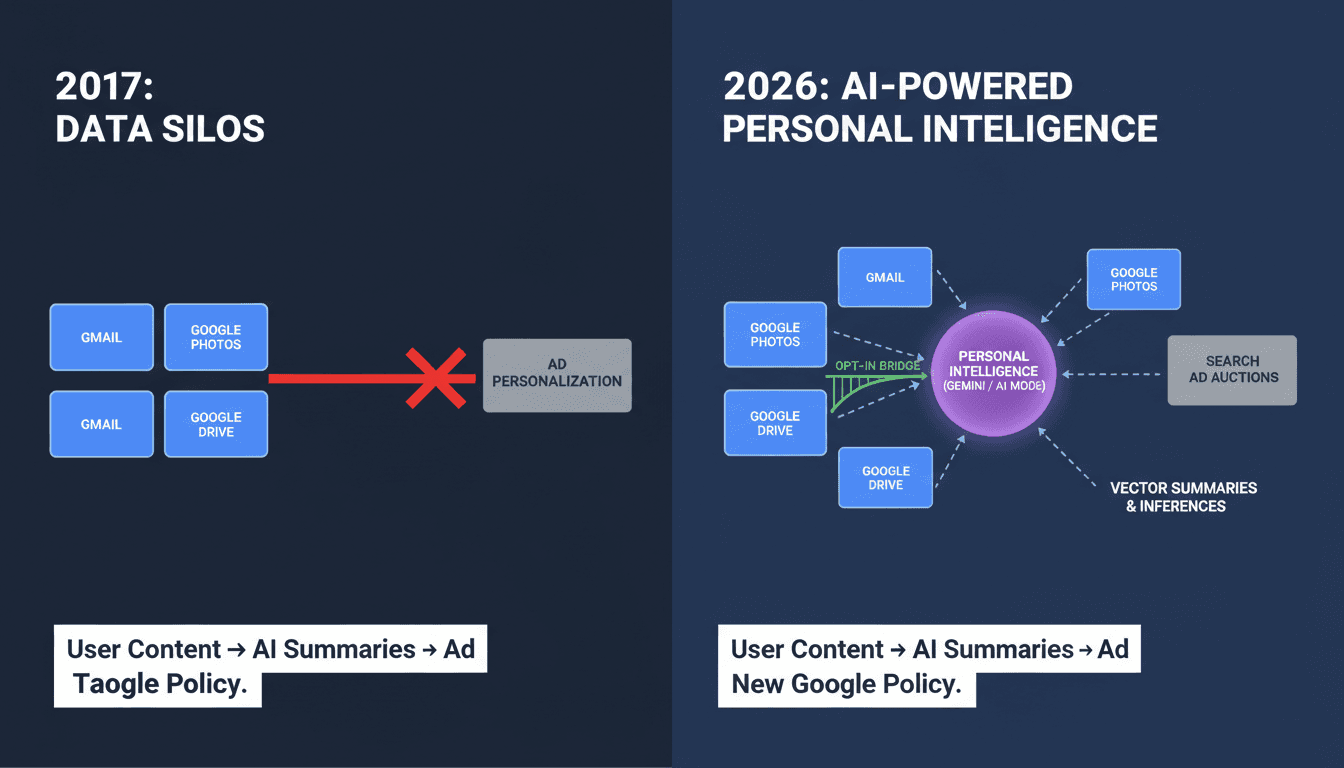
The firewall separating enterprise-grade productivity data from programmatic ad targeting is being replaced with an opt-in inference model.
What happened (in 30 seconds)
- Policy modification: Effective October 16, 2026, Google altered its core privacy framework to allow content from Gmail, Google Photos, and Google Drive to influence personalized ads when users opt into Personal Intelligence.
- Indirect processing mechanism: Google states third-party advertisers will not receive direct access to raw user files, relying instead on AI-generated summaries and behavioral inferences while excluding designated sensitive categories.
- Search AI Mode deployment: The adjustment specifically enables Search to leverage unified personal context across connected tools, coinciding with active commercial testing of ads inside Google's AI Mode interface.
The context you actually need
- Ending a nine-year boundary: Since 2017, Google maintained an explicit ban on processing Drive, Gmail, or Photos files for ad profiling after ending automated inbox-scanning routines due to commercial pushback.
- Staggered product rollout: Personal Intelligence launched for paid subscribers in January 2026 before expanding to all US users in March 2026, while remaining entirely unavailable across the EEA, Switzerland, the UK, and Nigeria.
- Regional business access: Google AI Plus, Pro, and Ultra subscribers in the Arab World, including the UAE, gained access to Personal Intelligence integration in April 2026, creating immediate operational relevance for regional knowledge workers.
What's really happening
The core monetization architecture of consumer artificial intelligence is moving away from purely keyword-driven placement toward contextual graph modeling. By modifying the terms that govern Gmail, Google Drive, and Google Photos, Google is establishing a bridge between utility-driven enterprise storage and programmatic ad auctions.
The mechanics rely on a specific clause added on October 16, 2026: prior categorical restrictions on ad targeting now stand waived "unless you choose to make data from these services available to other Google services that support personalized ads." When you connect cloud services to Gemini or Search AI Mode, the underlying system generates structured semantic inferences. Rather than selling access to an unencrypted file or an individual message, Google uses these derived context vectors to inform the automated bidding engine running inside Search AI Mode.
This structural pivot solves an immediate commercial problem for high-compute generative search. Delivering real-time synthetic answers requires substantially higher infrastructure capital expenditure than serving traditional indexed blue links. To fund this computation without imposing universal paywalls, search providers need higher-yield ad inventory. Ad impressions matched against comprehensive personal context—such as upcoming travel itineraries found in email, hardware purchases saved to Drive, or visual lifestyles captured in Photos—generate demonstrably higher return on ad spend than surface-level keyword queries alone.
Google's architecture limits raw data exposure by keeping the inference calculation internal and excluding designated sensitive sectors from the ad auction pipeline. Advertisers see only the targeting parameters, not the source documents. However, the economic design hinges on an asymmetrical trade-off: in exchange for conversational synthesis across work and home workspaces, users permit Google's algorithmic ad engine to incorporate their most intimate personal archives.
Because activation is opt-in, the system relies on the natural friction of default configurations. Users seeking productivity gains inside Gemini grant broad contextual permissions during setup. The policy update ensures that once those permissions are granted across services, the boundary between workflow assistance and commercial monetization dissolves unless the user manually intervenes in their personalization dashboard.
Who feels it first (and how)
- Executive subscribers in Dubai and the GCC: Having had access to Personal Intelligence through paid Google AI tiers since April 2026, regional operators who connected corporate or personal workspaces to Gemini are now the front-line demographic for contextual ad tests.
- Cross-border enterprise operators: Professionals using unified consumer accounts for cross-border logistics or commercial project planning will see their Search AI Mode answers adjust to reflect workflow documentation.
- Compliance and legal officers: Data governance teams managing distributed remote staff must audit whether employees connecting personal Google accounts on corporate hardware are inadvertently routing company-related Drive and Gmail summaries into ad profile databases.
- European and British market observers: Professionals in the EEA, UK, and Switzerland will experience no immediate functional change, as regional restrictions keep Personal Intelligence inactive within those legal boundaries.
What to watch next
- Ad load frequency in Search AI Mode: Track whether conversational results prioritize sponsored product summaries over purely factual references, which indicates how aggressively Google is monetizing cross-app inferences.
- Expansion to free-tier regional accounts: Monitor the planned extension of Personal Intelligence to free users across the Middle East, which will scale the data pipeline from a niche paid demographic to broad consumer markets.
- Granular permission updates: Watch whether consumer pushback forces Google to separate general workspace AI indexing from commercial ad personalization switches within Google account settings.
The privacy policy update went live on October 16, 2026; users must manually opt in via Personal Intelligence; raw content is not exposed directly to advertisers; users can decouple applications inside Search settings.
The operational efficiency of ads served within generative search will increase as multimodal context from Drive, Photos, and Gmail provides higher-intent commercial signals than standalone search queries.
Whether regulatory authorities examining international tech practices will classify aggregated AI inferences drawn from private documents as equivalent to direct inbox scanning.
Frequently Asked Questions
- Why it matters?
- The firewall separating enterprise-grade productivity data from programmatic ad targeting is being replaced with an opt-in inference model.
- What happened (in 30 seconds)?
- Policy modification: Effective October 16, 2026, Google altered its core privacy framework to allow content from Gmail, Google Photos, and Google Drive to influence personalized ads when users opt into Personal Intelligence. Indirect processing mechanism: Google states third-party advertisers will not receive direct access to raw user files, relying instead on AI-generated summaries and behavioral inferences while excluding designated sensitive categories. Search AI Mode deployment: The adjustme
- What's really happening?
- The core monetization architecture of consumer artificial intelligence is moving away from purely keyword-driven placement toward contextual graph modeling. By modifying the terms that govern Gmail, Google Drive, and Google Photos, Google is establishing a bridge between utility-driven enterprise storage and programmatic ad auctions. The mechanics rely on a specific clause added on October 16, 2026: prior categorical restrictions on ad targeting now stand waived "unless you choose to make data
- Who feels it first (and how)?
- Executive subscribers in Dubai and the GCC: Having had access to Personal Intelligence through paid Google AI tiers since April 2026, regional operators who connected corporate or personal workspaces to Gemini are now the front-line demographic for contextual ad tests. Cross-border enterprise operators: Professionals using unified consumer accounts for cross-border logistics or commercial project planning will see their Search AI Mode answers adjust to reflect workflow documentation. Compliance
- What to watch next?
- Ad load frequency in Search AI Mode: Track whether conversational results prioritize sponsored product summaries over purely factual references, which indicates how aggressively Google is monetizing cross-app inferences. Expansion to free-tier regional accounts: Monitor the planned extension of Personal Intelligence to free users across the Middle East, which will scale the data pipeline from a niche paid demographic to broad consumer markets. Granular permission updates: Watch whether consumer
Tech news and guides occasionally covering AI.
"Independent tech blog with practical tips and news."
— A47 Editor
Google Updates Privacy Policy to Let Gmail and Photos Data Shape Ads Through Personal Intelligence
Google has updated its privacy policy, effective October 16, to clarify that content from connected apps such as Gmail, Google Photos, and Google Drive may help shape personalized ads when users link those services through Personal Intelligence. The ...
Tech news, hardware, and AI tools coverage.
"PC/tech site increasingly covering AI hardware and apps."
— A47 Editor
Google's privacy policy now has a loophole for using your Gmail and Photos data in ads
Google has updated its privacy policy, effective October 16, to clarify that data from connected apps such as Gmail and Google Photos may be used for ad targeting, as first reported by Android Authority. The policy has long said Google does not show ...
Curated tech headlines including AI stories.
"Influential aggregator surfacing the day’s top tech/AI links."
— A47 Editor
Google updates its privacy policy to clarify it could use data shared via Personal Intelligence from connected apps, including Gmail and Photos, to target ads (Shimul Sood/Android Authority)
Google has updated its privacy policy to clarify that it may use data shared through Personal Intelligence from connected applications, including Gmail and Google Photos, for targeted advertising. This marks a significant shift from its previous poli...