
Meta Launches $95 Billion Equity Program to Fund AI Infrastructure Expansion
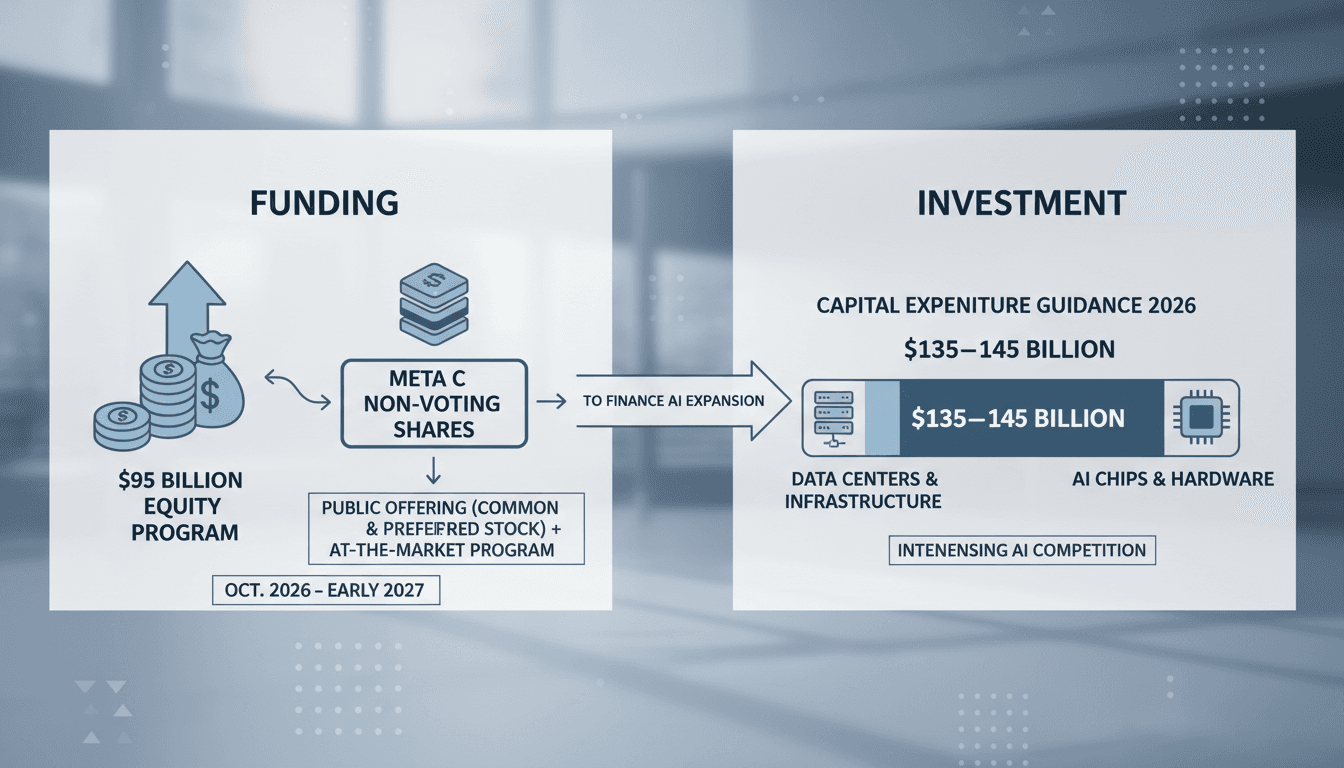
Why it matters
Meta is decoupling massive balance-sheet dilution from governance control, creating a precedent where hyperscalers fund capital intensity by issuing non-voting equity directly into public markets.
What happened (in 30 seconds)
- A dual-tranche equity program: Meta launched a $35 billion public offering of common and convertible preferred stock alongside plans for an at-the-market (ATM) program of up to $60 billion in new non-voting Class C shares scheduled for early 2027.
- Guidance elevated: The October 26, 2026 announcement follows an October 21 earnings report in which full-year capital expenditure projections rose to an updated range of $135–145 billion.
- Control preserved: The financial architecture introduces a two-for-one economic split effective January 2027, enabling broad market liquidity and talent acquisition while preserving founder and CEO Mark Zuckerberg's primary voting control.
The context you actually need
- Escalating capital commitments: Hyperscale technology operations are racing to absorb heavy infrastructure outlays, with Meta's forward commitments surpassing $825 billion across custom chips, facilities, and AI agents such as Muse.
- Following peer-level capital moves: Meta’s $95 billion equity program follows peer maneuvers, including Alphabet's earlier $85 billion transaction, reflecting a sector-wide pivot toward equity markets to bankroll sustained capex.
- A new share architecture: Meta’s upcoming Class C shares will hold economic value equal to existing shares but zero voting weight, creating currency designed specifically for public market distribution and competitive employee compensation packages.
What's really happening
The primary tension in modern artificial intelligence infrastructure is the gap between operating cash flows and the immediate cash required to procure high-end compute clusters, land, energy, and specialized engineers. While Meta’s digital advertising business continues to generate cash, scaling model training and deploying consumer-facing autonomous agents requires upfront capital expenditures of $135–145 billion in 2026 alone.
Meta chose not to fund these deployments solely through operating cash flows or debt instruments, which carry leverage limits and borrowing costs. Instead, it built a financial bypass using public equity markets. The $35 billion immediate offering paired with a $60 billion at-the-market program allows the company to tap public capital markets gradually across quarters without discounting large share blocks in one single liquidation event.
The structural core of this move is governance protection. Under normal circumstances, an equity issuance of $95 billion alongside an ongoing economic stock split would dilute the founding team's operational grip. By establishing non-voting Class C shares, Mark Zuckerberg secures pure liquidity. The mechanism lets executive leadership use stock for balance-sheet expansion, corporate development, and technical talent acquisition while shielding foundational strategy from activist investors and outside voting blocs.
Simultaneously, this dynamic changes market conditions for competitors. By formalizing infrastructure commitments of more than $825 billion, Meta raises the baseline cost of running frontier models. When a single market participant secures $95 billion in dedicated financing purely for chips, specialized facilities, and agent ecosystems like Muse, mid-sized AI labs and non-hyperscaler software firms face higher supply-chain costs. Hardware suppliers allocate their fabrication capacity to the highest-bidding corporate balance sheets, leaving smaller operators to either pay higher prices for cloud instances or abandon frontier-scale model training altogether.
Who feels it first (and how)
- Institutional public equity investors: Asset managers holding common stock take on economic dilution from the $35 billion issuance, balanced by the 4% after-hours valuation bump and future dividend rights in Class C shares, but gain zero additional voting leverage over company operations.
- Founders and executives at AI development firms: Technical leaders competing against Meta for engineering talent face a rival that now holds a $60 billion Class C treasury reserve engineered specifically for retention grants and acquisitions.
- Compute infrastructure and hardware procurement teams: Procurement managers at smaller enterprise tech operations will see prolonged supply constraints and priority allocations awarded to buyers with forward cash commitments exceeding $825 billion.
What to watch next
- Class C trading debut and discount spreads: Watch the launch of Class C trading in Q1 2027 to see if the market prices non-voting shares at a material discount to voting common shares, signaling how institutional funds view the governance trade-off.
- Pace of the $60 billion ATM execution: Monitor quarterly SEC filings through 2027 to track how fast CFO Susan Li taps the at-the-market facility relative to actual chip delivery timelines.
- Capital expenditure revisions across peer tech giants: Track subsequent quarterly capex prints from enterprise competitors to see if Meta's updated $135–145 billion target forces defensive spending revisions across the sector.
Meta launched an immediate $35 billion public offering and outlined a $60 billion ATM facility for new non-voting Class C shares, paired with an updated 2026 capex forecast of $135–145 billion.
The cash injection will give Meta the balance-sheet liquidity needed to sustain compute cluster procurement without curtailing consumer-facing AI rollouts or R&D allocations.
Whether institutional shareholders will eventually challenge the long-term expansion of non-voting capital structures across Big Tech if returns on AI infrastructure fall short of multi-hundred-billion-dollar spending targets.
Frequently Asked Questions
- Why it matters?
- Meta is decoupling massive balance-sheet dilution from governance control, creating a precedent where hyperscalers fund capital intensity by issuing non-voting equity directly into public markets.
- What happened (in 30 seconds)?
- A dual-tranche equity program: Meta launched a $35 billion public offering of common and convertible preferred stock alongside plans for an at-the-market (ATM) program of up to $60 billion in new non-voting Class C shares scheduled for early 2027. Guidance elevated: The October 26, 2026 announcement follows an October 21 earnings report in which full-year capital expenditure projections rose to an updated range of $135–145 billion. Control preserved: The financial architecture introduces a two-f
- What's really happening?
- The primary tension in modern artificial intelligence infrastructure is the gap between operating cash flows and the immediate cash required to procure high-end compute clusters, land, energy, and specialized engineers. While Meta’s digital advertising business continues to generate cash, scaling model training and deploying consumer-facing autonomous agents requires upfront capital expenditures of $135–145 billion in 2026 alone. Meta chose not to fund these deployments solely through operatin
- Who feels it first (and how)?
- Institutional public equity investors: Asset managers holding common stock take on economic dilution from the $35 billion issuance, balanced by the 4% after-hours valuation bump and future dividend rights in Class C shares, but gain zero additional voting leverage over company operations. Founders and executives at AI development firms: Technical leaders competing against Meta for engineering talent face a rival that now holds a $60 billion Class C treasury reserve engineered specifically for re
- What to watch next?
- Class C trading debut and discount spreads: Watch the launch of Class C trading in Q1 2027 to see if the market prices non-voting shares at a material discount to voting common shares, signaling how institutional funds view the governance trade-off. Pace of the $60 billion ATM execution: Monitor quarterly SEC filings through 2027 to track how fast CFO Susan Li taps the at-the-market facility relative to actual chip delivery timelines. Capital expenditure revisions across peer tech giants: Track
News and features on AI from The Guardian.
"Progressive-leaning international outlet with critical AI coverage."
— A47 Editor
Meta announces $95bn fundraising drive to pay for AI expansion – business live
Meta has announced a $95bn fundraising drive through a share sale, saying the proceeds will support its "continued investment in AI infrastructure and personal superintelligence." The announcement came as the company seeks to finance a major expansio...
Editor-curated FT homepage stories spanning markets, business, world, and opinion.
"The Financial Times is a globally respected business publication with a centrist/center-left tone and strong markets focus."
— A47 Editor
Meta plans $95bn stock offering to bankroll AI expansion
Meta has announced plans for a $95 billion stock offering to fund its artificial intelligence expansion, according to the Financial Times, with Nvidia, AMD and Broadcom named as cornerstone investors.
Business and tech news excluding paywalled content.
"High-volume business/tech outlet with frequent AI coverage."
— A47 Editor
Meta looks to raise up to $95 billion from stock sales to fund its huge AI build-out
Meta is looking to raise as much as $95 billion through stock sales to help fund its heavy spending on AI infrastructure needed to build consumer AI products, according to Business Insider. The move follows the company's revised 2026 capital expendit...
UK and international business news, economics, and corporate coverage.
"The Guardian’s business section covers finance and markets with a progressive editorial tone."
— A47 Editor
Meta announces $95bn fundraising drive to pay for AI expansion – business live
Meta has announced a $95bn fundraising drive through a share sale, saying the proceeds will support its "continued investment in AI infrastructure and personal superintelligence." The announcement came as the company seeks to finance a major expansio...
Top international stories selected by The Guardian editors.
"The Guardian is known for its progressive editorial stance and in-depth analysis."
— A47 Editor
Meta announces $95bn fundraising drive to pay for AI expansion – business live
Meta has announced a $95bn fundraising drive through a share sale, saying the proceeds will support its "continued investment in AI infrastructure and personal superintelligence." The announcement came as the company seeks to finance a major expansio...
Markets desk coverage, trading insights, and investor updates.
"WSJ’s markets reporting provides in-depth analysis and context for investors."
— A47 Editor
Meta Plans Up to $95 Billion in Financing to Power Its AI Growth
Meta Platforms said it would seek to raise up to $95 billion in financing to help fund its large investments in artificial-intelligence infrastructure and what it calls personal superintelligence, according to a report from The Wall Street Journal.
Tech business coverage, major deals, product launches, and Silicon Valley trends.
"WSJ’s tech section offers authoritative reporting on the intersection of technology and business, including exclusive industry analysis."
— A47 Editor
Meta Plans up to $95 Billion in Financing to Power Its AI Growth
Meta Platforms said it would seek to raise up to $95 billion in financing to fund its large-scale investments in artificial-intelligence infrastructure and what it calls personal superintelligence, according to the base report from WSJ Tech.
Curated tech headlines including AI stories.
"Influential aggregator surfacing the day’s top tech/AI links."
— A47 Editor
Meta plans to raise $95B to finance its AI infrastructure, including $35B in public equity offerings, backed by cornerstone investors Nvidia, AMD, and Broadcom (Tim Bradshaw/Financial Times)
Meta is reportedly planning to raise up to $95 billion to finance its AI infrastructure, including $35 billion through public equity offerings, with chipmakers Nvidia, AMD, and Broadcom acting as cornerstone investors, according to a Financial Times ...
Technology business and AI-related headlines.
"Data-driven tech newsroom with global scope."
— A47 Editor
Meta Seeks Up to $95 Billion in Equity to Fund AI Spending
Meta Platforms Inc. is seeking to raise as much as $95 billion by selling common and preferred stock, tapping investors to help fund its push to lead the development of artificial intelligence.
Technology business news, market impacts, and innovation trends.
"Bloomberg is a premier financial and tech news provider, respected for its in-depth reporting and analytical rigor."
— A47 Editor
Meta Seeks Up to $95 Billion in Equity to Fund AI Spending
Meta Platforms Inc. is seeking to raise as much as $95 billion by selling common and preferred stock, tapping investors to help fund its push to lead the development of artificial intelligence.